
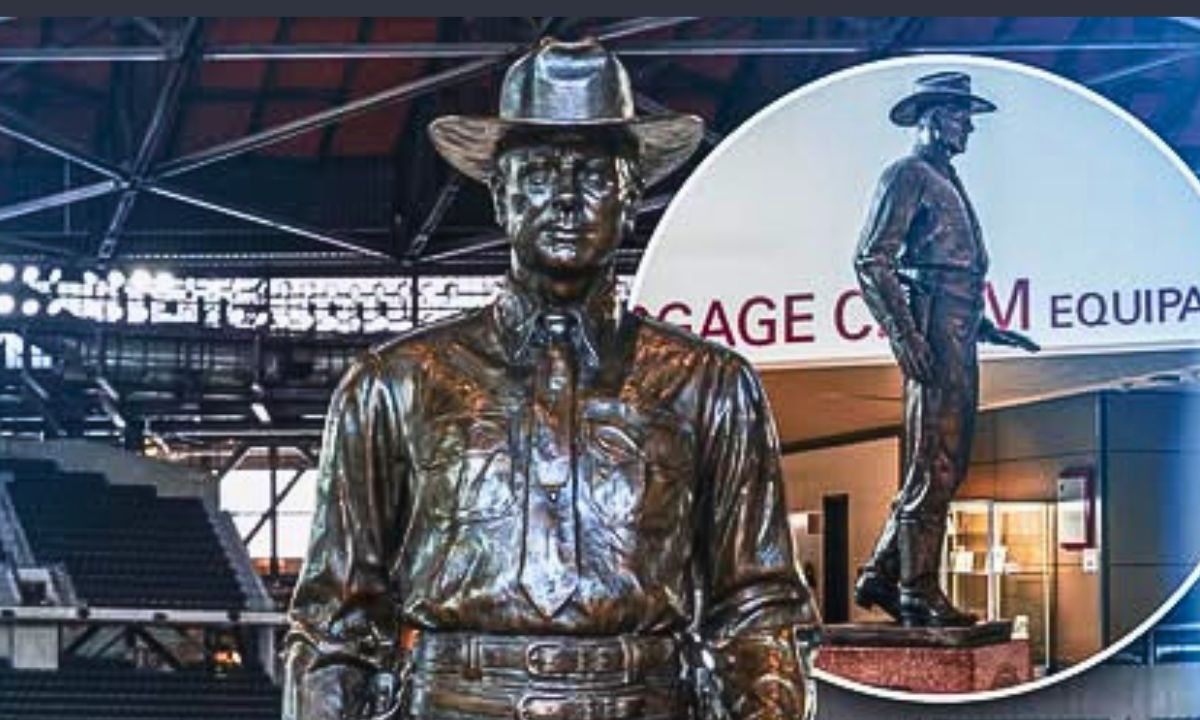
Veasey Demands Removal Of Rangers ‘Segregationist’ Statue | Image by Rangers Nation/Facebook
U.S. Rep. Marc Veasey (D-TX) is demanding Texas Rangers baseball remove a statue of a law enforcement officer, which he claims represents a “segregationist figure.”
Veasey, a Democrat from Fort Worth, wrote a letter on March 10 to MLB Commissioner Rob Manfred and Texas Rangers Co-Chairmen Ray Davis and Bob Simpson.
Veasey demanded they remove a historic statue of what he called a “segregationist law enforcement officer,” recently installed at Globe Life Stadium.
“Honoring a figure tied to resisting school integration – and doing so with imagery that evokes racist violence – sends exactly the wrong message about who belongs in that space,” Veasey wrote in the letter. “Let me be clear: celebrating the legacy of someone connected to blocking integration is not preserving history. It is glorifying injustice.”
The 1961 statue of a Texas Ranger stands 12 feet tall and is titled “One Riot, One Ranger.”
It was donated to the City of Dallas, and stood sentry at Dallas Love Field for decades – until 2020, when a book claimed the statue was part of a racist legacy among Texas Rangers. Then, as racial activism swept the nation, officials took it down and put it in storage.
On March 2, officials with the Texas Rangers baseball team announced they were bringing the statue back, placing it at Globe Life Field in Arlington.
“At the unveiling, Rangers ownership said the move is a part of the club’s ongoing support for law enforcement, first responders and community values, while acknowledging the complex history tied to the statue and the phrase,” officials said at the time.
A Tangled History
The statue was apparently modeled after Texas Ranger Sgt. E.J. “Jay” Banks.
Banks served with the Coast Guard in WWII, then with the Texas Highway Patrol for nine years, then with the Texas Rangers for nearly 13 years. In 1957, he stopped the “mad-dog killer” Gene Paul Norris – an Oklahoman who killed 40 to 50 people – in a Fort Worth shootout.
But what many remember about Banks’ career was his deployment to stop school integration.
When the NAACP tried to integrate Mansfield High School in 1956, white residents responded with backlash, according to D Magazine. Then-Gov. Allen Shivers, a Democrat, deployed the Texas Rangers. The commander was none other than Banks.
One infamous photo shows Banks leaning against a tree outside the school, while a group of white students assembled around a black effigy hanging over the school door. Ultimately, no black students enrolled at Mansfield.
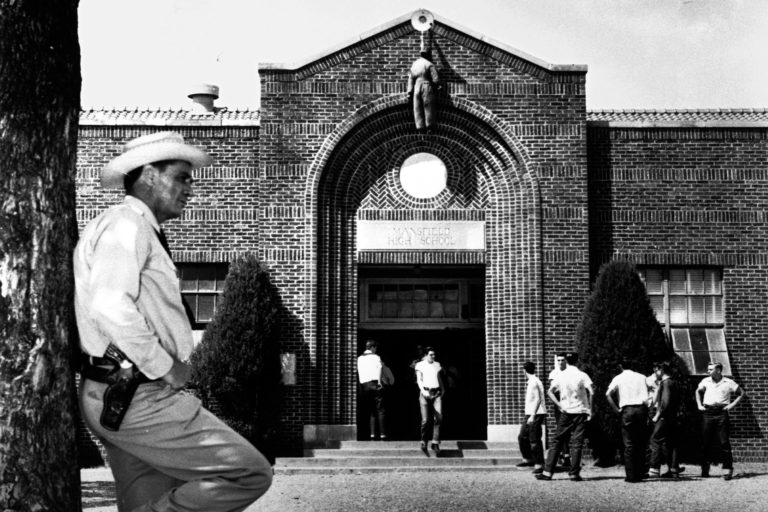
Ranger E.J. “Jay” Banks was sent to Mansfield High School in 1956. He didn’t seem to mind the black person hanged in effigy over the school’s entrance. D Magazine.
Days later, Shivers sent Banks and other Texas Rangers to Texarkana Junior College, allegedly to stop black students from enrolling.
A white mob surrounded black students trying to enter, while the Texas Rangers stood by and threatened to arrest the black students, who ultimately left. The local White Citizens Council reportedly treated Banks to a chicken dinner, according to D Magazine.
In 1959, San Antonio sculptor Waldine Tauch was commissioned to create the Texas Ranger statue, and she chose Banks as the model.
“One Riot, One Ranger”
The meaning of the statue, however, goes back even further.
The inscribed phrase, “One Riot, One Ranger,” originated in 1896. It reportedly came from an incident where Texas Ranger Capt. William “Bill” McDonald went to stop the illegal prizefight between Bob Fitzsimmons and Peter Maher, known as the “1896 World Heavyweight Championship.”
When McDonald arrived in Langtry, the Mexican border town where the fight would take place, the mayor met him at the train. He saw that the Texas Ranger was alone, then asked, “Where are the others?”
“Hell, ain’t I enough? There’s only one prize fight,” McDonald reportedly replied.
Ultimately, the fighters moved the event to a sandbar in the Rio Grande, outside Texas’ jurisdiction. Fitzsimmons knocked out Maher in 95 seconds.
When the Texas Rangers installed the statue at the ballpark, Texas Ranger Association Foundation Board Member Russell Molina said those who served with the agency deserve to be remembered, according to The Dallas Morning News.
“We recognize that the history of the Texas Rangers, like that of our state and nation, includes moments that must be confronted honestly,” Molina said at the time. “While not everyone who has served across more than two centuries lived up to the ideal, most did — and they deserve to be remembered for their service, sacrifice, and commitment to the people of Texas.”