
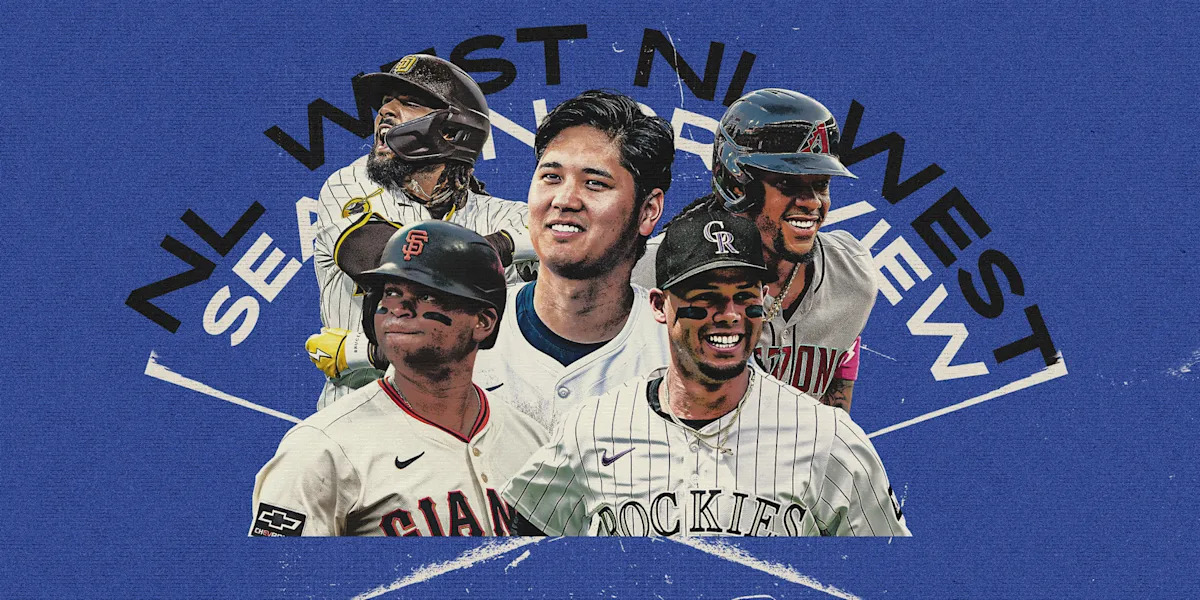
You think the Dodgers are breaking baseball? Try being another team in the National League West. Los Angeles has won this division in 12 of the past 13 seasons, and its win total in the season of that lone second-place finish (106) is tied for the team’s second-best mark over that 13-year stretch. There was a sense that the Dodgers were toying with the competition for much of last season, as they used their depth to rest any pitcher with a minor ailment before turning their full roster loose down the stretch and winning a second straight World Series title.
After adding Kyle Tucker and Edwin Díaz in the offseason, the Los Angeles juggernaut might be stronger than ever. Given that the Padres might’ve taken a small step backward this winter and the Giants have hovered around .500 for several seasons, the Dodgers should comfortably finish ahead of the pack again in 2026. The quest for San Diego, San Francisco and Arizona will be to earn a wild-card berth, which might be too much to ask. Meanwhile, the Rockies will be looking for any improvement after a historically bad 2025 season.
Advertisement
Read more previews: NL East | NL Central | AL East | AL Central | AL West Los Angeles Dodgers
Projected record (per FanGraphs, as of March 13): 99-63, 98.9% odds to make the playoffs, 93.5% odds to win the division
What happened last season? The Dodgers plodded along during the regular season, posting their lowest winning percentage (.574) since 2018, which was still good enough to win the NL West for the 12th time in 13 years. They rolled through the National League in the postseason, going 9-1 against the Reds, Phillies and Brewers, before winning one of the most memorable World Series in MLB history with an extra-innings, Game 7 victory over the Blue Jays. Yoshinobu Yamamoto was named World Series MVP, and Shohei Ohtani won the NL MVP award for the second straight year. The team’s slow start in 2025 was mainly due to an injury-riddled rotation, but the starters eventually returned to action and were excellent in October. The lineup was much more stable and led the senior circuit in runs scored.
Advertisement
What happened in the offseason? The rich got richer over the winter. After dealing with ninth-inning inconsistencies throughout 2025, the Dodgers solved that problem by signing the best closer on the open market, Edwin Díaz. And those who responded to that signing by saying the Dodgers were ruining baseball got even more fodder for their outrage when the team signed the consensus top free agent, outfielder Kyle Tucker. On a smaller scale, World Series hero Miguel Rojas and utilityman Enrique Hernandez were each re-signed for another season. Los Angeles didn’t lose a single player who made substantial contributions last year.
[Draft your Yahoo Fantasy Baseball team for the 2026 MLB Season]
Best-case scenario for 2026: As absurd as it sounds, the season will be a disappointment if the Dodgers finish as anything other than World Series champions. The offense is loaded, with Tucker (career .865 OPS) joining a group that has finished no lower than second in runs scored the past four seasons. The lineup includes five players who logged an OPS over .840 last year, and that doesn’t include superstar Mookie Betts or accomplished slugger Teoscar Hernandez. The rotation is as deep as the lineup and could be the best in baseball if Tyler Glasnow, Blake Snell and Roki Sasaki can stay healthy. And with a new anchor in Díaz, the bullpen suddenly features a solid group of setup men, including Tanner Scott, Alex Vesia and Blake Treinen. Plus, Shohei Ohtani is the greatest player the sport has ever seen and seems to find a way to get better each season. Only a rash of poorly timed injuries or terrible October luck would cause the Dodgers to finish short of their ultimate goal.
Worst-case scenario: The Dodgers finished 17th in ERA last season, as injuries to the rotation and some disappointments in the bullpen held the pitching staff back for most of the year. Similar issues could emerge in 2026, considering that Glasnow and Snell have lengthy injury histories. Sasaki, Treinen and Scott all struggled last season. Weaknesses can be shored up at the trade deadline, but if injuries happen late in the season, the Dodgers might be unable to use their wealth and prospect pool to fix their problems. It’s harder to envision the offense slowing down, but there’s certainly a chance the Dodgers’ bats could be stifled in October. After all, the Blue Jays were one inning away from disposing of the Dodgers last fall.
Advertisement
Make-or-break player: Edwin Díaz. The Dodgers showed last year that they could survive an injury or slump from virtually any player. Still, Díaz is the one man on this team who is being counted on to single-handedly stabilize a weakness. Los Angeles ranked 21st in bullpen ERA last season while the All-Star closer was having a stellar campaign with the Mets. If Díaz can repeat his recent success in 2026, the Dodgers will be a team without a weakness.
Season prediction: The Dodgers are heavy World Series favorites and will likely get the job done for a third straight season. Sure, there will be some bumps in the road, but the front office has the intelligence, financial backing and prospect pool to work around any setbacks.
Read more: NL West offseason gradesSan Diego Padres
Projected record: 80-82, 22.4% odds to make the playoffs, 1.2% odds to win the division
Advertisement
What happened last season? The Padres kept the Dodgers in their sights all season, and though they couldn’t quite keep pace with their archrivals, they comfortably grabbed a wild-card spot with a 90-win season. Unfortunately, an offense that was mediocre throughout the year caught up with the team in October, when the Padres scored five runs in three games while losing to the Cubs in the wild-card round. By design, San Diego’s bullpen was the strength of the team. Mason Miller was added at the trade deadline, joining a group that included Robert Suarez, Jason Adam, Adrian Morejon and Jeremiah Estrada. They led the majors by a wide margin with a 3.06 ERA. There were fewer stellar performances in the rotation, though Nick Pivetta deserves credit for a breakout season in his first year with the club.
What happened in the offseason? It’s hard to avoid the conclusion that the Padres got worse over the winter. Sure, Dylan Cease struggled last season, but his ability to eat innings will be missed in the rotation. And although the bullpen has the depth to withstand the loss of Suarez, his absence weakens a stellar group. The lineup will miss Luis Arraez and Ryan O’Hearn, who did their part to support the team’s stars. Retaining Michael King with a three-year contract was a necessary move. And there’s hope that Sung-Mun Song, who arrived from the KBO, and Miguel Andujar, who signed a reasonable, one-year contract, can make some contributions. The same can be said for Nick Castellanos, who joined the Padres after being released by the Phillies at the outset of spring training.
Best-case scenario for 2026: The Padres can survive the roster departures if some of their key players fare better in 2026 than they did in 2025. Since missing the entire 2022 season, Fernando Tatis Jr. has been good (.803 OPS); the Padres need him to be great. After all, he logged a .965 OPS from 2019 to ‘21 and should be in his prime right now. There’s also considerable room for third-year outfielder Jackson Merrill to improve on a disappointing sophomore season. Merrill, who will turn 23 in April, produced an .826 OPS as a 21-year-old rookie in 2024. Xander Bogaerts could also turn things around after two lackluster seasons. Thanks to the relief corps, the Padres’ rotation doesn’t have to be great. But getting more than 15 starts from King will help, as will the return of Joe Musgrove, who missed all of 2025. If everything goes well, this team can win 90 games.
Advertisement
Worst-case scenario: The rotation is the most vulnerable part of the team. Pivetta will be hard-pressed to repeat such a stellar year, and there’s no guarantee that Musgrove will make meaningful contributions. There is also a lack of exciting options for the final two rotation spots, and the lineup lacks depth. Jake Cronenworth, Gavin Sheets, Andujar and Song have mediocre offensive abilities. If Tatis and Merrill cannot improve their performances, this will be an average offense at best. And if the team is consistently losing after five innings, it won’t matter how dominant the bullpen is.
Make-or-break player: Joe Musgrove. The Padres desperately need their ace to return to form. When healthy, the right-hander is an excellent starter who can produce a low-3.00s ERA over 150 to 180 innings. By Opening Day, he will have had more than 17 months to recover from October 2024 Tommy John surgery. If they can stay healthy, the Padres’ front three of Musgrove, Pivetta and King would rival the rotations of most teams in the NL.
Season prediction: Unless the Padres’ ever-creative president of baseball operations, A.J. Preller, pulls a rabbit out of his hat, this team will fall short of a postseason berth. San Diego lacks depth in the lineup and rotation, and several other NL teams got better over the winter. Although it will be close, the Padres should still have enough firepower to stay ahead of the Giants and Diamondbacks and finish second in the division.
.jpg)
Can any team in the division keep up with Shohei Ohtani and the Dodgers? Can any team in the National League?
(Bruno Rouby/Yahoo Sports)San Francisco Giants
Projected record: 83-79, 38.1% odds to make the playoffs, 2.9% odds to win the division
Advertisement
What happened last season? A multiyear string of mediocrity in San Francisco continued. The Giants finished 81-81, marking the fourth year in a row that they won between 79 and 81 games. Their mediocrity was somewhat balanced, as they ranked 10th in ERA and 17th in runs scored. Logan Webb was the team’s lone standout player, as he led the majors with 207 innings, ranked third with 224 strikeouts and finished fifth in pitching WAR (5.5). There were a few other solid contributors, such as Willy Adames and Matt Chapman. Patrick Bailey continued to be baseball’s best defensive catcher. But there were also negatives, namely Rafael Devers, who was disappointing after arriving in a shocking June trade.
What happened in the offseason? The Giants’ biggest splash of the offseason came with their managerial hiring, as they brought in Tony Vitello from the University of Tennessee. Vitello, known for his passionate and candid style, has never coached in professional baseball at any level. In free agency, the Giants landed a quartet of second- or third-tier players but were never seriously involved with the marquee names. There were two additions to the rotation, as Tyler Mahle signed a one-year contract and Adrian Houser joined the team on a two-year deal. Both starters pitched well last year, although Houser’s success was somewhat surprising and Mahle was limited by a shoulder injury to 16 starts.
Center fielder Harrison Bader and infielder Luis Arraez were the top lineup additions. The 31-year-old Bader is coming off his best offensive season but is typically a more mediocre hitter (career 96 wRC+). Strong defensive skills are his calling card. Arraez, who will likely hit leadoff and work at second base or as the DH, is baseball’s best contact hitter but makes average contributions overall, due to his poor defensive skills and lack of power and speed.
Best-case scenario for 2026: Although the Giants cannot challenge the Dodgers, they could rise up to second place in this division and challenge for a postseason berth. To make that happen, they’ll need Devers to return to the superstar form he showed for several seasons in Boston. It would also help if top prospect Bryce Eldridge has a smooth transition to the majors after getting his feet wet in September. San Francisco will have an effective rotation if Webb and Robbie Ray are backed by Mahle, Houser and Landen Roupp. And while Ryan Walker stumbled when handed the closer’s role at the start of 2025, he has the skills to fare better this time around.
Advertisement
Worst-case scenario: If the additions of Arraez and Bader fail to make a notable impact, this lineup will be average at best. Aside from Devers, the players in the top half of the lineup are solid, not special. And while the offense profiles as a high-floor, low-ceiling group, the rotation could really let the team down. Ray logged a 5.54 ERA in the second half of 2025. Mahle made 24 starts the past three seasons combined, Houser has mediocre career numbers (4.06 ERA, 1.36 WHIP), and Roupp averaged fewer than five innings per start last year. The relief corps also lacks proven options. Finishing fourth in the division is a realistic possibility for the Giants.
Make-or-break player: Ryan Walker. The Giants’ closer needs to stabilize the relief corps by logging a 30-save season. He’s the only member of the group who has both the swing-and-miss skills and the major-league experience to handle the ninth inning. He went 7-for-9 in save chances last year after Randy Rodriguez was lost for the season. The results were inconsistent, but the right-hander dealt with poor luck last year (.318 BABIP, 67.2% strand rate). He could be much better this time around.
Season prediction: The Mets’ late-season collapse kept the Giants and several other teams in the wild-card race longer than they deserved. They probably won’t be as lucky this year. Another season hovering around .500 is the most likely expectation, and that would put the San Francisco front office in a tough spot at the trade deadline. This team really needs two more impactful players: one for the lineup and one for the rotation.
Arizona Diamondbacks
Projected record: 82-80, 34.0% odds to make the playoffs, 2.4% odds to win the division
Advertisement
What happened last season? Arizona entered July sitting at 42-42 before posting a 9-16 record over the next month, which forced the front office to make some tough decisions. In the end, the D-backs were among the most aggressive sellers at the trade deadline, swapping Eugenio Suarez, Josh Naylor and Merrill Kelly for a collection of prospects. The offense wasn’t the problem, as even with the departures of key players, Arizona finished sixth in baseball in runs scored. Corbin Carroll and Ketel Marte continued to be game-changers, and Geraldo Perdomo was one of baseball’s biggest breakouts of 2025.
The problems were on the mound. After signing a $210 million contract in the offseason, Corbin Burnes lasted just 11 starts before requiring Tommy John surgery. Others struggled to pick up the slack, as Zac Gallen, Brandon Pfaadt and Eduardo Rodriguez spent most of the season trying to get their ERAs below 5.00. The bullpen was no better, as most of the key pieces were sidelined by injuries.
What happened in the offseason? The biggest moves of Arizona’s winter came a few days before Christmas, when the front office brought back Kelly on a two-year contract, and on the eve of Valentine’s Day, when Gallen returned on a one-year pact. Those two will lead the rotation, which might include oft-injured righty Michael Soroka, who arrived on a one-year deal. The only other notable move was a trade to add Nolan Arenado. The rebuilding Cardinals kicked in plenty of money to get Arenado off their roster, as his offensive numbers have declined sharply for three straight seasons. The D-backs will hope the former superstar has enough left in the tank to be a respectable hitter in the bottom half of their lineup. Finally, Carlos Santana was added on an inexpensive, one-year deal. The 39-year-old has a solid .777 career OPS, but his play fell off dramatically last year. Unfortunately, the D-backs’ offseason ended in disappointment, as Carroll needed February surgery on a broken hamate bone and could miss Opening Day.
Advertisement
Best-case scenario for 2026: The lineup should be able to do its part. Carroll shouldn’t miss too much of the regular season. He and Marte are among the best hitters in baseball, and Perdomo’s breakout was well-supported by skill improvements. Catcher Gabriel Moreno can give the team a big boost by staying healthy, and Adrian Del Castillo and Jordan Lawlar are two prospects ready to make significant contributions. Kelly and Ryne Nelson give the rotation two pitchers who can be relied on, and though they struggled last year, Gallen, Rodriguez and Pfaadt have solid records and should bounce back. If the rotation exceeds expectations, Arizona can stay in the postseason race into the second half.
Worst-case scenario: The most likely scenario is that the pitching staff dooms any chance of the D-backs having a winning season. Behind Kelly, Gallen and Nelson, there’s a serious lack of skill and depth. Soroka last logged a 100-inning season in 2019. Rodriguez and Pfaadt are likely to be ineffective, and the organization lacks MLB-ready pitching prospects who profile as more than innings-eaters. The bullpen is in even worse shape, as there are no surefire candidates for high-leverage roles. And while the lineup won’t be the team’s weakness, it might not be a notable strength this season. Arenado, Alek Thomas, Del Castillo and Lawlar are just as likely to be below-average hitters as they are to be impact players.
Make-or-break player: Gabriel Moreno. Getting more games out of the catcher would go a long way toward boosting this team’s chances to compete. His strong on-base skills make the 26-year-old an excellent candidate to bat out of a premium lineup spot. And as a plus defender at the most important position, his availability is essential to get the most out of a mediocre pitching staff. There might also be more power potential in his bat, as his quality of contact and fly-ball rate have steadily risen in recent years.
Advertisement
Season prediction: This figures to be a retooling year in Arizona, while the organization waits to get Burnes back in 2027. Success this season might look like successfully determining which players, particularly among Del Castillo, Lawlar, Pfaadt, Nelson and Thomas, can be part of the next wave of success. There will also be more trade rumors around Marte in July, and the front office will have to decide whether to recoup a package of prospects or keep Marte in hopes of competing in 2027.
Colorado Rockies
Projected record: 65-97, 0.2% odds to make the playoffs, 0.0% odds to win the division
What happened last season? To say 2025 was a forgettable year is a massive understatement. The Rockies got off to the worst start in MLB history, winning just eight of their first 50 games. They finished 43-119, which tied the 2003 Tigers for the second-worst record in the past 60 years. Their minus-424 run differential was the worst of any team since 1900 and indicative of a squad that not only lost a lot but also was blown out of many contests. Amid the rubble, there were a couple of positives. Hunter Goodman enjoyed a breakout season. He represented Colorado in the All-Star Game and led NL catchers in home runs (31) and RBI (91). Mickey Moniak was another success story. Released by the Angels near the end of spring training, Moniak joined the Rockies and had the best season of his six-year career.
Advertisement
What happened in the offseason? After such a miserable season, the Rockies were in no position to be major players in free agency. They did, however, add a couple of pieces. Utilityman Willi Castro arrived on a two-year contract. He can play virtually anywhere, which will be helpful for manager Warren Schaeffer, who lacks reliable options at most infield spots. There was also a minor trade to land outfielder Jake McCarthy. As someone who rarely strikes out and runs the bases well, he could be a perfect fit at Coors Field. Veteran pitchers were added in the form of Michael Lorenzen, Jose Quintana and Tomoyuki Sugano, who all signed one-year contracts. Lorenzen can handle a variety of roles but will likely be needed in the rotation. Sugano was unimpressive (4.64 ERA) across 30 starts as a 35-year-old rookie last season. Quintana enters his age-37 season on the heels of a solid 24-start campaign (3.96 ERA) with the Brewers.
Best-case scenario for 2026: The 2026 Rockies’ season will be measured by the development of young players. Goodman needs to cement his status as a top catcher by repeating his breakout season. Brenton Doyle must recover his 2024 form, and Ezequiel Tovar needs to to bounce back from an injury-impacted campaign. Jordan Beck can build on a respectable showing in his first full season in the majors. Two of the organization’s top prospects, Charlie Condon and Cole Carrigg, should be ready to debut by the second half. And former first-round pick Chase Dollander has plenty to prove after going 2-12 with a 6.52 ERA his rookie season. This season will be a successful one for Colorado if the front office can sit down in October and identify 10 players who can eventually be part of the next winning team.
Worst-case scenario: The Rockies might not be much better than they were last season. The offense should improve, perhaps pushing the team to 50 wins. But the pitching staff is a mess, and there are few bright spots on the horizon. All of the organization’s notable prospects are position players, which means the same cast of characters who combined for a 5.97 team ERA will be tasked with producing better results this year. That isn’t likely to happen.
Advertisement
Make-or-break player: Ezequiel Tovar needs to get his career back on track after hip and oblique injuries wreaked havoc on his 2025 season. Still just 24 years old and entering the third season of a seven-year contract, Tovar is one of the core pieces of this organization’s future. With better health, he should be able to match the 26 homers he hit in 2024. Currently, his lack of on-base skills make him a poor option to hit out of a premium lineup spot, but he made minor strides with his plate discipline last season, and this should be the year he finally posts an OBP over .300. Tovar could also improve his baserunning, as he has 56th-percentile sprint speed but has swiped just 22 bases in 414 career games.
Season prediction: We’re beginning another dismal season in Colorado. Forget a winning record; the Rockies can strive to match the progress of the 2025 White Sox, who went from 41 wins to 60. Colorado’s 597 runs scored last year marked a franchise-low for a 162-game season. If Tovar, Doyle, Beck, Goodman and Moniak can form the foundation of a respectable lineup and improve that run total, the organization’s die-hard fans should at least have something to cheer about.