
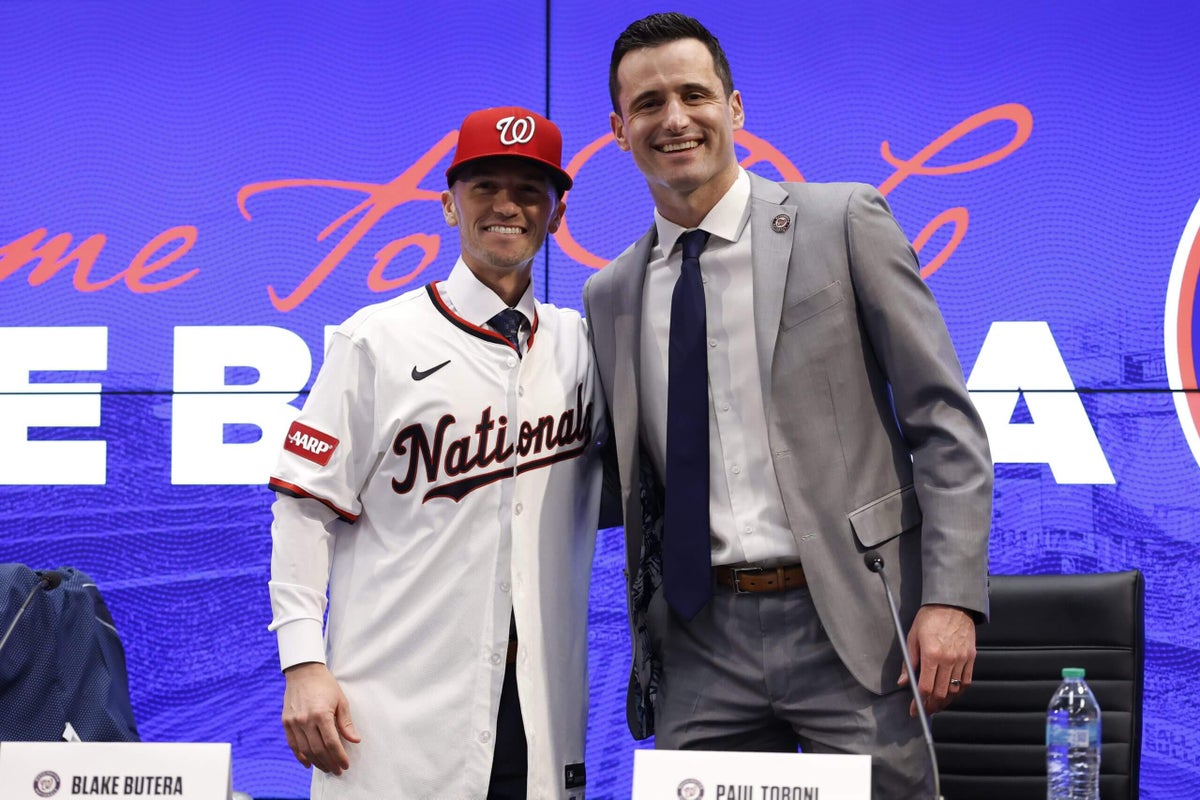
WEST PALM BEACH, Fla. – Paul Toboni holds a bachelor’s degree in political economics, which seems useful for a job in Washington, D.C. But Toboni’s unofficial college major mattered even more: He studied baseball players, and had lots of time to do it at the University of California, Berkeley.
Toboni played shortstop, but three hip surgeries ended any hopes of advancing to pro ball. He took a handful of at-bats and watched countless more. He tried graduate school at Notre Dame, earned a master’s of business administration with a specialty in finance and analytics, then decided not to use it. He wanted a career he would love.
And what Toboni most enjoyed was scouting. The draft process was especially fascinating. Teams gave him internships, and he happily roamed Texas and Louisiana scouting draft prospects.
Last fall, as the new president of the Washington Nationals — after a decade with the Boston Red Sox — Toboni had to choose a new manager. He was running a franchise committed to starting over, and needed a dugout leader with upside. In some ways it felt familiar.
“The way I thought about it is similar to the draft,” Toboni said, “where it’s like, you have this awesome high school hitter that you can take, and you also have this feeling that if you don’t take him, he’s going to be the No. 1 overall pick in two or three years if he goes to college – and then you’ll be sitting there kicking yourself. And so that thought was percolating in the back of my mind.”
In this case, the prospect was Blake Butera, the farm director for the Tampa Bay Rays. Butera had four years of experience as a minor league manager and two more as a player. He had coached in the Australian League, the Dominican League and the World Baseball Classic. He came from a baseball family, with his father and brother also having played pro ball.
The catch was that Butera was only 33. No MLB manager had been that young in more than half a century. Toboni hired Butera anyway. Always bet on talent.
“Age is just another number, brother,” said Jake Irvin, a Nationals starting pitcher. “It’s just another number in this camp, and it doesn’t matter at all. We’re here to do something special, and it doesn’t matter what anybody thinks.”
(Long-ago precedent, at least, offers hope. When the Washington Senators won their only World Series, in 1924, their manager was 27-year-old Bucky Harris, who also played second base. His Hall of Fame plaque calls him “Boy Wonder”.)
The Nationals exemplify the impulse of teams to replace one extreme with another. Toboni was born in 1990, a few months after his predecessor, Mike Rizzo, drafted Frank Thomas for the Chicago White Sox. Butera was born in 1992, about halfway into the 16-year playing career of the Nationals’ last manager, Dave Martinez.
Rizzo and Martinez used their decades of experience to lead Washington to a title in 2019. Since then, though, the Nats are a full 162 games below .500, losing more often than any other team but the Colorado Rockies. As the architect of the rebuild, Toboni, 36, is the youngest president of baseball operations in MLB – a fitting pairing with the game’s youngest manager.
“If you have two guys under 40 who lack humility and think they know everything, it could go sideways,” said Mike Gambino, who coached Butera at Boston College, where he also got to know Toboni. “But when you have two guys like Paul and Blake who are totally authentic and genuine and smart and driven – but also humble enough to be continuously learning and striving to get better – they have a chance to do some really special things together.”
Gambino, now the head coach at Penn State, was working for the Detroit Tigers when he first met Butera at a high school in New Orleans. He was scouting Butera’s older brother, Barry, and another player, and Blake took infield too. He was 13 and undersized, but feistily demanding of himself – much like Dustin Pedroia, who was soon to become Butera’s favorite player.
“Blake would not accept that he was just a younger kid taking ground balls with those guys,” Gambino said. “If he couldn’t make a play they made or do something they did, he was pissed.”
A few years later, Butera was part of Gambino’s first recruiting class at Boston College. He hit only .265 with little power for the Eagles, but showed an uncanny acumen for the game. Butera might not play in the majors, Gambino guessed, but he would make an impact for years.
“He would always come up to me in my junior, senior years and be like, ‘Hey, if this happened, like how would you address it as a coach?’” Butera said. “He’d kind of put those different scenarios in my head.
“And I think what stands out to me is I’ve had so many different coaches and managers who’ve made a lasting impression on my life and changed who I am as a person, and that’s ultimately why I wanted to do it. I’m like, ‘Man, the impact that you have on players’ lives, even outside of baseball, I want to share those things that coaches have passed down to me.’
“I didn’t know what position I would be in – an assistant coach in high school or a head coach in college or whatever – but whatever it was, I knew I wanted to be in a leadership position so I could help players become great players and also great people.”
Some of his new players have just arrived, such as starters Foster Griffin, Zack Littell and Miles Mikolas, catcher Harry Ford and the five-prospect bundle acquired from the Texas Rangers for starter MacKenzie Gore.
What stands out more in camp is the sense that the Nationals, after a half-decade of failure, have caught up to the rest of the league in ways to help players improve.
“The resources are definitely the number one thing that sticks out,” said starter Josiah Gray, a 2023 All-Star who has missed most of the last two seasons after Tommy John surgery. “And then the clear, cohesive message of ‘This is how we’re going to get you better as an individual.’”
Irvin, now in his eighth year in the Nationals’ organization, said he was struck by the overall tone of the team leaders. It is more about what the players should expect from the manager and coaches, he said, not the other way around.
In that way, perhaps, the youth of Butera and the staff can be a secret weapon: They all speak the same learning language. And they all think technology is pretty cool.
For the hitters, there is a new Trajekt device, a pitching machine that simulates pitchers’ deliveries and release points. (Most teams have had this for at least two seasons.) When pitchers throw in the bullpens here, monitors hover behind them, displaying their TrackMan data.
“I throw a pitch, and now I can take a look right away and be like, ‘OK, we made this small tweak and your numbers did this,’” Irvin said. “This generation of baseball players grew up having everything at their fingertips with technology and things like that, and being able to have stuff in real-time, to make adjustments quicker in a game that’s developing super-fast, is paramount.
“There’s a confidence that you get from having quantitative numbers right there in front of you. So instead of, ‘Ooh, that felt great.’ Now it’s, ‘Ooh, that felt great – and holy crap, it did something different, and it was a lot better than what I was throwing before.’”
The hard questions will come later for the Nationals, who built a winner in the 2010s with a strong farm system but also top-of-the-market deals for free agents such as Max Scherzer, Patrick Corbin and Jayson Werth. Nobody on the current roster makes more than $7 million. Nobody had more than 3.7 bWAR last year, either.
Toboni talks about “making the scoreboard visible” – that is, knowing where you rank to understand where you need to be. It is a sensible approach for any age, and should play well in an organization now growing up together.
“Obviously, I never played in the big leagues,” Toboni said, “but I can assume that one of the most uncomfortable positions to be in is not knowing where you stand – and then maybe even worse, not knowing whether you have a plan to get to where you want to go.
“That’s a tough spot to be in, so we pride ourselves on being super-honest with our player group and staff, saying like, ‘Hey, this is where you are right now, this is where we want you to go, let’s work our tails off together to get there.’”