
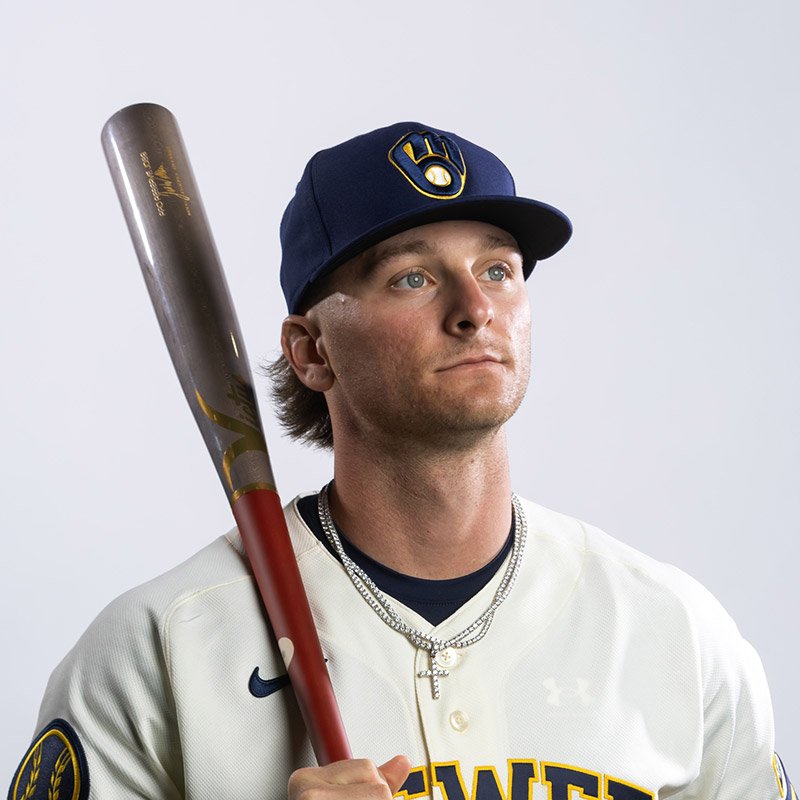
Williams joined the Brewers organization in the Freddy Peralta trade with the Mets, and immediately stands out because of his unique profile. The organization is more than willing to look past a player’s height, and Williams is the latest example of that. He had a very strong 2025 in the Mets organization, between Double-A and Triple-A.
What to Like
Despite standing just 5-foot-7, Jett Williams generates more power than his size might suggest. He combines average or better raw power (his 103.4 MPH 90th-percentile exit velocity is close to the league average) with a swing built to lift the ball to the pull side, giving him the ability to drive the ball in the air consistently. That combination of strength and swing path gives him legitimate long-term power potential, with the tools to produce 20 home run seasons at the major-league level at his peak.
His offensive profile also includes a playable hit tool. While evaluations vary, the underlying data and game action suggest a hitter capable of making enough contact to support his power and speed. There is some swing-and-miss in his game, but not at a level that should significantly limit his overall production. The combination of contact ability, pull-side power, and bat speed gives him a solid offensive foundation.
Speed is another major part of Williams’s profile. He possesses plus-plus speed that impacts the game in multiple ways. His quickness allows him to pressure defenses on the bases and gives him the potential to steal at least 20 bases annually in a regular role. That speed also increases his defensive value.
Defensively, Williams offers versatility. His glove is playable at shortstop, and he has the athleticism to handle several positions around the field. If he remains in the infield long term, second base would seem to be the most natural fit, where his range and athleticism could play well, but he could handle third base as well, and that might be his best chance at a big-league role in 2026. His physical tools also create the possibility of transitioning to the outfield. With continued improvement in his reads and jumps, his speed could allow him to handle center field, adding another path to regular playing time.
What to Work On
The biggest question in Williams’s profile is the consistency of his hit tool. While he has the ability to make solid contact and produce power, his offensive approach does still include some swing-and-miss. Continued improvement in pitch recognition and overall swing decisions will be important to ensure his contact ability supports his power production at higher levels.
Defensively, while he has some versatility, Williams does not yet have a clear long-term position. While he can handle shortstop, his overall fit there may depend on continued defensive development. Refining his defensive actions and improving consistency will help determine whether he remains in the infield or ultimately shifts to the outfield.
If he transitions to the outfield, further development will be required, particularly in his reads and routes. His speed gives him the physical ability to cover ground, but additional experience will be necessary for him to become a reliable defender in center field. Determining his best defensive home will be an important step in deciding his long-term role.
What’s Next
Williams could compete for a spot on the major-league roster in the near future, especially following the Caleb Durbin trade. However, he is likely to begin the season at Triple-A Nashville, where the focus will be on refining his defensive skills and establishing consistency at whichever position the Brewers view as his best long-term fit. With strong performance and continued development, he could position himself for a call-up early in the season.