
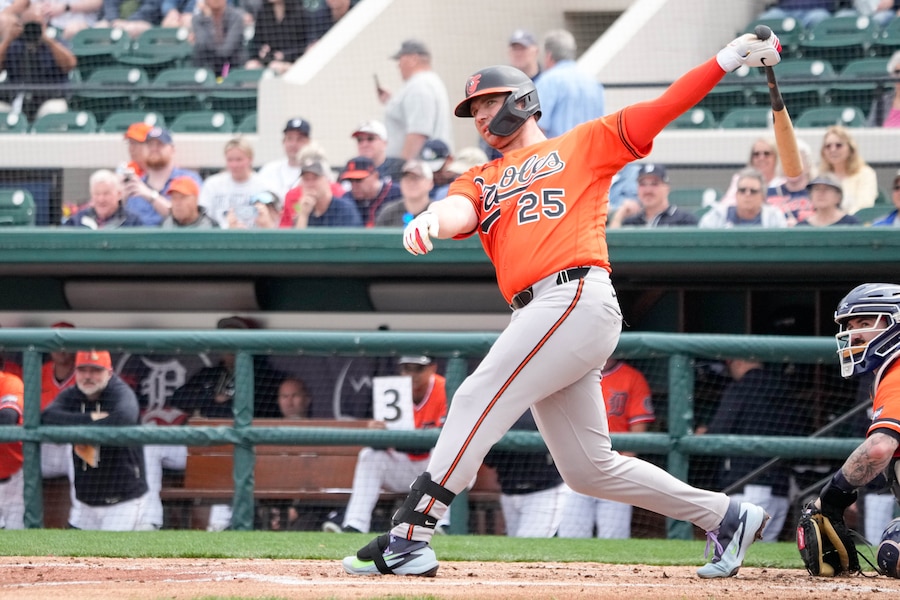
SARASOTA, Fla. — In hindsight, Blaze Alexander would not have tapped his helmet twice during his first-inning plate appearance last week against the St. Louis Cardinals.
The first one was fine — he won, after all — but the second?
“Didn’t want to strike out,” the Orioles infielder said, “so I called it.”
And he lost the automatic ball-strike challenge by a margin larger than 3 inches.
“That’s not the approach I want, especially not in the first inning,” Alexander said.
But this is what spring training is for, trial and error. After a month of games with the challenge system in place ahead of full implementation this season, the Orioles’ strategy is beginning to take shape with each tap of the helmet to signal a review.
First baseman Pete Alonso, who declined to specifically detail the strategy to maintain what he called a tactical advantage, summed it up this way: “You’ve got to be self-aware to realize when to use it and when not to use it, but you relatively want to keep them for those [big] moments.”
The challenge system shouldn’t monumentally change baseball. Both teams have two challenges per game, and if they win the appeal, they retain that challenge. The idea is to erase the obvious mistakes from a home plate umpire’s ball and strike calls, and those within Baltimore’s clubhouse welcome the addition of the challenge system as a happy medium compared to a full robotic strike zone.
But with anything new there is a learning curve. And, with limited challenges, Baltimore knows prudence — not emotion — must be a central pillar of the tactics.
“If it’s blatant, then I think that merits it, but if it’s a borderline call, you can’t really risk those or force that,” catcher Adley Rutschman said. “I think there’s definitely a difference between wanting something to be a strike or a ball and knowing it is, and baseball players have a tough time with that.”
That has led to centuries of wearing out umpires. Now umpires can retort: “Why don’t you challenge it?”
“I respect umpires who go, ‘I thought it was a ball. You can go challenge it. If you don’t want to, then stop asking,’” catcher Sam Huff said.
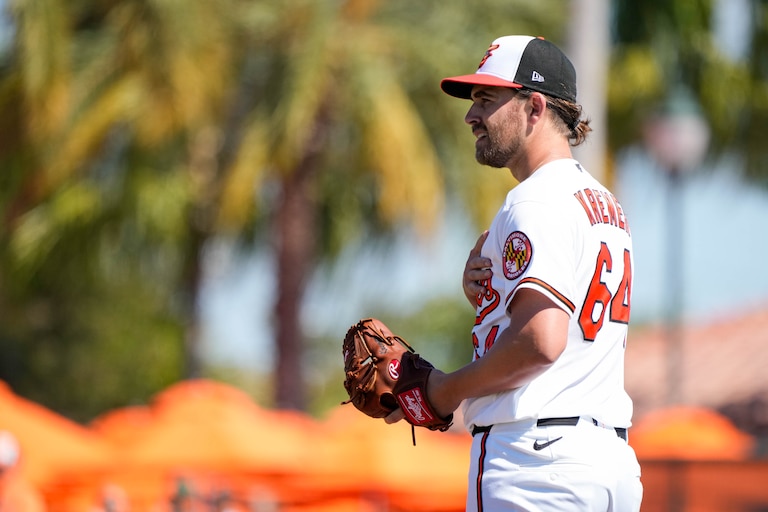 Dean Kremer is the only Orioles pitcher to challenge a ball called during spring training. The club considers that the catcher’s responsibility. (Ulysses Muñoz/The Banner)
The early results of the challenge system, through Sunday morning, show the Orioles as one of the better challenge teams. Before Sunday night’s game, Baltimore’s hitters successfully overturned a strike call into a ball on nine of their 18 challenges — a 50% rate that was tied for the sixth best in spring training, according to Statcast data.
The Orioles’ pitchers and catchers have been more cautious. Their 15 challenges, attempting to turn balls into strikes, were the fewest of any defending team this spring. They’ve won seven appeals, which is the second fewest out of 30 teams, and their 47% win percentage on challenges as a pitcher-catcher battery was tied for the fourth lowest.
The best challenge teams so far are the Seattle Mariners on defense (73% win rate) and the Philadelphia Phillies on offense (59% overturn rate). Overall, the New York Yankees’ 37 overturns combined on offense and defense are the most (and Baltimore’s 16 the fifth fewest).
The situations and tactics are evident. When on defense, the Orioles are mostly leaving challenges up to the catchers. There is good reason for that.
“If it was up to me, I would have challenged probably six today and got a lot of them wrong,” right-hander Chris Bassitt said last month.
Left-hander Cade Povich held a similarly honest self-assessment.
“Shoot, if we had unlimited challenges, I would’ve challenged a lot yesterday and probably would’ve lost a few and won a few,” Povich said last week. “I don’t think a pitcher’s emotion really helps the team.”
Part of the issue, Bassitt said, is how much movement a pitcher’s motion involves. They don’t have a clear view of where the pitch lands. The catcher, meanwhile, should have a better understanding of the strike zone and a clear view of where the pitch crosses the plate.
When Povich reached Triple-A for the first time in 2023 — the challenge system arrived there first before its implementation into the majors — then-pitching coach Justin Ramsey made it clear the challenge system would be a catcher’s duty.
That seems to be the case still, even at the MLB level. This spring, right-hander Dean Kremer is the only Orioles pitcher to challenge a call (he lost the appeal). Rutschman and catcher Silas Ardoin have won each of their two challenges, while catcher Samuel Basallo has a 1-for-4 success rate.
For both offense and defense, there’s encouragement to save the challenges for critical situations rather than burning one as the leadoff batter in the first inning, as Alexander did last week.
“In certain counts, certain moments, are you being selfish?” said Alexander, who leads Orioles batters with four challenges, of which he has won three. “The spots you want to use it are with guys on base, bases loaded. An opportunity when I can drive in runs, if it’s, ‘Hey, I think I got screwed on that call,’ use it.”
There could be an additional benefit to saving at least one of the challenges for late in the game. Huff, who has experienced the challenge system during his ample time in Triple-A the last few years, said a remaining challenge keeps an umpire honest.
“There are umpires that, when there are no challenges, you could tell he was calling more,” Huff said. “I would catch a ball two balls off [the plate], and he would call them, and I would be like, ‘Bro, just stick to your zone.’”
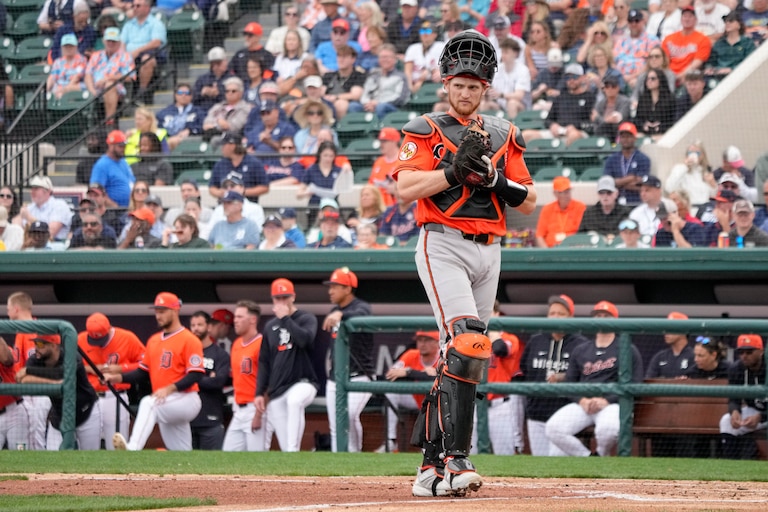 Orioles catcher Sam Huff has had ample experience with the challenge system in Triple-A. (Ulysses Muñoz/The Banner)
Still, the days of an egregiously poor call from an umpire appear to be gone, so long as a team retains challenges. A well-timed challenge can flip the course of an inning and change a game.
The Orioles just need to be smart about when to tap their helmets, so they can make the most of the technology.
“We’re not trying to fix the ones that miss .0000-whatever,” Alonso said. “The ones we’re trying to fix are the balls that aren’t balls and the strikes that aren’t strikes. I think it’s really good for the game to get it right.”