
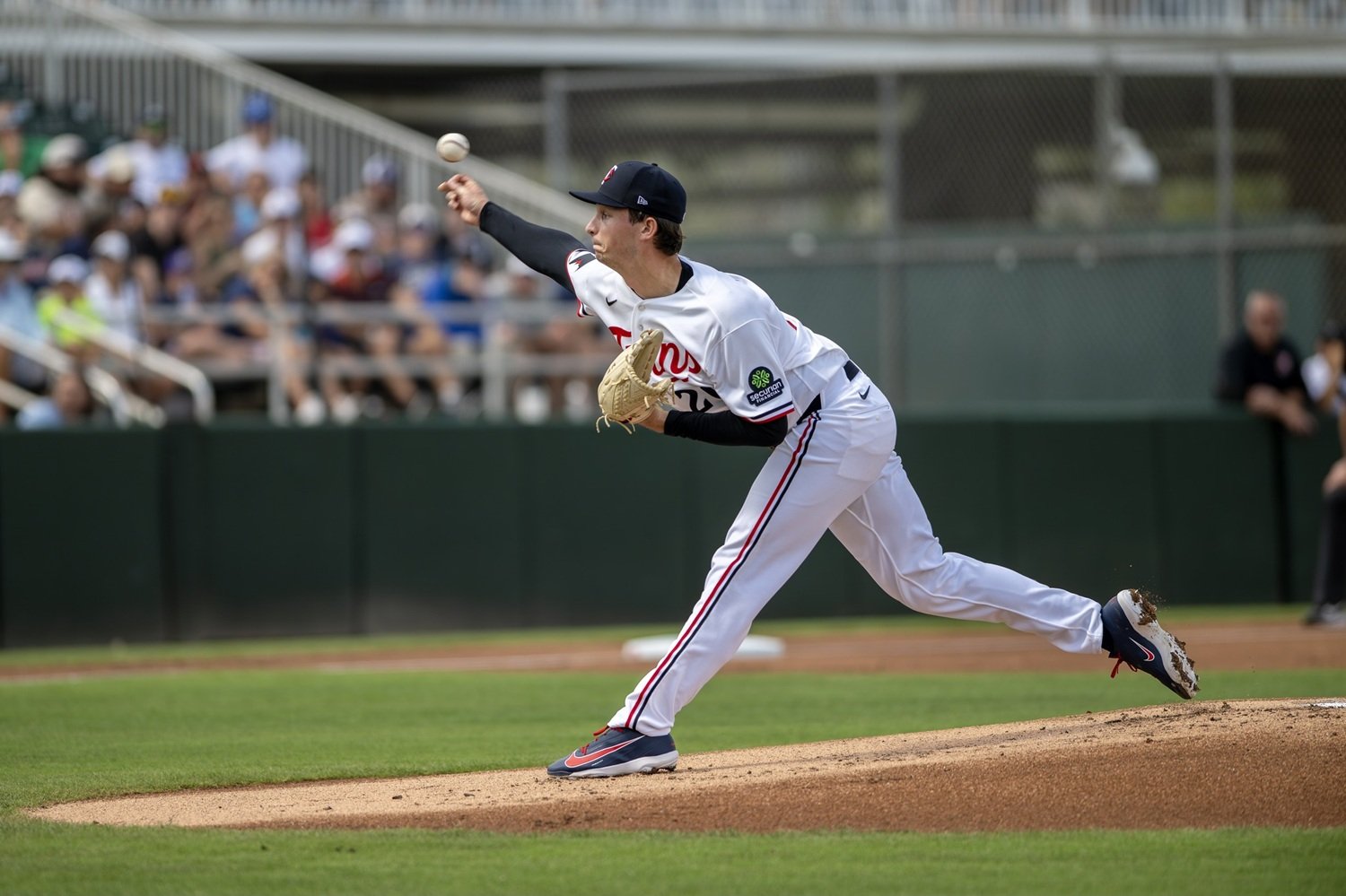
Spring training is ending, and final roster decisions loom for the Minnesota Twins. Injuries to Pablo López and David Festa have unexpectedly created an opening in the rotation.
Now, two young pitchers compete for the last rotation spot. Zebby Matthews began spring as the favorite, but Mick Abel’s recent electric performance has made the decision tougher. Only one will break camp with the club for Opening Day in Baltimore.
Why Matthews Should Make the Roster
To begin with, Matthews entered spring training as the leading candidate for the final rotation spot, and his overall profile still makes him a strong option for the Opening Day staff. Matthews’ 5.92 ERA through 25 starts raises concerns at first glance. Yet a closer look reveals tools that suggest greater potential than the ERA implies.
Matthews has the type of velocity teams crave in a modern starter. His four-seam fastball averaged 96.5 mph last season, and he pairs it with a slider that generated 50 strikeouts and a 38.5% whiff rate. That combination alone gives him the ability to miss bats consistently. Matthews has recorded 131 strikeouts in 117 innings, showing that his stuff is capable of producing outs at the highest level.
What makes Matthews even more intriguing is the depth of his arsenal. In addition to the fastball and slider, he mixes a cutter, changeup, curveball, and sinker. Few young pitchers possess that many options, and the variety allows him to attack hitters in multiple ways throughout a lineup.
Control has also been one of his greatest strengths. Over the past two seasons across all professional levels, Matthews has posted a 4.8% walk rate. Among pitchers with at least 50 combined starts during that span, that mark ranks seventh best. That type of command provides a solid foundation for long-term success.
Why Matthews Could Be Left Off the Roster
Despite the tools and upside, Matthews has struggled to turn his raw ability into consistent results. One of the biggest concerns has been his command within the strike zone. While Matthews does an excellent job limiting walks, his pitches often drift into dangerous locations once they cross the plate. Over the past two seasons, opposing hitters have posted a .362 batting average and a .979 OPS against his strikes, the second-worst marks among pitchers with at least 25 starts.
Left-handed hitters have been especially problematic. They have crushed Matthews’ pitches in the zone for a .406 batting average and a 9.1% home run rate. Those numbers suggest that his pitch placement needs significant improvement before he can fully harness his arsenal.
Still, there are signs that better days could be ahead. Matthews’ career FIP sits 1.51 runs lower than his ERA, suggesting he has been somewhat unlucky. Even a modest improvement in his in-zone command could significantly raise his ceiling.
Why Abel Should Make the Roster
Abel has made a case this spring. In 10 innings, he struck out nearly 40 percent of batters and issued no walks, quickly garnering attention for his control. Abel’s early outings were nearly flawless. He threw his first 10 innings without a walk or run, displaying the command the Twins wanted.
Even when tested, Abel responded well. Facing the Toronto Blue Jays, he walked George Springer on eight pitches, then left a slider that Daulton Varsho hit for a two-run homer. Abel rebounded by striking out the next three, then finished 3 1/3 innings. He gave up only three singles and erased a runner with a double play. That ability to recover could be a sign of maturation.
Abel has always possessed excellent raw stuff and a wide pitch mix. If his improved control is real, he could quickly become one of the most dynamic arms in the Twins’ rotation. On the fringes of contention, Abel might offer the highest upside among the pitchers competing for the final spot.
Why Abel Could Be Left Off the Roster
Abel still faces a challenge: experience. He has the fewest major league innings in the starting group, making him the easiest to send to Triple A. Developmentally, that option could make sense. Abel has struggled with walks throughout his minor league career, and the organization may want to see a larger sample size of improved command before handing him a permanent spot in the rotation.
Roster management also matters. Teams often keep younger pitchers in the minors early to avoid inconsistency in the big league rotation. Even with Abel showing the most electric arm this spring, the Twins may see a few more Triple-A starts as the safest path for his long-term growth.
The final rotation decision depends on philosophy. Matthews offers more experience and stability. Abel brings more upside. The Twins must weigh early-season safety against the potential boost Abel could provide. Realistically, both pitchers will be needed for critical roles throughout the 162-game season.
With Opening Day approaching quickly, the Twins must decide whether to trust Matthews’ experience or gamble on Abel’s potential. Either way, the outcome of this spring battle could have a significant impact on who heads north with the club.
Who should earn the final rotation spot? Leave a comment and start the discussion.