
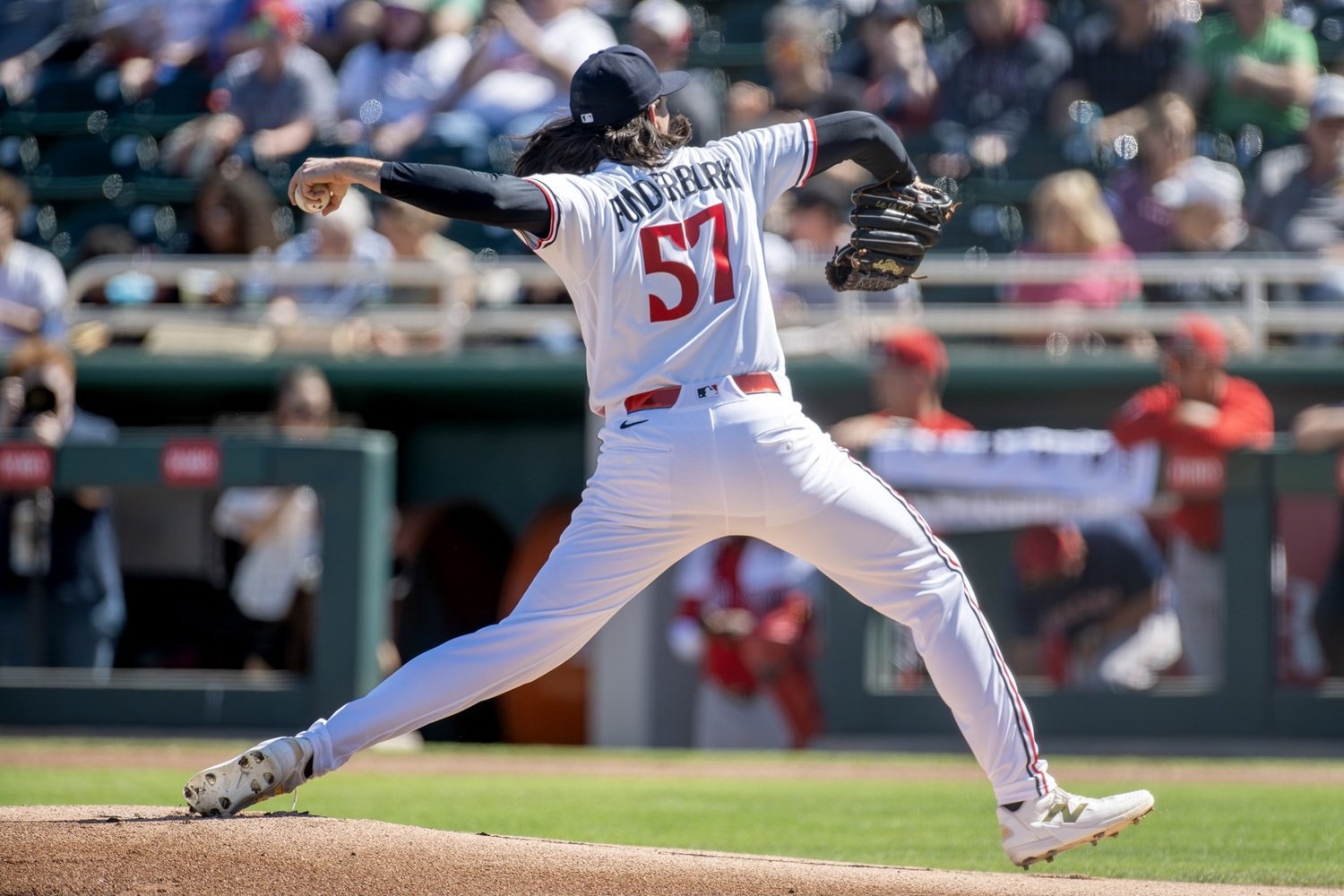
As the Minnesota Twins finalize their Opening Day roster, the bullpen remains one of the most fluid areas of the team. One of the biggest questions involves the final left-handed spot in the relief corps.
Several left-handed relievers are competing for as many as four available spots. Veterans Taylor Rogers and Anthony Banda are roster locks, leaving one certain spot (and perhaps a second, but perhaps not) for Kody Funderburk or Andrew Chafin. Funderburk brings youth and had a strong finish last season, while Chafin provides over a decade of MLB experience.
With the Twins unlikely to carry four left-handed relievers, one of these pitchers may end up on the outside looking in.
Why Funderburk Should Make the Roster
On performance alone, Funderburk has made a strong case to remain in the Twins bullpen. He has been sharp during spring training, posting a 1.35 ERA with a 7-to-2 strikeout-to-walk ratio across 6 ⅔ innings. That success has carried over from the second half of last season, when he became a stabilizing force in a bullpen that needed reliable innings.
After the All-Star break last year, Funderburk produced a 2.61 ERA, with 21 strikeouts and eight walks across 20 2/3 innings. Even more impressive was his dominant stretch late in the season. During August and September, he appeared in 25 games and posted a 0.82 ERA, striking out 25 batters and recording a save. That stretch suggested that Funderburk may have turned a corner in his development.
One of the biggest adjustments came from a change in his arm slot during the 2025 season. By lowering his release point, Funderburk created more deception, aided by extension that sits in the 95th percentile league-wide. That extra deception can make his fastball appear to jump on hitters faster than its radar gun reading. If those mechanical tweaks continue to pay off, the Twins could have a dependable bullpen arm who is already familiar with the organization and capable of handling meaningful innings.
Why Funderburk Could Be Left Off the Roster
Despite his recent success, Funderburk still faces significant competition for a roster spot. The Twins may simply have too many left-handed relievers. Carrying four southpaws in the bullpen would create matchup complications throughout a 162-game season, particularly when several of those pitchers struggle against right-handed hitters.
Funderburk’s splits highlight that concern. Over the last three seasons, right-handed hitters have produced a .279 batting average and a .768 OPS against him. Those numbers make it difficult to rely on him in high-leverage situations when opposing managers can counter with right-handed bats.
His overall underlying metrics also present some warning signs. While his surface numbers have looked strong at times, his WHIP has remained elevated. Even during his excellent late-season run, that figure still sat at 1.23; elite relievers often keep their WHIP around 1.00. Some of his expected metrics paint a more modest picture, as well. A 4.08 xFIP and a 76.4% strand rate suggest that some regression could occur if batted-ball luck begins to shift.
Because of those factors, Funderburk may find himself squeezed out by veteran options, even after a strong finish to last season.
Why Chafin Should Make the Roster
Chafin offers the type of veteran reliability that teams often value when shaping a bullpen. If he makes the roster, the 35-year-old will be pitching for his ninth major-league team in what would be his 13th season in the majors. Last year, he split time between the Washington Nationals and the Los Angeles Angels, posting a 2.41 ERA with a 25.2% strikeout rate across 33 2/3 innings.
Those results suggest that Chafin still has something left in the tank, despite his age. While his strikeout rate dipped slightly from the previous season, many of his underlying metrics remained solid. His ability to miss bats and limit hard contact has kept him effective even as he moves deeper into his career.
Chafin has also proven capable of handling right-handed hitters better than many left-handed relievers. Over the past three seasons, righties have posted a .243 batting average and a .714 OPS against him. Those numbers are noticeably better than Funderburk’s splits. That difference could be meaningful for a Twins bullpen that cannot always guarantee favorable matchups late in games, and who already have two locked-in lefties to handle those moments.
Why Chafin Could Be Left Off the Roster
Despite his long track record, Chafin’s case is not without flaws. One of the biggest concerns is his control. Last season, he posted a 13.3% walk rate, which created unnecessary traffic on the bases. While his ERA remained excellent, his 4.11 SIERA suggested that his true performance level may not have been quite as dominant.
His velocity is also a major red flag. All his pitches averaged under 90 mph last season, and he has been topping out in the upper 80s so far this spring. He has found a way to be successful at a lower velocity in previous years, but at some point, that level of velocity is unsustainable in modern baseball.
Health has also become a growing concern. Chafin spent time on the injured list in 2025 due to a right hamstring strain, and later dealt with left triceps inflammation. Those issues caused him to miss more than five weeks during the season.
There is also the reality that Chafin signed a minor-league contract, which means he’s not guaranteed a roster spot. The Twins could prioritize a younger arm already in the organization, rather than committing to a veteran who may be nearing the end of his career—and having to make room for him on the 40-man, to boot.
The Twins’ final bullpen decision may come down to experience versus internal momentum. Funderburk offers familiarity with the organization and is coming off a strong second half that hinted at real improvement. His mechanical adjustments and strong finish make him an intriguing option if the Twins believe his development is sustainable.
Chafin brings a veteran presence and a lengthy track record of success across multiple teams. His ability to better handle right-handed hitters could make him a safer option in a bullpen that may already lean heavily on matchup-based left-handers.
Either way, the Twins appear unlikely to carry four left-handed relievers on the Opening Day roster. That means one of these pitchers will likely be watching from the outside when the season begins.
Who will win the final left-handed relief role for the Twins? Leave a comment and start the discussion.