
Garion Thorne breaks down his top three starting pitcher sleepers for 2026 Fantasy Baseball drafts.
The start of the MLB regular season is just over a week away, which means we’re currently in the thick of fantasy baseball draft season. Two very similar seasons. Very easy to mix-up, so I forgive anyone of the error.
If you’re someone looking to fade starting pitching early, or maybe you’re just searching for this year’s hot sleeper pick on the mound, these are the three names that I’ve highlighted towards the end of my drafts. Also, if you want to fight me on my use of the always controversial “sleeper” term, for the purposes of this article, any pitcher being selected, on average, outside the first 250 picks of National Fantasy Baseball Championships (NFBC) will qualify. If you don’t agree, argue with a wall.
Let’s get into it.
2026 Fantasy Baseball: Sleeper Pitchers
Jack Leiter, Texas Rangers | NFBC ADP: 250.7
Allow me to quickly jet through the usual “sleeper” indicators that Jack Leiter carries into the 2026 campaign. First and foremost, the soon-to-be 26-year-old is dripping with prospect pedigree, as the right-hander was the second-overall pick in the 2021 MLB Draft by the Rangers, after turning heads in a stacked rotation during his time at Vanderbilt. Leiter mostly struggled in the minors, then posted a ghastly 8.83 ERA in his 35.2 innings at the major league level in 2024. Things weren’t tracking a lot better in the first half of Leiter’s 2025, but then the switch flipped. Harnessing a fastball that averaged 97.2 mph — the sixth-highest velocity for any starter with at least 150 innings thrown — Leiter posted a 3.28 ERA over his final 13 starts of the season. It was a span of time where the rookie’s strikeout rate jumped from 19.9% before the All-Star break to 26.3%. Impressive stuff.
Now, that’s not to say there weren’t some red flags along the way. Leiter’s 12th percentile chase rate (25.0%) doesn’t portend amazing swing and miss stuff, while a 13th percentile opponent barrel rate (10.8%) means the RHP can get hit hard. Still, Leiter dramatically altered his pitch mix mid-season, which legitimizes the stark statistical improvements. Following a string of poor results in May and June, Leiter relied more on his fastball in the final three months of 2025. He also started throwing his newly discovered kick change more often, with its usage in July spiking at 23.2% after Leiter threw the offering around 10% of the time in the prior two months. Why is that significant? Well, by put away rate (25.7%) and swinging strike rate (13.0%), it was Leiter’s best pitch.
We have to mention Globe Life Field, as well, which played as the best pitcher’s environment in MLB in 2025 according to Baseball Savant’s Park Factors. More specifically, it graded out as the worst park in the American League to hit a home run. That’s a very important aspect to note, given that Leiter is an extreme fly ball pitcher. Obviously Leiter won’t be able to make every start in Texas in 2026, but as the seventh or eighth starter on your roster, you might be able to be a little more picky with how you deploy the young righty.
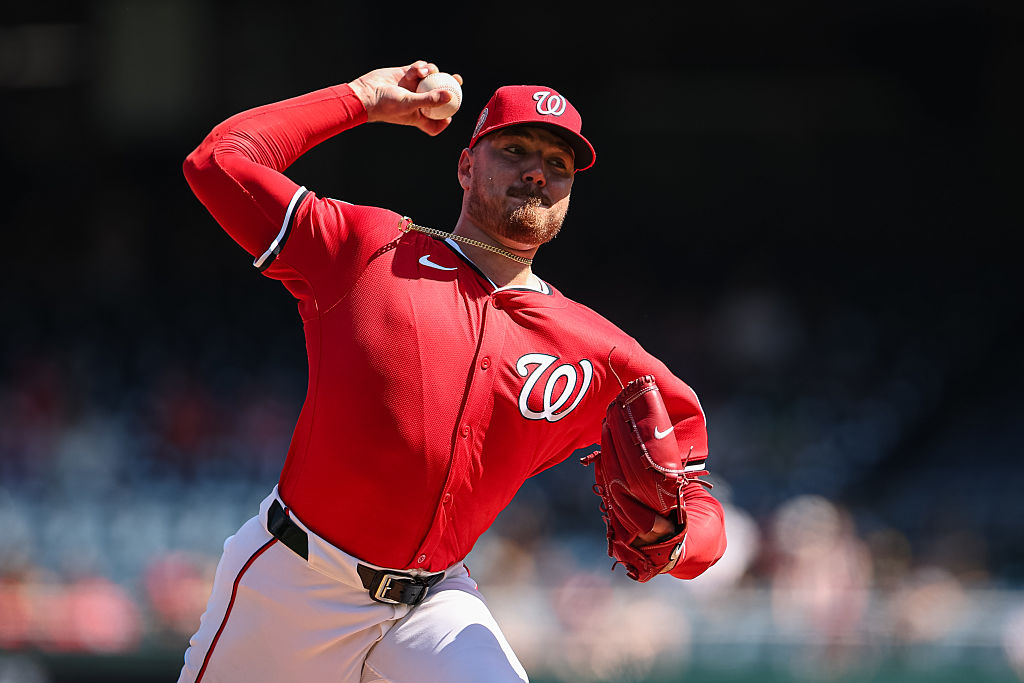
Cade Cavalli, Washington Nationals | NFBC ADP: 366.0
I’m allowing myself one (1) sleeper pick that is purely based in having fun with small samples. That is my right.
Like Leiter, Cade Cavalli does carry some serious prospect juice, as the former first-round pick of the Nationals back in 2020. Unlike Leiter, Cavalli’s path to the big leagues has been stunted by injury, which is how you explain debuting with a single start in 2022, then not making it back to the majors until August of last season. The 27-year-old pitched in 10 games for Washington down the stretch, maintaining a 4.14 xERA and an 18.3% strikeout rate across 48.2 innings. A great story of perseverance, to be sure, but not exactly attention grabbing numbers, right? …Right?!
Simply put, there are more strikeouts in this arm. Cavalli somehow only struck out 40 of the 219 batters he faced in 2025. That was despite a 95th percentile chase rate (33.9%) and a 12.2% swinging strike rate — two very consistent signifiers of strikeout potential. It’s not like there’s a lack of raw stuff or sequencing issues, either. Cavalli’s fastball averages 97.0 mph. His knuckle curve induced a 39.3% whiff rate, and justifiably, its Cavalli’s most thrown pitch. There’s so, so much to like about this profile.
Again, the samples are tiny, but Cavalli finished last season with a 95th percentile opponent barrel rate (4.4%), thanks primarily to a 93rd percentile ground ball rate (55.1%). That’s right, it’s not just that the RHP misses bats, he also suppresses launch angle when opponents actually do put a ball into play. Here’s a list of all the qualified starters in 2025 that managed at least a 12% swinging strike rate with a 50% ground ball rate: Cristopher Sanchez and Yoshinobu Yamamoto. Is Cavalli as good as either one of those men? Of course not. But to have similar traits and be going outside the first 350 picks in drafts is ludicrous. Take advantage.
Justin Verlander, Detroit Tigers | NFBC ADP: 457.5
Look, there was a point last season where we all collectively thought Justin Verlander was cooked. Heck, I’ll take it one step further and say that I think I was in attendance for said moment. On July 18, Verlander took the mound in Toronto to face the Blue Jays. He’d face 18 batters over 2.2 innings, surrendering nine hits, four earned runs and a pair of walks. Maybe most ominously? Verlander did not strike out a single hitter. Not one. When Verlander and the Giants left Canada that weekend, the veteran’s ERA sat at an ugly 4.99. The 42-year-old, who was seemingly chasing the allure of being the last 300-game winner in MLB history, had started 16 games for San Francisco in 2025 and had yet to add a single win to his career total. In short, Verlander was living a nightmare.
The funny thing about nightmares, though? Sometimes you wake up. Five days later in Atlanta, Verlander took the bump and threw five scoreless innings against the Braves, allowing only a single hit. From that point on, the ageless wonder maintained a sterling 2.60 ERA and 3.36 FIP, holding opponents to a .283 wOBA over 72.2 frames. From July 23 to the end of the regular season, that ERA and those innings each represented the seventh-best mark among all qualified starting pitchers in MLB. That’s a pretty decent span of time and results to suggest that Verlander still has at least a little something left in the tank. I mean, who am I to doubt a first ballot Hall of Fame arm?
The key with Verlander, especially now that he’s not generating whiffs at an elite rate, is keeping the ball in the park. Verlander’s 0.77 GB/FB ratio was the fifth-lowest of any pitcher with 150 innings thrown in 2025, and that’s a profile that can lead to the long ball. Fortunately, Verlander will once again be calling Comerica Park home, an environment that was the worst place to hit a home run as recently as 2022, according to Baseball Savant’s Park Factors. Verlander likely isn’t going to blow anyone away with his stats by season’s end, but with a price tag that’s essentially free, you could do worse than taking a chance on a living legend.