
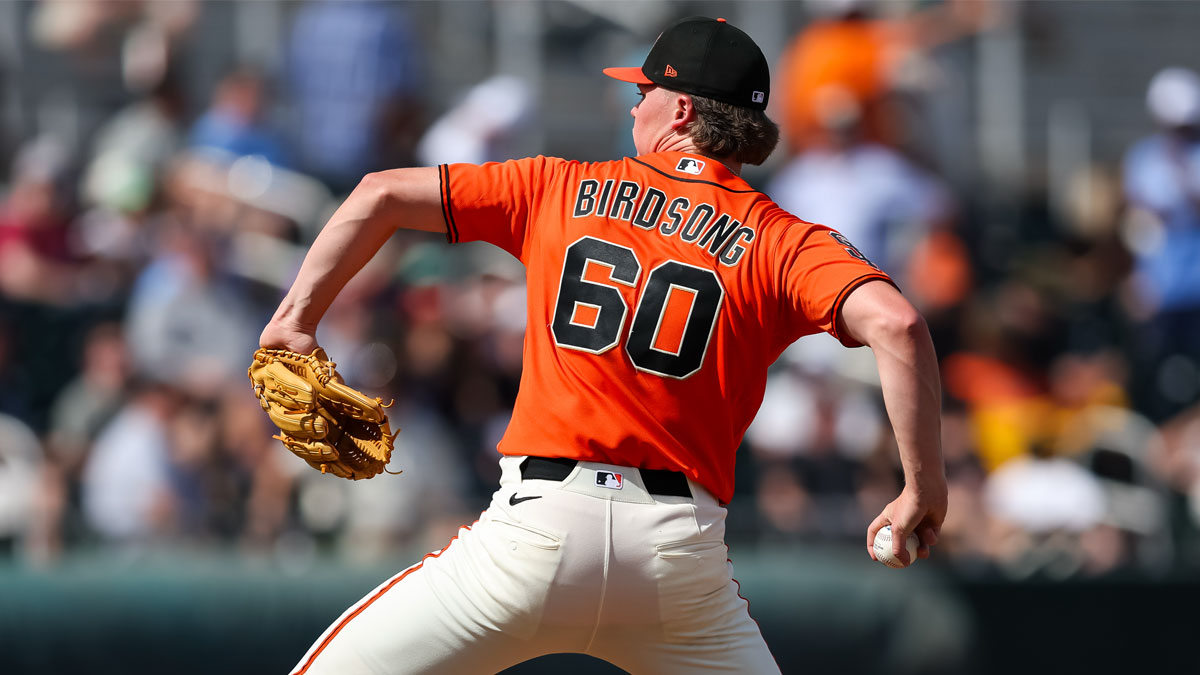
It appears the Giants, at the very least, will be without young pitcher Hayden Birdsong for an extended period of time.
The 24-year-old right-handed pitcher left his latest relief appearance in San Francisco’s spring training game on Tuesday with right elbow discomfort, which an MRI revealed was a Grade 2 forearm strain and sprain of his ulnar collateral ligament.
Birdsong is weighing his treatment options and will fly to Dallas to meet with Dr. Keith Meister. The team is hopeful the young pitcher will be able to rehab the injury, but this diagnosis more often than not leads to Tommy John surgery, which, if he undergoes, likely would sidelined him until the middle of the 2027 MLB season.
UCL injuries are increasingly common for pitchers in today’s game, and while, on the surface, it might seem like the writing is on the wall and that Birdsong’s season is ending before it starts, his injury is not as straightforward as the common UCL tear.
Stanford Medicine’s Dr. Michael T. Freehill, M.D., in an interview with NBC Sports Bay Area, discussed Birdsong’s concerning injury, which consists of both a strain (for muscles and tendons) to the forearm and a sprain (for ligaments) to the UCL, and how the two different injuries go together.
“Yes, two separate entities. Yes, two separate injuries. Two separate structures, but they do go hand-in-hand, and we’re seeing that more and more know as flexor strains are becoming more prominent,” Freehill told NBC Sports Bay Area. “So, when you have one, you want to be careful that it doesn’t ultimately cause UCL ligament failure.”
Simply put, in Birdsong’s case, if he does not undergo Tommy John surgery, he and the Giants must proceed cautiously with their rehab plan and not risk further injuring or fatiguing the flexor pronator mass, which would increase the liklihood of serious UCL injury at some point.
“I think in this case, the fact that you have the flexor pronator with some change of that ulnar collateral ligament puts you at a position where you have to be really careful, because we do know from literature that’s coming out, is that when you pitch with an injured flexor pronator or a fatigued flexor pronator, you set yourself up for potential injury of the ulnar collateral ligament,” Freehill explained. “Those who have had a flexor pronator strain are at increased risk for ulnar collateral ligament injury in the future.
“The time to return after a flexor strain, you don’t want to rush that. Because if you do rush it, there is an inverse coralation. If you give it a little extra time, the likihood of the UCL doing well is higher versus if you rush this back with a flexor pronator strain, you increase your odds of potential ulnar collaterral ligament injury.”
If Birdsong chooses to rehab the injury this season rather than undergo Tommy John surgery, which often sidelines a pitcher anywhere from 12 to 15 months, it likely still would keep Birdsong out for a majority of the 2026 season as he works through one of multiple different treatment options.
“Obviously shutting down throwing for a time, working with the athletic trainers, going through different types of treatment modalities, strengthening up that flexor pronator mass, letting things calm down,” Freehill said when asked about non-surgical treatment options. A lot of times, anti-inflammatories.
“Now, depending on the severity of this, you can also introduce other types of options such as biologics, and many have heard of these treatment options, with PRP (Platelet-Rich Plasma) for example.”
If the decision is to not have surgery, Birdsong likely will be out a minumum of three months, and potentially longer if he and the Giants take a very cautious approach to his recovery, which Dr. Freehill believes is important in order to avoid a more serious injury to the UCL.
“I do think when you have these two going hand-in-hand like this, you have to have some caution, versus one or the other,” Freehill added. “But I think in regards to the flexor pronator strain itself, if you have that, and they’re calling that a Grade 2 here, that you’re probably looking at a minimum of three months and I think more recent literature would support that.
“You just want to make sure that you’re not rushing back too fast and that it’s not bearing more stresses than it should and not truly recovering from the flexor pronator.”
It’s unclear which direction Birdsong and the Giants will go in at the time of this writing, but it is safe to say the young pitcher, who still has very promising upside after a disappointing 2025 season, will not be much of a factor — if at all — for San Francisco in 2026.
Download and follow the Giants Talk Podcast