
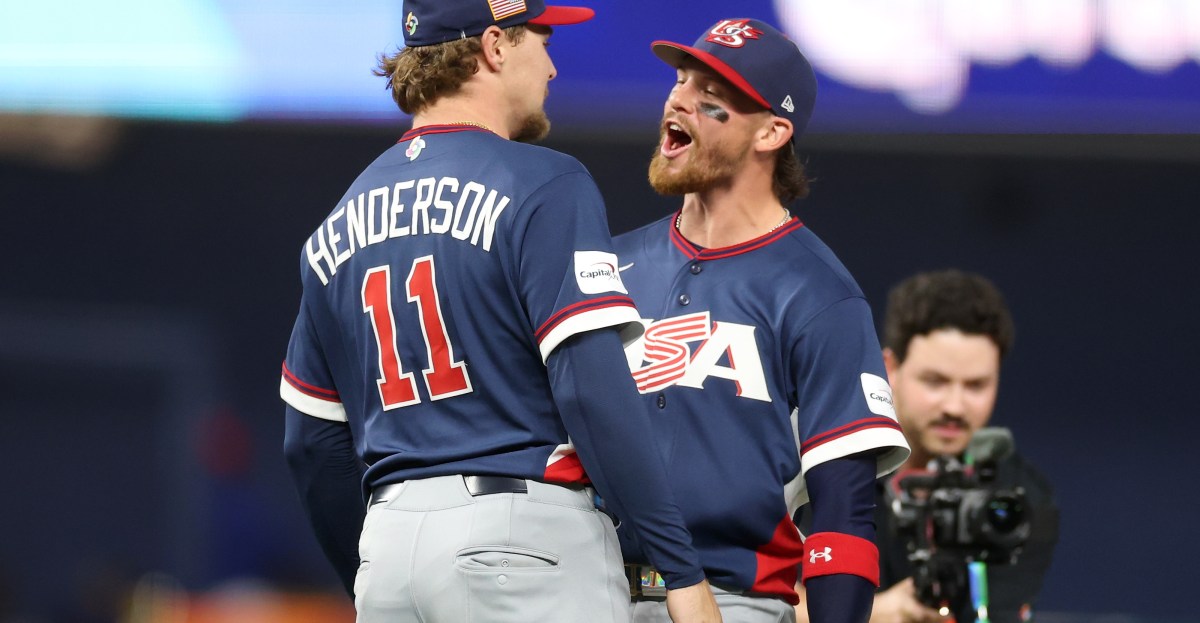
This year’s World Baseball Classic has been a resounding success, a theorem that proves so many assertions about baseball: that baseball is global, that baseball can be fun, that there’s so much talent, that the sport itself is exciting.
It has also demonstrated that national teams don’t have to rally around jingoism to forge an identity. Indeed, teams and fans have broadly had a blast, celebrating their countries’ rich traditions. Nobody’s out there reveling in their nation’s conquests and thanking their military.
The exception to everyone else is, of course, Team USA. America is a land of problems and promise, with plenty of causes to rally around. One of those causes is support for “the troops,” as it were, and that’s not an inherently bad one. A relationship with servicemembers sometimes factors into the decision to play for Team USA, as it was for star starting pitcher Paul Skenes, who went to the U.S. Air Force Academy. Generally, there’s some level of lip service for the troops, and that’s par for the course. It’s fine.
What is different about this particular team is that they are really leaning into the “yes, sir, we fight for the army” vibe in a way that isn’t necessary, especially when you look at the attitude of the other WBC teams. Manager Mark DeRosa invited the retired U.S. SEAL Team Six member Robert J. O’Neill to talk about the mission to kill Osama bin Laden. And they’ve adopted a sort of militaristic nobility, where they put “country ahead of teammates and friendships.”
Lo and behold, it’s played out on the field. Earlier in the tournament, Randy Arozarena tried to shake the hand of Cal Raleigh, his Seattle Mariners co-star, before a plate appearance. And the reason for Raleigh’s refusal is, ah, silly at best:
Arozarena felt disrespected when Raleigh wouldn’t shake his hand prior to his first at-bat in WBC pool play. Per multiple sources, Raleigh had made it clear to Arozarena that he couldn’t shake hands, following a Team USA philosophy agreed upon by the players. But Arozarena attempted a handshake and Raleigh refused, saying something to him.
The issue here is not so much that the players want to represent people who they value. The issue here is in playing soldier to the extent that they don’t engage in basic sportsmanship because…reasons. Nobody else is doing this but Team USA. Nobody else is doing this but Team USA. This attitude is a choice, and again a stark choice in contrast with the wild joy exemplified by other teams.
And unfortunately, the subtext has ascended to the text, because Team USA’s opponent in the final is none other than Venezuela. Venezuela, the sovereign nation whose head of state was captured and imprisoned just two months ago in what some in the internationally community see as an illegal attack by the United States. That’s to say nothing, of course, of the ongoing conflict with Iran, whose soccer team is set to play their first World Cup game in California a few months from now.
“Stick to sports” is a common refrain that is lobbied towards writers, athletes, and commentators alike when an uncomfortable political issue bubbles too close to the surface. But what we’re seeing here is evidence that professional sports has always and will always be political, because professional sports is an apparatus where power, money, and influence reside.
We were never going to avoid some weirdness with a United States vs. Venezuela final. But it could have been an opportunity for sports to bring us together. Instead, Team USA seems to be more interested in putting a boot in the ass of their opponents. I don’t like that we’ll probably have to see Bobby Witt Jr. pointedly ignore Salvador Perez because Team USA decided that “putting country first” means what they think it means.
It’s an unforced error in an otherwise fantastic tournament.