
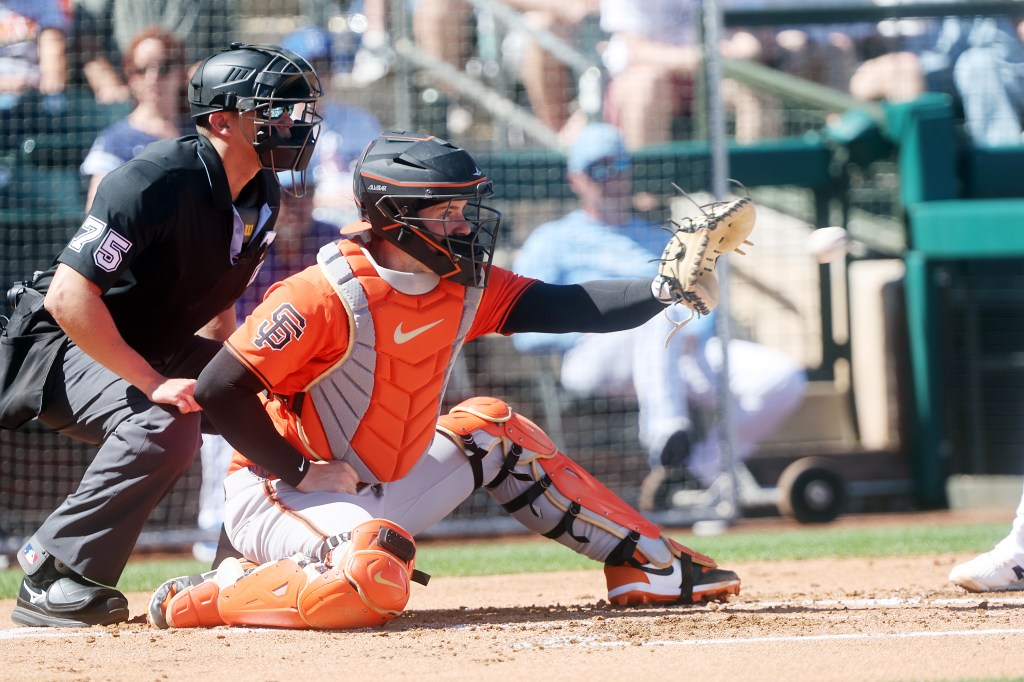
SCOTTSDALE, Arizona — Patrick Bailey was skeptical when Major League Baseball announced the implementation of the automated ball-strike system, or ABS, last September.
Bailey, a two-time Gold Glove Award winner, is the best defensive catcher in baseball, and much of his value derives from framing. That is, making balls appear like strikes. “Robo umps,” as they’re colloquially known, then represented an antagonistic figure. But as spring training winds down, Bailey’s tone has changed.
Despite his initial hesitation, Bailey has found he can use the new system as another vessel to steal — and, by extension, be even more valuable. With ABS, he’s found another way to distance himself from his fellow catchers.
“I think it’ll widen the gap, to be honest,” Bailey said. “I think it’s going to be super valuable and resourceful. I just have to be good at it. I’m happy with how this spring’s gone in terms of the challenges. I think the biggest thing is just taking the emotion out of it.”
“If anything,” said manager Tony Vitello, “(ABS will) accentuate what type of player he is.”
Bailey has won nine of his 11 challenges as a catcher over nine games, one behind the Padres’ Freddy Fermin and the Twins’ Ryan Jeffers for the most this spring. While the league-wide overturn success rate is 59 percent, Bailey is well above the fray at 82 percent.
The quality of these challenges has been as impressive as the quantity. Of his nine successful challenges, four of them have flipped a ball into a strikeout.
“In our work, we’ve done a lot of stuff where we’re trying to learn the zone and try to figure out how to become better,” said catching coach and major league field coordinator Alex Burg. “If you would’ve asked me two years ago, I would say he wouldn’t be very good at it because he didn’t really have a great understanding of the strike zone. To his credit, he’s gotten much better at understanding what the strike zone is.”
Beginning last year, Burg saw Bailey take ownership of truly learning the strike zone. Even as Bailey focused on receiving, he’d ask himself whether a pitch was a strike.
Bailey and Burg acknowledge that the top and bottom of the zone will always fluctuate due to hitter height. But the sides? The sides are always the same. And while the reduced “buffer zone” last year resulted in fewer called strikes around the margins, it helped Bailey further understand what made a strike a strike.
“At that time, I thought it was something that might kind of hinder my abilities,” Bailey said. “In conversations with Burg, I asked, ‘How do we attack this? How do we make this a weapon?’”
Bailey has only caught nine games this spring, but he’s already compiled an impressive reel of overturns.
This past Friday, right-hander Landen Roupp tossed a 1-2 curveball down-and-away to left-handed hitter JJ Bleday that was deemed a ball. It was a fair call, but Bailey tapped the top of his head to signal a challenge. The verdict: Roupp’s curveball barely nicked the zone. Instead of a 2-2 count, Bleday was out looking.
“I definitely thought that one was more of a strike than what it was,” Roupp said. “I was comfortable with him challenging that one. There’s been some where I’ve watching and thought, ‘There’s no way.’ Then, it’s there. He’s super good at that.”
It’s one thing to challenge a pitch that just clipped the zone. It’s another to successfully challenge a pitch that’s almost never called a strike.
In Logan Webb’s final Cactus League start before the World Baseball Classic, Bailey called for a sinker on the inner half to the San Diego Padres’ Jose Miranda. Webb yanked the pitch, throwing it outside instead of inside, and Bailey had to reach across his body to receive the two-seamer.
Even with a good frame, catchers usually aren’t able to get those types of pitches called strikes since their bodies are moving from one side of the zone to the other. Bailey, though, was certain this pitch clipped the zone. So, he signaled to challenge. Scottsdale Stadium played the animation, and Bailey was correct. The ball turned into a strike, and Miranda turned from hitter to spectator.
“We were trying to go in and I missed away,” Webb said. “That usually never gets called a strike. Now, we can challenge it. So, I’m excited about that.”
Roupp and Webb, independent of one another, both referenced their trust in Bailey’s knowledge of the strike zone. So strong is the staff’s trust, in fact, that there hasn’t been a single Giants pitcher who has challenged a call with Bailey behind the plate.
Bailey said there haven’t been any conversations with the pitching staff about letting him exclusively handle challenges. For Roupp, it’s a conversation that doesn’t even need to be had.
“It’s kind of just unspoken that everybody trusts him,” Roupp said. “He knows the strike zone better than anybody else. There’s not much stress there when it comes to trying to challenge. I’m not going to be thinking about challenging when he’s behind the plate.”
“If Patty doesn’t call it,” Webb said, “then it’s a ball.”
For all of Bailey’s defensive value, the 26-year-old knows he still has more game to give.
Bailey ended last season with career lows in batting average (.222), on-base percentage (.277), slugging percentage (.325), homers (six) and strikeout rate (29.4%). By weighted runs created plus (wRC+), which accounts for offensive environment and ballpark, he was the sixth-worst hitter in baseball (min. 400 plate appearances).
As poorly as the season went offensively, Bailey entered the offseason swinging a hot bat. In September, Bailey hit .288/.321/.493 with four home runs, one being his walk-off grand slam against the Los Angeles Dodgers. That month couldn’t salvage the entire season, but it was a much-needed confidence boost after spending the summer in the doldrums.
Bailey, a switch-hitter, tweaked his right-handed batting stance this offseason with the help of Chicago White Sox assistant hitting coach Joel McKeithan. He’s placing his hands much lower, and his leg kick is much more pronounced. Bailey toyed around with different mechanics in the winter, and his current setup makes him feel much more athletic compared to last season.
“I’m not pleased with how last year went, but it’s another learning opportunity to go into this year and be more confident in my swing,” Bailey said.
Bailey, 26, has already become the first catcher in Giants history to win multiple Gold Glove Awards, and there’s reason to believe he’ll add more to his résumé in the coming years. He’s the best framer in baseball, his arm is elite and he’s transformed himself into an above-average blocker. And for all his initial reservations about robo umps, he’s quickly proving he can be elite in that department, too.
“I want to be the best defender in baseball,” Bailey said. “I believe I am the best defender in baseball. I also want to continue to get better defensively. I want to continue to get better offensively. I believe there’s a lot left in the tank in a lot of areas of my game as a whole, and I’m super excited going into this year.”