
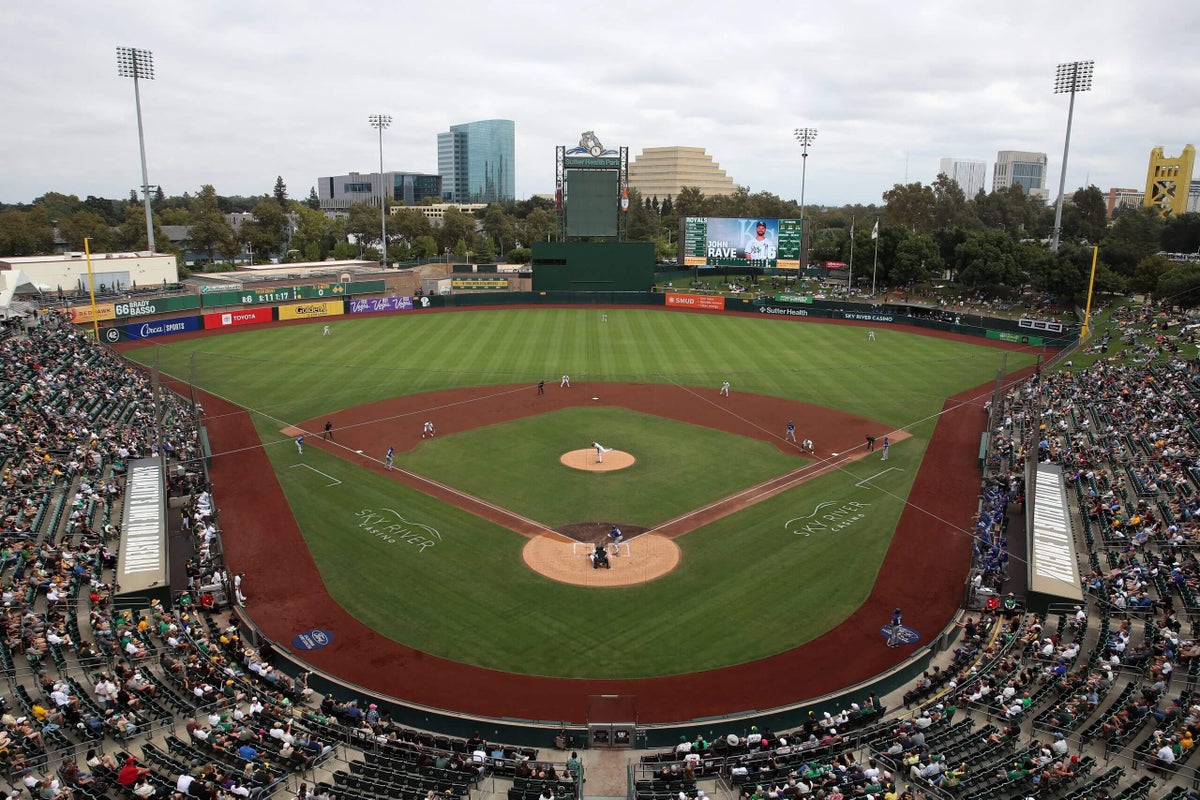
Where a hitter or pitcher calls home can have a significant effect on their fantasy value. To illustrate just how important a venue can be, consider Kyle Schwarber’s 60 expected home runs in Sacramento last season; he would have had only 39 expected HRs had he played in Kansas City. Many elements outside of dimensions also go into park factors, including but not limited to climate, wind (even affecting pitch movement), mound height, umpire accuracy, vision from the batter’s box and more.
Parks also influence strikeouts and walks, not just homers and runs scored. In fact, pitchers are recording higher-than-usual strikeout rates at home, presumably because away teams don’t have the same access to the Trajekt Arc — an advanced robotic pitching machine that has a projection screen facing the batter (instead of a wheel), which allows the batter to see a video of a specific pitcher, and which includes a hole that coordinates with that pitcher’s release point.
Just got some early evidence from @Dtovitz showing that extreme arm angles got more whiffs at home in 2025 (where the away team has no access to Trajekt machines and their ability to preview release point information). Trey Yesavage at home again tonight. https://t.co/kVCxNsYivo
— Eno Sarris (@enosarris) October 13, 2025
It’s best to use three-year samples, but we must also be aware of recent changes. Baltimore moved in its left-field wall before last season, and the results were evident — Oriole Park at Camden Yards went from a pitcher’s park from 2022 to 2024 to the sixth-best hitter’s park in 2025, including boosting homers by 21% (only Dodger Stadium was higher).
BEAT OUR EXPERTS
Predict how you think the tournament will
play out. Can you beat one of our experts?
The Rays and Athletics played in new venues last season, with both minor-league parks unsurprisingly favorable to hitters. Only Coors Field was a better place to hit than the A’s Sutter Health Park, while Tampa Bay will experience a dramatic difference going back to pitcher-friendly Tropicana Field.
Kauffman Stadium moving in its fences is the other notable offseason change entering 2026. It should cause more homers and runs scored, with fewer doubles and triples — Eno Sarris covered in detail what this means for Royals hitters and pitchers. Kauffman Stadium has decreased HR for lefties an MLB-high 27% over the past three seasons, so the changes should certainly help Vinnie Pasquantino and Jac Caglianone.
I should also note that baseballs have seemingly been deadened recently and are not traveling as far lately, but that can change year-to-year without warning or public knowledge. We’ll begin with ballparks that favor hitting.
Parks that boost runs (2023-2025)Coors Field, COL (+28%)
Jake McCarthy is a candidate to bat leadoff for the Rockies, and he has 30+ stolen-base upside. McCarthy and Willi Castro are sleepers with Coors now on their side. Rockies pitchers can be ignored in fantasy leagues, but Ezequiel Tovar, Brenton Doyle and Mickey Moniak are intriguing buys purely because of their home park.
Sutter Health Park, ATH (+17%, 2025)
Sutter Health was baseball’s second-best hitter’s park in 2025. Dimensions can be misleading in minor-league parks, as the lack of multiple decks allows for more distance on fly balls — Sutter Health Park was an even better hitter’s paradise than Coors Field during day games. The Athletics’ hitters will continue to benefit in 2026, with newcomer Jeff McNeil a deep fantasy sleeper.
Fenway Park, BOS (+8%)
Willson Contreras gets an upgrade moving to Fenway Park, as Busch Stadium is even tougher on righty power. Contreras slugged nearly 75 points higher on the road last season, and he’s also slated to hit cleanup for the Red Sox. He’s a clear buy. Meanwhile, Sonny Gray and Ranger Suárez suffer modest downgrades in home parks after joining Boston.
Great American Ballpark, CIN (+6%)
Matt McLain was a post-hype sleeper entering draft season, but he’s shot up in ADP after becoming the hottest hitter in spring training. Be careful chasing stats this time of year, but a healthy McLain has real fantasy upside. Great American Ballpark will also help Sal Stewart’s bid to win NL Rookie of the Year.
Chase Field, ARI (+6%)
Chase Field is a bit different, as it sports the third-best Park Factor over the past three seasons, but it’s suppressed homers ever since introducing the humidor in 2018. Nolan Arenado gets a fantasy bump moving to Arizona.
Side note: After years of playing favorably to pitchers, Comerica Park in Detroit was surprisingly MLB’s third-best hitter’s park last season. It may just be small sample noise, given no reported changes occurred, but it’s something to monitor.
Parks that boost HRs for lefties (2023-2025)Citizens Bank Park, PHI (+28%)
Kyle Schwarber hit 10 more homers in Philadelphia than on the road last season, while Bryce Harper’s OPS jumped nearly 200 points at home (.760 vs. .941). Aaron Nola’s 6.01 ERA is due for regression, but it’s not a fluke he serves up too many homers (22.4 HR/FB% in Philadelphia last season). Citizens Bank Park jumped to +37% in boosting HR for left-handed batters in 2025.
Great American Ballpark, CIN (+26%)
Elly De La Cruz has surprisingly performed better on the road (110 wRC+) than at home (104) during his career, including six more homers. There’s potential De La Cruz takes far more advantage of Great American “Smallpark” this season. Chase Burns has immense fantasy upside, but he’ll be vulnerable to homers given his venue.
Oriole Park at Camden Yards, BAL (+25%)
Adley Rutschman remains in the right home park to bounce back, especially since the switch-hitter also benefits from Baltimore’s changes to the left-field dimensions — Camden Yards was baseball’s second-best park for overall home runs (+21% boost LHH and RHH combined) last season. Meanwhile, rookie Samuel Basallo could reach 20-25 homers as a rookie while playing half his games in Baltimore. However, Shane Baz moved to yet another hitter’s park after getting destroyed at home last season.
Dodger Stadium, LAD (+19%)
Kyle Tucker had an OPS 176 points higher (.923 vs. .747) away from Wrigley Field last season, and he’ll now be unleashed in Dodger Stadium. Tucker has the upside to finish as fantasy’s No. 1 player in 2026. Edwin Díaz is my top fantasy closer and could threaten 50 saves, but he’ll also serve up more homers than usual pitching in Los Angeles.
Yankee Stadium, NYY (+18%)
Jazz Chisholm was one of the league’s best hitters at home (150 wRC+) last season, while Cody Bellinger made the right decision in re-signing with New York (.909 OPS at home vs. .715 on the road). While his teammates took full advantage of Yankee Stadium last season, Trent Grisham’s career year came while oddly recording an OPS 202 points higher on the road (.904. vs. .702). The .904 road OPS is due to come down, but it should be mitigated somewhat by improvement in his home park.
Parks that boost HRs for righties (2023-2025)Dodger Stadium, LAD (+35%)
Teoscar Hernández is a prime bounce-back candidate after he played through a left groin injury for much of the 2025 season. Mookie Betts should rebound as well. Dodger Stadium has boosted homers for righties by a whopping 35% over the past three seasons. It’s been MLB’s most homer-friendly place (+27%), while PNC Park (-24%) in Pittsburgh has been the toughest for both-sided hitters over that span.
Based on just last season, George M. Steinbrenner Field (+27%) in Tampa Bay was the second-most favorable park for right-handed power.
Great American Ballpark, CIN (+21%)
Eugenio Suárez clubbed 49 homers last year despite being traded to Seattle for 50+ games. T-Mobile Park has been the toughest place to hit for right-handed batters by a wide margin, and Suárez posted a measly .111/.193/.287 line over 108 at-bats in Seattle. He experienced a significant fantasy boost moving from Seattle back to Cincinnati.
Yankee Stadium, NYY (+19%)
If we prorated Giancarlo Stanton’s stats at home last season over 600 at bats, his line would be .300-81-64-163 (just 17 more runs scored than HR!). That was clearly unsustainable with a comical 36.7 K% and 6.0 BB%, but Yankee Stadium is a big help. Stanton remains a major injury risk, but he still mashes when in the lineup, especially at home.
Angel Stadium, LAA (+16%)
Jo Adell is in a good park to keep slugging homers, while Jorge Soler could rebound with 25 or more. Mike Trout had an .894 OPS at home last season, but he hit a pedestrian .220/.323/.394 on the road. Most athletes traditionally perform better at home, but that gap widens in baseball depending on park factors.
Petco Park, SDP (+13%)
Petco Park remains one of MLB’s worst parks for hitters, but it’s been one of the five most favorable for right-handed power (+13%) over the past three years (while decreasing HR for LHB by 10% over that span).
Conversely, PNC Park has been by far the toughest park for right-handed power (-32%!). That’s bad news for a Marcell Ozuna bounce back, although there’s hope the extreme drop in average barrel distance last season resulted from a broken humidor that negatively affected hitters, according to Tommy Pham. Even so, PNC Park has been death to righty power.
We’ll now turn our attention to favorable pitcher’s parks.
Parks that suppress runs (2023-2025) T-Mobile Park, SEA (-17%)
T-Mobile Park remains baseball’s premier pitching park. It’s decreased run scoring (-17%), home runs (-7%) and walks (-3%) while increasing strikeouts an MLB-high 17% over the past three seasons. Cal Raleigh’s 2025 would’ve been truly insane had he played in Colorado. Julio Rodríguez possesses stark splits not only for first and second halves but also home and away — his OPS was a whopping 236 points lower at home last season (.912 vs. .676), and he swatted 23 of his 32 homers on the road. Moreover, Josh Naylor could be overvalued in fantasy leagues looking at a full season in Seattle, while Jorge Polanco benefits from leaving.
Meanwhile, Logan Gilbert (2.24 ERA at home vs. 4.74 away last year), Bryan Woo (2.44 vs. 3.40), George Kirby (3.38 vs. 5.16) and Luis Castillo (2.60 vs. 4.71) will continue to benefit from T-Mobile massively.
Tropicana Field, TBR (-8%, 2022-24)
The Rays will experience a dramatic shift going from hitter-friendly George M. Steinbrenner Field back to Tropicana, which ranked behind only T-Mobile in suppressing run scoring (-8%) from 2022 to 2024. Junior Caminero had an OPS 211 points higher at home (.954 vs. .743) last season, when he hit .218 with a 100 wRC+ outside of the minor league park. Moreover, Yandy Díaz hit 18 of his 25 home runs at Steinbrenner Field. However, the switch back is terrific news for Tampa Bay’s pitchers, assuming Tropicana Field plays similarly to the past (the renovations didn’t feature any dimension changes).
Globe Life Field, TEX (-6%)
Globe Life Field has suddenly become an extreme pitcher’s park over the past two years, including suppressing run scoring (-17%) as much as T-Mobile last season. The extreme variance is curious, given there have been no ostensible changes, but THE BAT X projects Globe Life Field to be baseball’s second-best pitcher’s park again in 2026.
Adolis García’s ADP is suppressed coming off a couple of down seasons, but he’s in a much better situation after leaving Texas. Globe Life Field was baseball’s toughest park for right-handed hitters last season, including decreasing homers by 19%. García now gets a park in Philadelphia that boosts home runs for righties.
Brandon Nimmo somehow gets a downgrade leaving Citi Field, but MacKenzie Gore will enjoy his new environment in Texas. Marcus Semien gets a fantasy bump leaving Texas. Jacob deGrom recorded a much lower ERA at home last season (2.35 vs. 3.61) despite oddly having a higher K-BB% (20.7 vs. 23.6) and a lower WHIP (0.93 vs. 0.91) on the road.
Progressive Field, CLE (-6%)
Only Seattle and Texas decreased run scoring more than Progressive Field (-10%) last season, when Tanner Bibee produced dramatic home/road splits (3.22 ERA vs. 5.17). Meanwhile, Joey Cantillo posted a staggering 30.0 K% at Progressive Field. Some of his work came out of the bullpen, but that K% would’ve ranked behind only Tarik Skubal and Garrett Crochet among qualified starters.
American Family Field, MIL (-6%)
Jackson Chourio had a .304 batting average with an 18.4 K% on the road last season, but he hit just .233 with a 22.8 K% at home. It’s likely not a fluke, as strikeouts have increased by 9% in Milwaukee over the past three seasons, with only T-Mobile being more K-friendly. Jacob Misiorowski could be a fantasy monster this season with the help of American Family Field, while Kyle Harrison has added velocity and a new pitch and has emerged as a fantasy sleeper.
Wrigley Field, CHC (-6%)
Alex Bregman suffered a major downgrade in parks going from Fenway to Wrigley Field during the offseason, although he could have a couple more homers. Edward Cabrera delivered a 2.95 ERA with a 1.14 WHIP after April last season and continues to show improved control. Should health cooperate, Cabrera has top-25 fantasy starter upside pitching in Chicago.
Petco Park, SDP (-6%)
Michael King was a completely different pitcher depending on where he was playing last season, when Petco Park suppressed run scoring an NL-high 10%. He posted a 2.44 ERA, 1.02 WHIP and 22.1 K-BB% at home compared to a 5.33 ERA, 1.54 WHIP and 6.2 K-BB% on the road. Dylan Cease moved to a neutral park in Toronto, but he’ll likely miss Petco.
Oracle Park, SFG (-6%)
Landen Roupp is a deep fantasy sleeper, even if only used during home starts. Last year, Willy Adames became the first Giant to reach 30 homers since Barry Bonds in 2004. Rafael Devers hit .234 in San Francisco over 175 at bats after getting traded to San Francisco — Oracle Park is especially tough on left-handers (-22% HR for LHB from 2023 to 2025). Thanks in part to San Francisco’s dense ocean air, Oracle Park has been by far MLB’s worst place for left-handed power since it opened in 2000. Make no mistake, Bonds is the GOAT.