
The World Baseball Classic has concluded, and players have returned to camps. Team USA was loaded with stars and fraught with discourse, and fell in the finals to Team Venezuela. Last week, we looked at the structure of the WBC, including whether it should replace the All-Star Game. This week, we fielded a bunch of questions about the American team, most of which delved into the deeper issues raised by the tournament. Let’s dive in!
The questions have been edited for clarity.
Is Team USA just complacent, and feels like they can steamroll anybody? — Ashley B.
After Team USA’s semifinal victory over the Dominican Republic, outfielder Pete Crow-Armstrong was asked about being able to “slay the giant.” It was a reasonable inquiry given the talent in the Dominican lineup, a group built around Juan Soto, Vladimir Guerrero Jr., Fernando Tatis Jr., and a bunch of other guys on nine-figure contracts.
BEAT OUR EXPERTS
Predict how you think the tournament will
play out. Can you beat one of our experts?
In a polite way, Crow-Armstrong rejected the premise.
“I think we’re the giant,” he said.
And, hey, fair enough! These guys had Gunnar Henderson coming off the bench. Roman Anthony batted seventh. Pretty good club.
The thing about Team USA’s affect of languid professionalism — which is a snooty way of saying “it kind of seems like these guys are bored by this tournament” — is that when it goes well, it looks like confidence. When it goes poorly, as it did for Team USA against Italy during pool play, it looks like complacency.
One of the central questions generated by this edition of the WBC is simply: how much does this matter to American players? Or, maybe better phrased: how much should this matter?
It is worth reminding that the WBC is a false construct. Saying that doesn’t mean it doesn’t rule, but it is totally made up. Bud Selig conjured this thing out of the ether back in 2005 as baseball’s version of the World Cup. At the outset, most American players considered it somewhere between a distraction and a joke. That stood in contrast to the emotion and intensity displayed by teams from Latin America or Japan.
Why was it different for non-American players? Because it was a chance to represent their country on a big stage, to show that a team of players from their home could be the best in the world at the game of baseball. If you grow up playing the sport in America, though, there already is a Holy Grail for demonstrating you are the best in the world at baseball. It’s called the World Series. That takes place on American soil (with occasional visits to Toronto) and represents the apex of the game as it is played in America.
And the World Series, obviously, matters to professional players who were not born in the United States. But a tournament like the World Baseball Classic allows them to represent their home, while surrounded by their countrymen, in a way that the World Series does not. I asked Team Venezuela captain Salvador Perez about this earlier in the spring.
“It’s different,” he said. “To represent your country, it’s different.”
How so?
“It’s special to wear that jersey,” he said. “I love the game. I still play hard. I give everything I have for the Royals every day. And I think I proved that for a lot of years. But when you put Venezuela on your chest, it’s different.
“It’s hard to explain. The country sees you, the country where you were born and raised. You think about your family. You think about your grandmom, your mom. Everybody. It’s special.”
And I think a lot of the subplots that have come out of this edition of the tournament have stemmed from members of Team USA openly working through their feelings about the competition.
Bryce Harper said the WBC cannot compare to the Olympics. And, hey, fair enough! The Olympics has a far richer history than this 20-year-old exhibition. (Which, by the way, there is no official date for the next iteration, because it has not been negotiated yet between MLB and the MLBPA.)
Tarik Skubal said he thought the WBC would feel like the All-Star Game. And, hey, fair enough! The pitching lions of the last generation — Max Scherzer, Justin Verlander, Zack Greinke — never took part in the tournament. (Clayton Kershaw couldn’t get insured back in 2023, but joined up in 2026 because he is retired and no longer has a contract to insure.)
So the disparity between Team USA’s ambivalence and the hyperkinetic passion displayed by teams like the Dominican Republic can look vast. And when Team USA was stumbling through that debacle against Team Italy, with manager Mark DeRosa unable to convince the public that he knew the rules, it looked like complacency. But when Team USA showed up in Miami, stood and traded with the D.R. for nine innings, and came out on top? It looked like confidence.
“We’ve carried ourselves this tournament in the way that we’ve wanted to,” Crow-Armstrong said. “And that is, feeling like we’re the best team in this tournament, best team in the world.”
I may be in the minority on this, but I think Team USA needs to lighten up a bit. It’s obvious the other teams are having fun. Does it really seem that way with a majority of the USA guys? — Luke W.
I don’t think you are in the minority, at least in the opinions I’ve heard from readers over the past few weeks. There are plenty of American fans who wish that Team USA would play with the verve of the Dominicans or the Venezuelans. Even Team Italy cooked up a good bit, in the form of the espresso machine. On the other hand, DeRosa has been open about how he views his team as a way to pay tribute to the American military. To see Team USA wearing T-shirts reading “Front Toward Enemy” and hosting visits from controversial figures like Robert J. O’Neill can be a jarring contrast.
The concept of the Americans not having a good time came up after the game against the Dominicans. Crow-Armstrong offered a thoughtful take on the situation. He laughed off the suggestion that Team USA was not having fun. He pointed out that if the Americans tried to act like the Latin American players did, they would look silly and inauthentic. Both Crow-Armstrong and Harper joked on Sunday about how they simply are not as cool as Tatis or Soto.
“What those guys do so well on the other side of the ball is they make every pitch interesting,” Crow-Armstrong said. “And that’s so cool. You saw it with the fans. One hit for them got the crowd out of their seat. A 3-0 count got the crowd out of their seat. You don’t necessarily see that with fans from the U.S. all the time.
“But I think what we’re good at, on our side, if the crowd wants to be big and loud, we will keep that steady heartbeat until the pop happens. The Gunnar homer. The Roman homer. David Bednar getting out of a big inning. I think we just pick our spots.”
Even so, the overarching ethos of American baseball, really of American sports, is “Scoreboard, baby.” Pick your quote from the annals of American sports history. Vince Lombardi: “Winning isn’t everything, it’s the only thing.” George Steinbrenner: “Winning is the most important thing in my life, after breathing.” Ricky Bobby: “If you ain’t first, you’re last.”
To me, this feels like an argument between process and results. The players from Latin America find joy in the process of playing baseball. The Americans find joy in the results. Maybe this is painting with too broad a brush. But when Crow-Armstrong said he would look foolish if he tried to replicate Soto’s shuffle, I asked him if he had ever practiced that in front of a mirror.
No, he said. He was too busy practicing his swing.
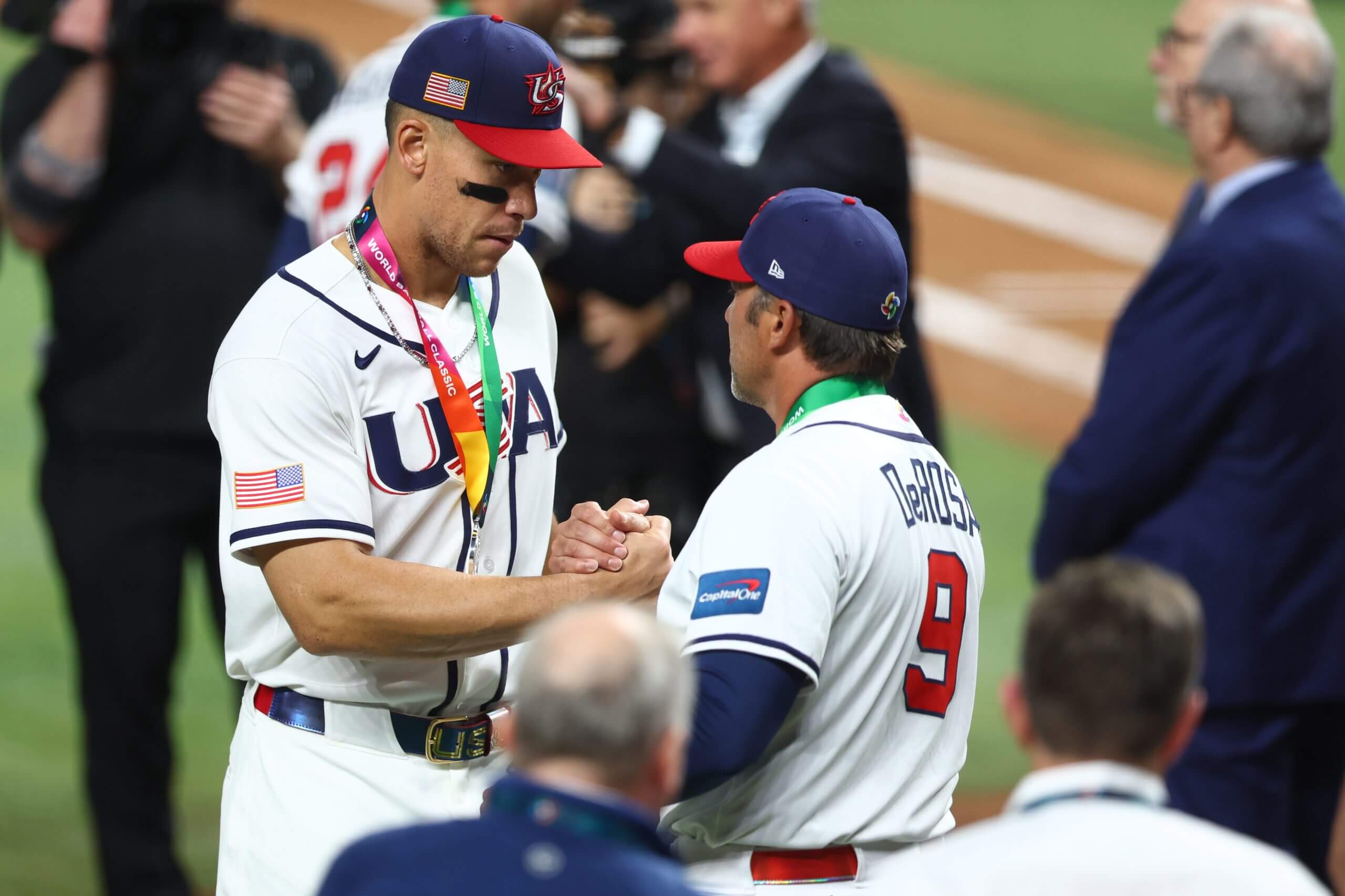
Aaron Judge and Mark DeRosa put together a loaded roster, but didn’t get the result they wanted. (Megan Briggs / Getty Images)
Why did USA Baseball select Mark DeRosa for 2023 anyway, when the strategy of recruiting a recently-retired manager had given USA a title in 2017 with Jim Leyland? Why not have someone like Bruce Bochy as skipper going forward? — Dan G.
DeRosa took a lot of heat for his comments before Team USA’s loss to Team Italy, when he went on MLB Network and spoke as if his team had already qualified for the quarterfinals. Of course, the only reason anyone heard about that, which occurred during a random mid-day interview, is because the Americans were getting blitzed by the Azzurri and sleuths on the Internet found the clip. And then it got even more attention because MLB Network pulled the clip, which embarrassed the league. The Streisand effect remains undefeated.
And, hey, fair enough. DeRosa said he misspoke. I’ve also been told that folks within Team USA informed him of the precise tiebreaker rules soon after, so DeRosa wasn’t flying blind into the game. But part of the job of being a manager is public relations, and being the face of an organization. And the face that Team USA projected going into the game against Italy was one that said “We’ve got this in the bag.” When they got smashed, they had to wear it, DeRosa especially. That’s just how the business works. That’s why the tickets cost money.
But the reason DeRosa was hired as the manager, and the reason why Team USA recovered from that loss to Italy, is because of the talent assembled on that roster. The primary responsibility of the Team USA manager is not bullpen usage or lineup construction. It is recruiting. During his two stints at the helm, DeRosa has excelled at convincing the best American players to sign up for the WBC. His energy and enthusiasm for that task is why Team USA put him in charge.
Again, we return to the unclear meaning of this tournament to American players. Part of DeRosa’s job is cajoling them into coming aboard. He got Mike Trout to captain the 2023 squad. He brought on Aaron Judge to fill that role this time around. Neither had ever participated before.
Perhaps in time, whenever this tournament returns, the recruiting will matter less. Maybe American players will be just as excited to represent their country as the Venezuelans or the Dominicans or the Japanese. And if that happens, DeRosa deserves credit for putting together stacked rosters that set such an example for the younger generation.
Was the rotation order of Webb, Skubal, Skenes, McLean a managerial decision or was it part of the give-and-take with the MLB teams to keep their players on a specific schedule for Opening Day? If USA was serious about the WBC, wouldn’t they have held off on using Skubal until Mexico or Italy? — Craig R.
Indeed, if Team USA could maximize its roster, Tarik Skubal would have been lined up to take out the left-handed hitters on Team Italy, rather than cruise through the less accomplished lineup of Great Britain. But, as you suggested, these assignments require discussion with both the teams and the players. Teams are willing to let players take part in the WBC, but they get irritable if that participation hampers preparation for the season. So part of the deal with Skubal playing for Team USA is that he and the Tigers wanted him to stay on track for Opening Day with Detroit. That was why they used the schedule they did.
Let’s talk about some other stuff!
The bargaining corner
Is there a chance the players soften their stance on a salary cap if the owners let them have free agency at five years? That would be a win-win for owners to get a salary cap-floor system, but with free agency earlier for players when they are closer to their prime years. And maybe the players get more early extensions with one less contentious arbitration year battle. — Mike B.
Here is the answer from the MLBPA on any suggestion of a salary cap: No. And here is what it would take to get them to budge off that stance: Nothing, so stop asking. But, of course, the owners are going to continue to push for it, and that conflict will be the story of this coming winter. And probably the spring. And hopefully not the summer. And if it is the story of the next winter, then I’ll probably be writing about college football or something.
It is true, as you say, that this theoretical exchange would be a victory for the owners. But from the union’s perspective, they would not view earlier entry into a free-agent system under a hard cap to be a victory. Because they feel that a free-agent system that includes a hard cap is not actually free agency. They would not trade the current setup for earlier access to a new system that sets artificial limitations on what the owners can spend. Yes, players might get paid earlier — but the union believes they would get paid less. They say they aren’t willing to make that trade.
For as much as players complain about the perceived injustice of teams leveling criticism at the hearings, arbitration is good for labor. It might be the crowning achievement of Marvin Miller’s tenure leading the union. They built a system that grants players the chance to receive raises based on how their performance stacks up against their predecessors and forces teams to cooperate. The owners would love to get rid of it.
Actual baseball discussion
Do the Cardinals have a shot at the Wild Card this year? — Pa L.
FanGraphs gives St. Louis an 8.8 percent chance of making the postseason, which feels reasonable to me. They are projected to be one of the worst teams in baseball, and that also feels reasonable.
I still think Milwaukee is the team to beat in the National League Central, although it will be hard for them to top last year’s 97 wins (and 99-win Pythagorean record). And the addition of Alex Bregman improved the Cubs to the degree that I will certainly be in the minority when I pick the Brewers to win the division. Not sold on the Pirates, not interested in the Reds.
And, to be honest, I haven’t spent much time this winter thinking about the Cardinals. Then again, they weren’t making moves with the goal of being relevant in 2026. Chaim Bloom shed a bunch of veteran players and salary as part of a much-needed reset. And there is enough talent on the roster that if you squint, you can foresee St. Louis surging above .500. But that would likely require JJ Wetherholt to debut as a star, Masyn Winn to level up and Jordan Walker to put it all together. Not impossible, just hard to bank upon.