
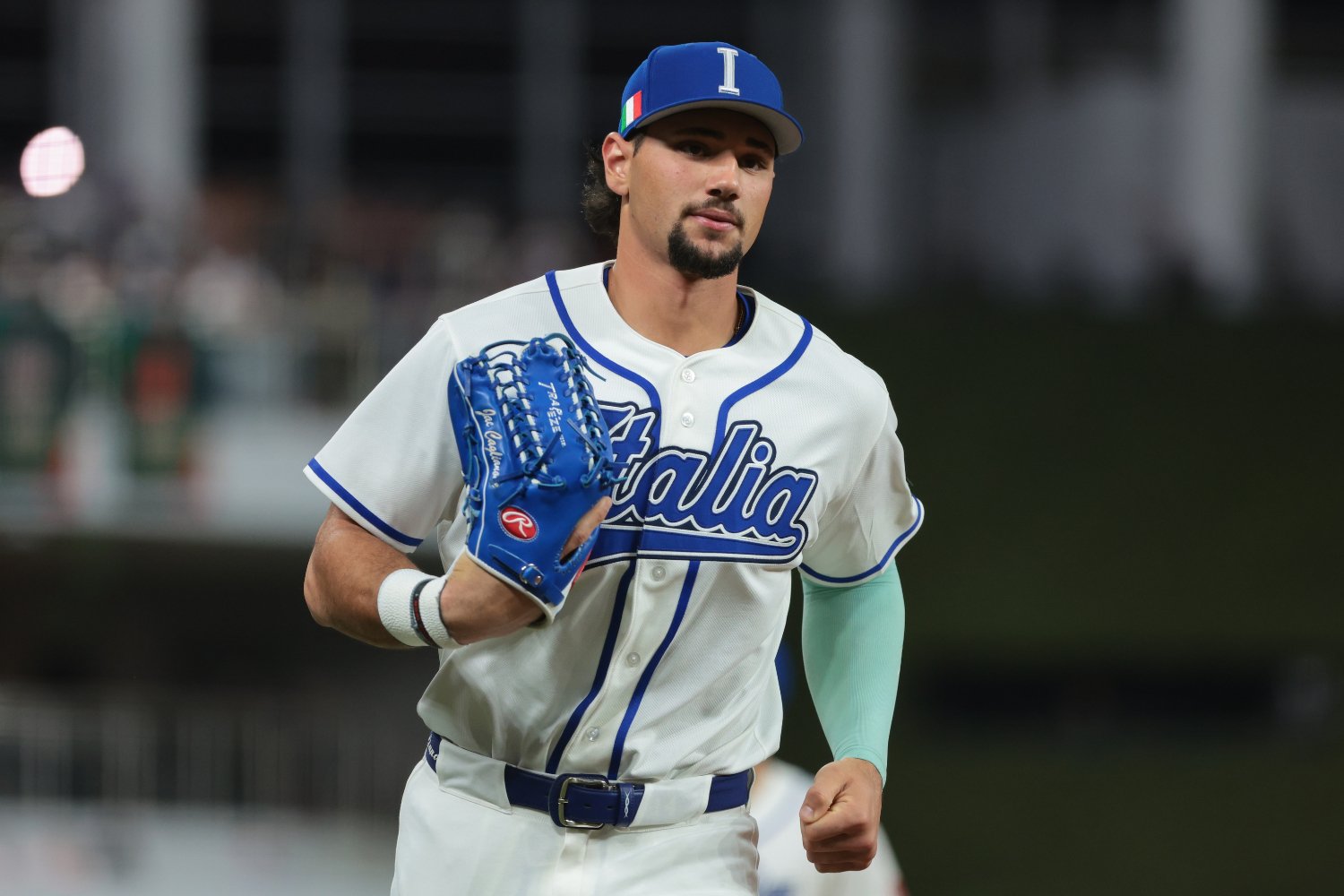
Without a doubt, one of the biggest beneficiaries from the World Baseball Classic may be Jac Caglianone, the projected Opening Day right fielder for the Kansas City Royals.
Team Italy’s dream run ended on Monday night, as they lost to Team Venezuela 4-2 in Miami. That sets up a massive WBC championship matchup between Venezuela and Team USA, which is trying to win its first WBC since 2017.
While Team Italy’s journey ended in the semi-final, their stellar performance allowed Caglianone to get some much-needed at-bats against good competition. There was some worry initially that Caglianone’s absence from the Royals camp due to the WBC could affect his work with the Royals’ new assistant hitting coaches. However, if anything, he showed the same kind of approach in the WBC that he did in Cactus League play, which should bode well for him with Opening Day roughly eight days away.
Let’s explore how Caglianone did this spring, the changes he made from his rookie year with the Royals, and what fans can expect from the promising slugger this season.
Caglianone Showed Progress in Arizona and WBC
Caglianone didn’t get a whole lot of plate appearances in Cactus League play before reporting to Italy for the WBC. That said, his small sample was stellar, with him showing growth in the right areas offensively.
In six games and 20 plate appearances in Arizona, Caglianone slashed .400/.550/.733 with a 1.2833 OPS. He only struck out in 15.5% of at-bats and had a walk rate of 25.5%. Furthermore, the batted-ball metrics were excellent, as he ranked in the upper percentiles in 90th EV, Max EV, and xwOBA, as seen in his Statcast percentiles below.
.png.0556c0b99d09796405c94095b935d4d2.png)
The power has always been Caglianone’s calling card, especially in Spring Training. Last spring, he posted a 25% barrel rate, 50% hard-hit rate, and .667 ISO. However, the plate discipline was a lot more questionable last season in Arizona.
In 23 plate appearances last spring, Caglianone had a swinging-strike rate of 13%, a swing% of 50%, and an O-Swing% of 34.1%. That hurt him in his transition to the Major Leagues, as his over-eager approach was exposed last season. That said, it’s been a different story this spring, as the former Florida Gator has shown a more discerning approach at the plate. His swinging-strike rate is down to 10.3%, his swing% is 37.9%, and his O-Swing% is 23.4%. As a result, his O-Swing% ranks in the 67th percentile, a major improvement from his mark last spring.
As a result, his better pitch selection has led to more pulling of the ball than a spring ago. His pull% is 42.3%, which is much better than his 21.4% pull% last spring. He still needs to work on launching the ball better, as his pull air% of 15.4% is 6 percentage points lower than a year ago. That said, it seems like Cags is seeing the ball better at the plate, which shows the progress he has made since his Royals debut.
In the WBC, it’s been much of the same for Caglianone with Italy.
In 14 at-bats, he slashed .286/.500/.571 with a 1.071 OPS. He had five walks to four strikeouts, scored six runs, collected four RBI, and launched a home run against Ryan Yarbrough of Team USA in pool play.
While he had only one home run, Caglianone had a patient approach that was valuable to Team Italy in the middle to lower end of the lineup. It seemed like he wasn’t used as an everyday player initially (he sat out Italy’s second game of pool play), but after his strong performance against Team USA, manager Francisco Cervelli made Caglianone a mainstay in the Italian lineup for the remainder of the WBC. Caglianone’s .500 OBP was the third-best mark of Italian players, and 1.071 OPS ranked 7th.
Issues With Chase and Launching the Ball
It was a tough MLB debut for Caglianone in 2025. In 62 games and 232 plate appearances, he slashed .157/.237/.295 with a .532 OPS. He showed some solid exit velocity and hard-hit ability, but he failed to launch the ball and struggled with chasing out of the zone, as illustrated in his TJ Stats Statcast summary below.
.png.0805f95a0e1f9ae9013028c980051479.png)
Last year, Caglianone ranked in the 8th percentile in O-Swing% and 71st percentile in Swing%. It’s been the opposite story this spring, both in the Cactus League and the WBC competition. That is an encouraging sign that Caglianone is not only developing better pitch recognition but is relaxing and not pressing at the plate, something he struggled with in 2025.
The main area of focus will be Caglianone launching the ball, as his 30.4% LA Sweet-Spot% ranked in the 20th percentile last year. We haven’t seen a ton of progress in this area, as his 26.9% LA Sweet-Spot% this spring is actually lower than his mark in the 2025 regular season. That said, it is such a small sample, so some time for adjustment may be needed, especially for a hitter as talented as Caglianone.
When looking at his radial chart from last year via Savant, he hit so many balls on the ground, both of the fielding out and base hit variety.
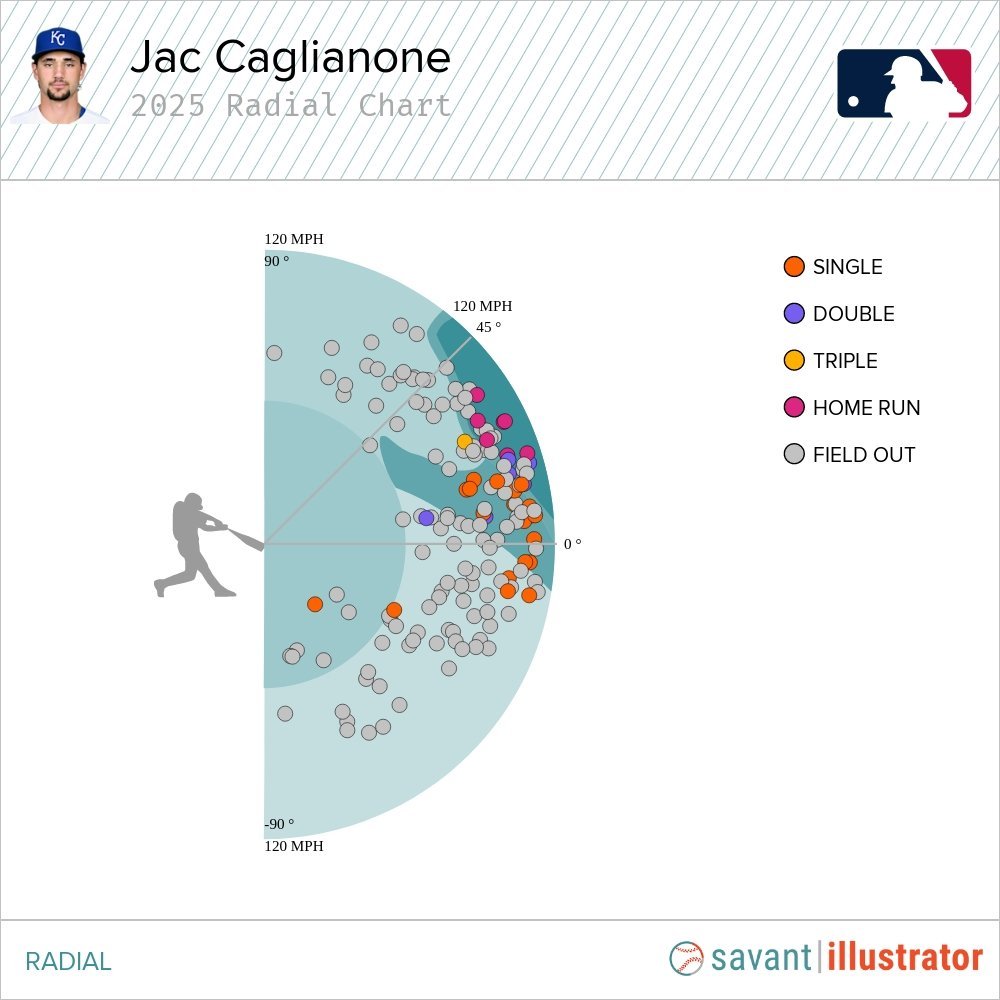
For a hitter with elite exit velocity and hard-hit skills, that needs to improve. He has been pulling the ball better in the air this spring, as his 15.4% pull air% is 3.4% higher than his regular-season mark last year. His 9.0-degree average launch angle is also 4.9 degrees better than his average launch angle from his Royals debut. Thus, baby steps are being made for Caglianone this spring, which is promising.
Another promising development for Calgianone is his gradual improvement in Ideal Angle% over the course of the season. Below is the definition of Ideal Attack Angle and why it’s important, according to MLB.com.
Quote
A hitter’s ideal attack angle rate is the percentage of his competitive swings that fall within the 5-20° attack angle range…Swings in the ideal attack angle range are much more likely to produce line drives and fly balls, resulting in significantly higher slugging percentage and more extra-base hits.
Hitters with high ideal attack angle rates include Alex Bregman (69% of competitive swings in 2024), Kyle Schwarber (67%), José Ramírez (64%) and Juan Soto (61%).
Note that ideal attack angle rate is largely reflective of the hitter’s timing. The hitter’s attack angle is constantly changing throughout the course of the swing. If the hitter’s swing passes through the ideal attack angle range too early or too late, he is less likely to make productive contact with the pitch.
Here’s a look at Caglianone’s Ideal Attack Angle rolling chart from last year, via Savant.
.png.d168d05e2177b2d12692fd147b5f8069.png)
Caglianone showed some initial progress, but hit a wall around the 150th to 225th competitive swing range. However, after that 225th swing, he ended up seeing a positive Ideal Angle% trend and ended up being an above-average hitter in this category by the conclusion of the season. Caglianone, carrying this positive trend into 2026, will help him get off to a much better start in his sophomore season with the Royals.
Final Thoughts on Caglianone’s Spring
The Royals do not need Caglianone to be a “savior” of this Royals lineup, as was the case last June when they called him up to the big leagues.
The top of Kansas City’s lineup is well-established with Bobby Witt Jr., Maikel Garcia, Vinnie Pasquantino, and Salvador Perez. These four guys will carry the Royals offensively and should be due for strong years, even if one or two of them regress. Furthermore, the floor of this Royals lineup is better with Jonathan India and Michael Massey looking to bounce back, and newcomers Isaac Collins and Starling Marte giving Kansas City some professional at-bats at the bottom of the lineup. Lastly, don’t forget Carter Jensen, who had a sensational rookie campaign in September and has been looking good this spring with an .880 OPS in 32 plate appearances.
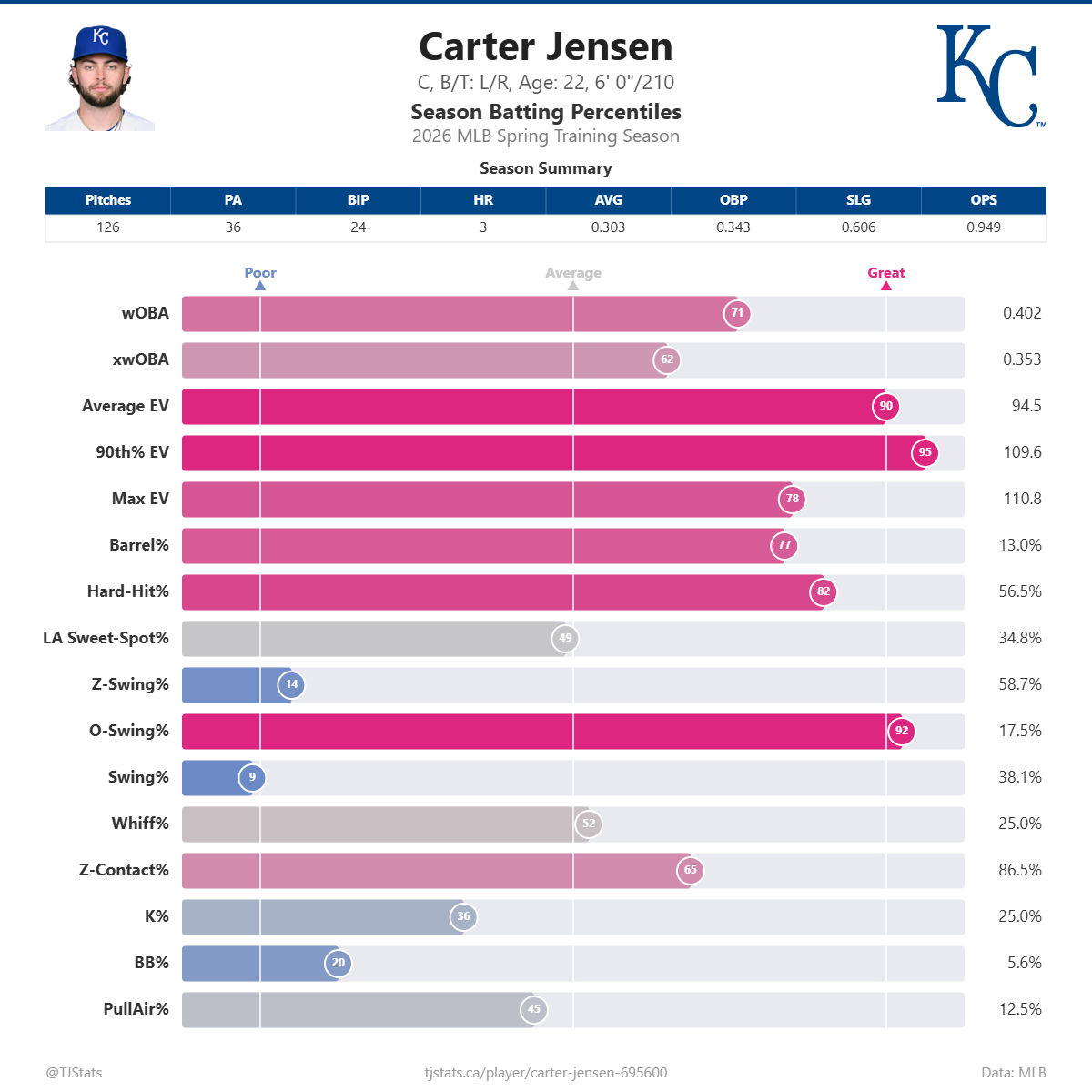
In addition to posting solid Statcast percentiles, especially in terms of exit velocity, barrel rate, hard-hit rate, and O-Swing%, he has launched three home runs this spring. That included this 438-foot one below from a few days ago against the Diamondbacks.
Thus, the Royals need Cags to do what he’s been doing this spring with the Royals and Italy. If he can be a solid bat in the middle of the lineup, Kansas City will be more than happy.
Here are a few projections for Caglianone in 2026:
ATC: 496 plate appearances, 19 home runs, 58 runs scored, 64 RBI, 100 wRC+
The BAT X: 496 plate appearances, 16 home runs, 56 runs scored, 60 RBI, 90 wRC+
ZiPS: 524 plate appearances, 23 home runs, 64 runs scored, 71 RBI, 109 wRC+
If Caglianone can produce something in the range of those three projections, not only will the Royals be a playoff team, but they will have a player in Caglianone who may be worth a long-term extension at the conclusion of the 2026 season.