
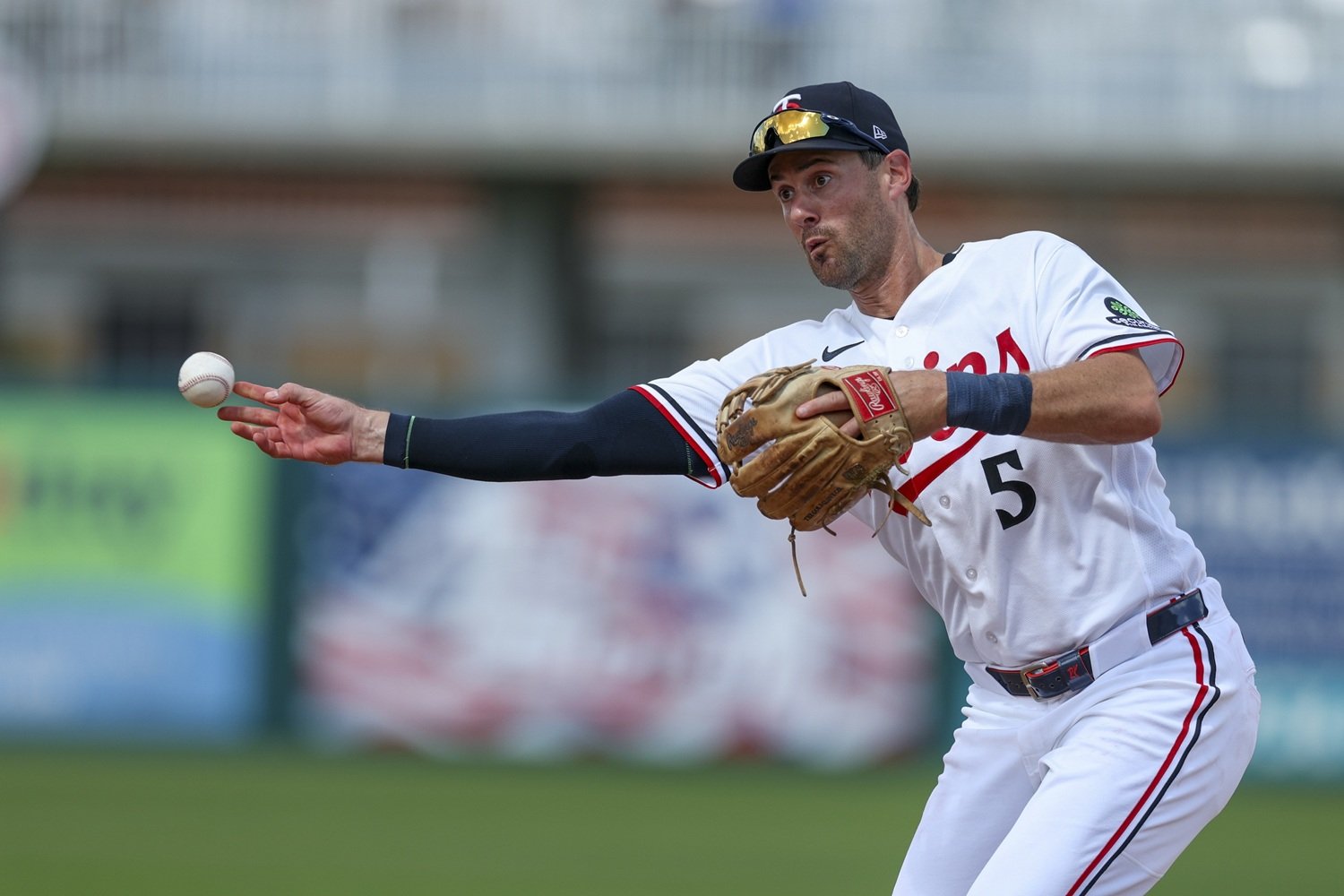
Through 34 plate appearances this spring, Ryan Kreidler has hit .133/.235/.233, with a 27 wRC+ and 32.4% strikeout rate. After posting an 11 wRC+ over 211 plate appearances with the Detroit Tigers the past four seasons, the 28-year-old’s offensive ineptitude doesn’t come as a surprise; it’s an understood cost of being in the Ryan Kreidler business. His ability to hit wasn’t what led former Minnesota Twins president of baseball operations Derek Falvey to claim Kreidler off waivers last October. Instead, it was his plus glove and defensive versatility, two traits that have been on full display this preseason.
Over 13 games, Kreidler has appeared five times at third base; four times at shortstop; three in center field; and once in right. Despite not yet playing the positions, he would also be serviceable in left field and at second base, making him a true super-utility player. Kreidler will never be the hitter Willi Castro was during his Twins tenure. His edge over Castro, rather, is that he provides plus value at every position he plays, including the positions highest on the defensive spectrum: center field and shortstop.
As things stand, Kreidler is favored to win one of Minnesota’s four open bench spots, beating out Tristan Gray and Orlando Arcia in the club’s backup shortstop competition. Kreidler is projected to earn the nod due to his aforementioned defensive flexibility and his plus glove. There’s more than the usual amount of lost offense when a team rosters Kreidler, though. Exactly how lousy a stick can the Twins tolerate?
Two players jump to mind upon being asked this question: West Sacramento Athletics center fielder Denzel Clarke and Houston Astros shortstop Nick Allen. To make up for a 75 wRC+ over 159 plate appearances for West Sacramento last season, Clarke was one of the best defensive center fielders in baseball, netting 1.3 Wins Above Replacement at FanGraphs (fWAR) almost exclusively on the strength of his fielding. Allen was one of the best defensive shortstops in the game while playing for Atlanta in 2025, generating 17 Outs Above Average (OAA) at the position highest on the defensive spectrum. Like Clarke, however, Allen struggled mightily at the plate, with a heinous 53 wRC+ over 416 plate appearances.
Clarke and Allen are outliers. Still, it’s vital to note their 2025 campaigns, as there was fairly little debate whether Clarke’s or Allen’s respective clubs would continue rostering them last season, proving that team decision-makers can have a high tolerance for offensive ineptitude if it comes with plus defense at premier positions. Obviously, Kreidler is not the elite-level defender Clarke is in center, or Allen is at short. Yet, given that Kreidler can play a plus third, second, left, right, and most importantly center and short, the 28-year-old functionally provides the same amount of value as Clarke and Allen, both of whom are locked in at one position.
Alas, we have to keep saying it: Kreidler even pales in comparison with Clarke and Allen as hitters. As mentioned earlier, Clarke (75 wRC+) and Allen (53 wRC+) combined to create a 64 wRC+ last season, which is 36% below the league average. Kreidler’s career wRC+ of 11 is 53 points below that, making him the worst-performing hitter (766 out of 766) with at least 200 plate appearances this decade. Again, Kreidler has technically performed better at the plate this spring, generating a 27 wRC+, including an opposite-field home run off Philadelphia Phillies reliever Jonathan Hernández on Mar. 8. Still, defensive versatility can make up for only so much offensive ineptitude. He’s well below that line right now.
Defensive wizardry and versatility go a long way, but as Bill James once said, if you shake a tree in Triple-A, a good glove guy will fall out. Teams pay for offense because it’s the harder side of the ledger to bolster for position players. If Kreidler keeps wearing sneakers to a snowstorm every time he steps into the batter’s box, his flexibility won’t keep him around very long.