

As stable as the collective lineup has been for the Chicago Cubs over the last handful of seasons, third base has been a position more commonly associated with turnover than performance. It was Christopher Morel before it was Isaac Paredes before it was a smattering of below average options — Gage Workman, Jon Berti, and Vidal Bruján among them — before Matt Shaw eventually established himself as something resembling a viable option at the spot down the stretch. However, even much of Shaw’s value was wrapped up in his glove, with the bat still needing levels of development before team leadership would be inclined to trust him as an everyday player.
Which was likely a factor in why the team chose to pursue Alex Bregman this winter. Not that it was their first of him. But in signing Bregman to a five-year deal, the team was able to establish actual stability at third base moving forward. A steady player on both sides of the ball, Bregman projects for 94 percent of the time at third, bringing a blend of performance and intangible qualities that appear poised to bring the Cubs from the depths of the league rankings in positional performance to among its best.
Chicago Cubs Third Baseman At A Glance
Starter: Alex Bregman
Backup: Matt Shaw
Depth & Prospects: Scott Kingery, BJ Murray, Jonathon Long, Pedro Ramirez
fWAR Ranking Last Year: 27th (0.0)
fWAR Projection This Year: 6th (3.8)
The Good
The positive outlook of the position for 2026 centers almost exclusively around Alex Bregman. The fielding remains solid, the intangibles are there, and he’s long demonstrated an approach that allows him to be aggressive while also posting strong figures in both strikeout and walk totals. Bregman was above the 90th percentile in both chase and whiff rates last year and also sat safely in the 88th in K% (14.1 percent). When the team signed him, though, one of the immediate concerns was how poor Wrigley Field has been as an environment for right-handed hitters. Bregman’s hit distribution should help to quell those concerns rather quickly:
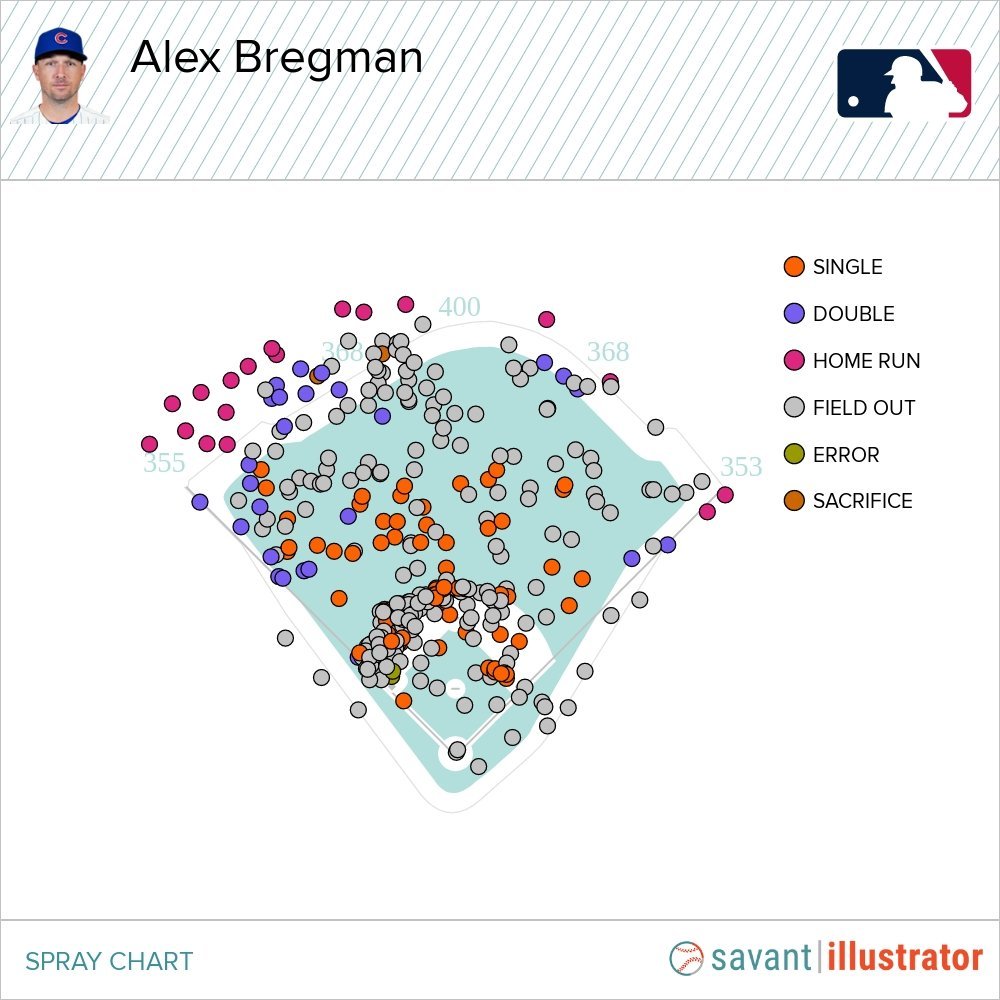
That’s Bregman’s spray chart overlayed with Wrigley Field. Getting away from the Green Monster in Fenway (and the Crawford Boxes in Houston) is scary at a glance. But the most important aspect is that, unlike someone like Isaac Paredes, Bregman brings a distribution that falls much more into the gaps than working as a dead-pull hitter. Combine that with a penchant for elevation (23.5 PullAIR% for his career), and you have someone who should be able to overcome the negative effects of his new home park.
The Bad
The absence of depth remains a concern. Bregman on his own is a fine player and raises the floor of the position significantly. However, he also missed time with a quad injury last year. That injury limited him to 114 games. Should anything like that befall him in 2026, it presents a rather precarious situation for the Cubs.
In such a doomsday scenario, that would force Shaw back into regular duty. We know he’d be fine defensively, though there’s no certainty as to where the bat will land in Year 2 of his major-league action. That would, in turn, sap some juice from the bench, where Shaw is projected to open the year in an effort to stretch out his versatility. The minor leagues don’t offer a lot of additional hope on that front, either. Scott Kingery is a versatile player with virtually no bat to speak of. He also has an opt-out included in his minor-league deal down the line. Jonathon Long is much more first baseman than third baseman at this point. BJ Murray had to repeat Double-A in 2025 after a brutal time in Iowa the previous year. Pedro Ramirez is in Double-A to start the year.
It feels like something of a positive that the “bad” of the position would only manifest in the event of a long-term injury to an otherwise above-average player. Nevertheless, the specter looming is that lack of depth behind him.
The Bottom Line
Unlike last year, where the position was saved only by the glove of Matt Shaw, third base stands to be one of the better aspects of the Cubs’ lineup in 2026. Alex Bregman doesn’t offer as much power as he once did, but there’s something to be said for the remarkable amount of stability provided by his blend of approach, squared-up contact, and quality defense. Subsequently, it flips Matt Shaw into a utility player that strengthens the bench in a way that was sorely needed coming off last year’s rotating cast of reserves.