
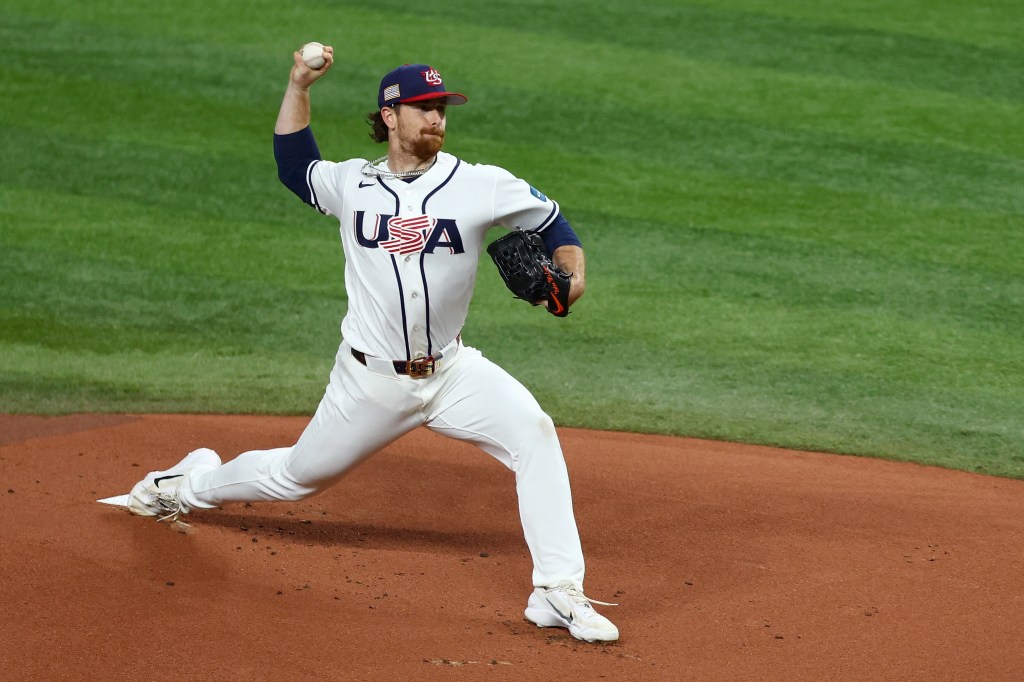
Much was made about Team USA’s decision to pitch Nolan McLean in the World Baseball Classic title game Tuesday night, especially since the rookie had all of eight Major League starts under his belt. However, had the Mets made the postseason last fall, they would have made a similar decision.
McLean was lined up for the Mets to start a potential NL Wild Card series. Of course, that’s not exactly the same as facing a team with an entire country behind it as he did against Venezuela, the eventual champions of the 2026 WBC, but it does speak to how the Mets view the 24-year-old right-hander. As manager Carlos Mendoza put it last month, there is no moment that is too big for McLean.
Here’s what the Mets can take away from the World Baseball Classic.
LIGHTNING McLEAN
Had McLean made that postseason start last October, the Mets might have looked at his start in the tournament finale differently, though they still would have seen it as a positive experience. But since the Mets missed the playoffs, this game was an opportunity for him to pitch in a championship atmosphere as a professional. The Oklahoma State product had to navigate a lineup and execute his game plan in front of a rowdy crowd that was largely made up of fans rooting for the opposing team.
Again, something the Mets knew he could handle when they lined him up to open a Wild Card series.
This was a different crowd than one he would have faced at Wrigley Field or Petco Park. There were drums and noisemakers in a domed stadium where the sound carries. There was an entire country behind the hitters McLean was facing. No offense to the Americans, but by the time the NCAA Tournament gets into full swing later this week, McLean’s country will be more focused on their brackets than baseball.
Since 2015, nearly 8 million Venezuelans have been displaced globally because of socioeconomic conditions in the country. It’s considered one of the largest humanitarian crises in South America in recent history. The country needed an emotional win. And not for nothing, but the country’s baseball prowess has long been overshadowed by the success of other Caribbean nations, like the Dominican Republic. The energy and the eagerness practically radiated through television screens around the world.
Now, no one can deny Venezuela’s legitimacy in the sport. But the sport can’t deny McLean’s legitimacy either.
He gave up two earned runs on four hits, walked one and struck out four over four innings, holding his own against an aggressive lineup. Since it’s still spring, the Mets wanted him to get his pitch count up during the tournament. Throwing 63 pitches in a do-or-die championship game is going to be more challenging mentally and physically than throwing 63 against the St. Louis Cardinals’ B-squad in a Grapefruit League game.
McLean will be an NL Rookie of the Year candidate this season, and he’ll be better for having played on one of the game’s biggest and most unique stages.
EMBRACE THE PASSION
The Mets have a prime opportunity to reach a new fanbase. Since 2022, tens of thousands of Venezuelans have settled in Queens. The club has a Venezuelan manager in Mendoza, and two Venezuelan catchers, Francisco Alvarez and Luis Torrens. In the same way the Yankees have long benefitted from the Dominican presence in the Bronx, the Mets can benefit from Venezuelans in Queens.
The Mets have long celebrated the various cultures of the World’s Borough in various ways, be it spotlighting local restaurants at Citi Field, partnering with area charities, or holding heritage nights. In recent years, the club has done a good job of bringing in Puerto Rican fans. Shortstop Francisco Lindor and former closer Edwin Diaz have played starring roles, and owner Alex Cohen’s Puerto Rican father, Ralph, is a popular figure around Citi Field on game days.
Expanding that outreach to Venezuelans will bring in new, younger fans who can grow with the team, as well as families looking for community. The club should embrace elements of Venezuelan culture and Caribbean culture by integrating things like tambores music, and allowing fans to bring drums to Citi Field.
IT’S TIME FOR ABS
Let’s be clear on something: The umpires have an extremely difficult job, and it’s not getting any easier with fastballs that are well over 100 MPH and devastating breaking pitches. But a game can’t end on a missed call like it did in the US-Dominican Republic semifinal game.
The WBC has not yet adopted the automated ball-strike system, but it’s coming to the big leagues this season and it’s clear that it’s needed more than ever at this point in time.
The ABS has been controversial in the minor leagues and it will undoubtedly be controversial in the big leagues. The sport doesn’t take kindly to change, and it almost has to be forced at times. But when an important game is decided by a missed call, it’s a bad look for all involved. It almost erases the excitement of what took place before the ninth inning and it calls into question the integrity of the game.
The challenge system won’t take away the human element of the game, but it will do is keep everyone — hitters, pitchers, catchers and umpires — honest.