
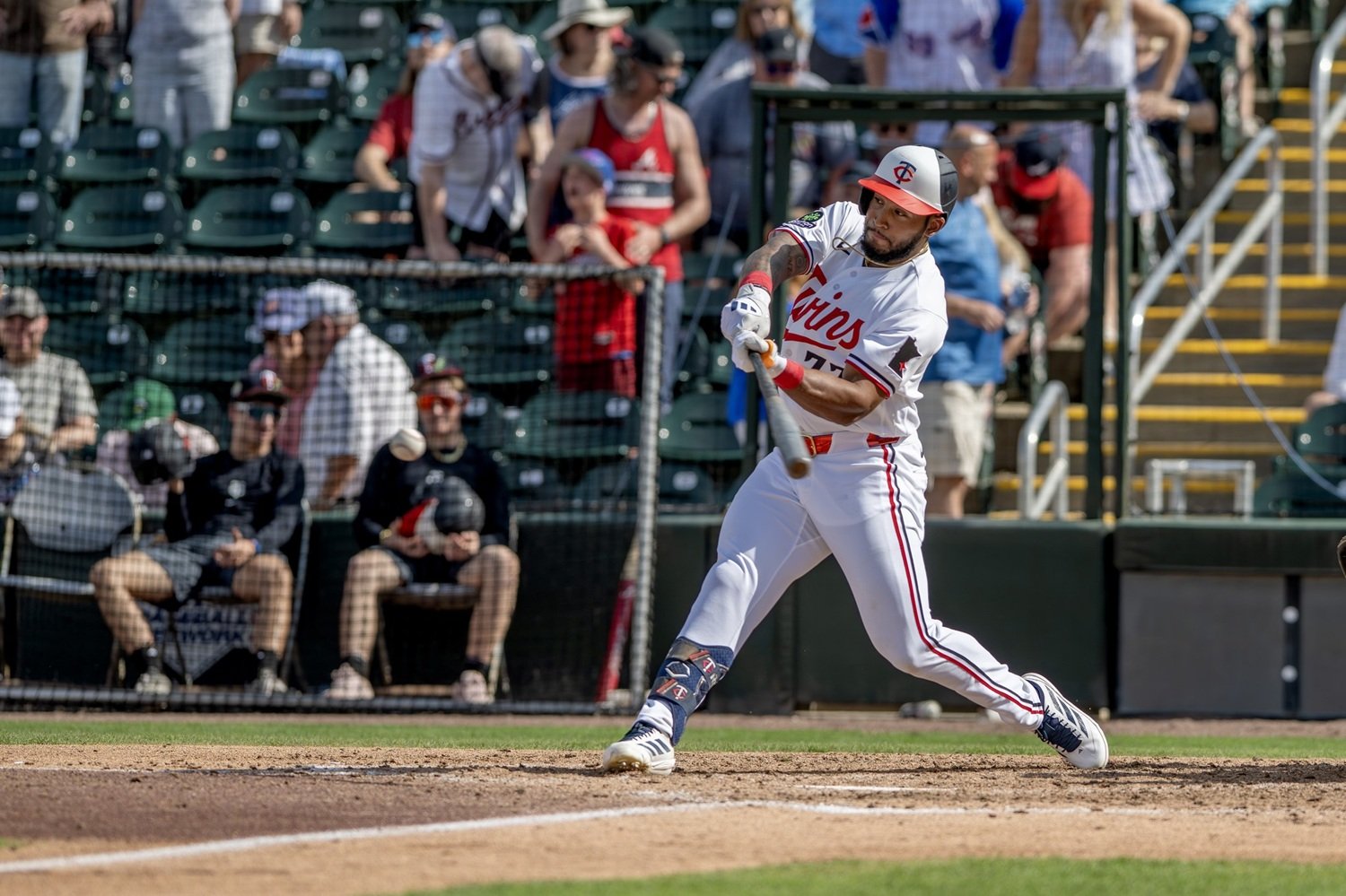
The Minnesota Twins may have sent Emmanuel Rodríguez to minor-league camp, but his spring performance made sure he did not leave quietly. In a camp filled with roster battles and final decisions, Rodríguez consistently stood out every time he stepped into the box, turning routine Grapefruit League at-bats into must-watch moments.
Even though Rodríguez didn’t make the big-league roster during camp, his spring performance ensured he remained a prominent topic of discussion. By showcasing some of the most impressive underlying metrics in the organization, he offered a reminder that his arrival in Minnesota is imminent.
According to MLB.com, Rodríguez, Twins Daily’s third-ranked prospect, was raking up to that point, with a 94-mph average exit velocity and 60% hard-hit rate in his spring games for the Twins. Those aren’t just good numbers. They’re indicators of a toolsy hitter squaring the ball up consistently, and they explain why Rodríguez generated so much buzz during camp.
One of the loudest moments came early in March, when Rodríguez showed just how much damage his bat can do. On March 9, the 23-year-old lefty crushed a double with an exit velocity of 114 mph. That number would have tied for the hardest-hit ball by any Twin during the 2025 season, matching a blast from Byron Buxton last August. That type of raw power is immediately noticeable. However, for Rodríguez, this power is just one element within a more nuanced offensive profile.
“There’s some bat speed there,” Twins manager Derek Shelton said. “Quite honestly, I thought he hit the (Feb. 22) homer off the end of the bat. When he hit it, it didn’t sound flush. I even said, ‘Oh, he didn’t get it.’ And it landed about 15 rows deep, so I don’t know if we should use me as the barometer.”
In addition to his power, Rodríguez used spring training to demonstrate his versatility. The Twins gave him playing time at all three outfield spots, providing experience that could prove valuable as the big-league roster deals with inevitable injuries over the course of the season.
On the bases and in the field, Rodríguez looks like a traditional athletic center fielder. He has averaged roughly 30 steals per 150 games in the minors and brings the range and arm strength to handle center or slide into a corner role without losing value.
At the plate, though, he becomes something entirely different. Rodríguez pairs his power with an extremely patient, selective approach. He rarely chases pitches outside the strike zone and is comfortable working deep into counts. That approach has led to an eye-popping 278 walks in just 295 minor-league games, good for a 21.7% walk rate.
It also comes with tradeoffs. Because Rodríguez often hits with two strikes and swings less frequently than most hitters, strikeouts are part of the package. He has fanned 389 times in the minors, posting a strikeout rate north of 30% while hitting .254. One has to wonder if his strikeouts will increase at the big-league level, and a lower batting average might sap his overall value.
This offensive and athletic profile is rare. While Rodríguez has some traits of power-hitting, high-walk sluggers, he uniquely combines this approach with the athleticism of a center fielder. That blend makes him incredibly intriguing—and somewhat difficult to project.
What is not difficult to project is the upside. Rodríguez owns a .424 on-base percentage and a .488 slugging percentage across five minor-league levels, posting an OPS of at least .840 at every stop. Few prospects can match that level of consistent production, while also flashing the kind of Statcast data he showed this spring.
As for the timeline, Rodríguez may be closer than some realize. After spending all of last season at Triple-A St. Paul, he is already a step ahead of fellow top prospects Walker Jenkins and Kaelen Culpepper in terms of proximity to the majors. If the Twins need a spark in the outfield at any point this season, Rodríguez will be one of the first names considered.
The questions are still there. Can he make enough contact against major-league pitching? Will pitchers challenge him differently once they realize how selective he is? Those answers will come with time.
What the Twins already know is this. Rodríguez brings elite underlying metrics, a disciplined approach, and enough power to change a game with one swing. If those traits translate, even partially, he has a chance to make a real impact in Minnesota before the 2026 season is over.
What stands out about Rodriguez’s spring Statcast data? Leave a comment and start the discussion.
Interested in learning more about the Minnesota Twins’ top prospects? Check out our comprehensive top prospects list that includes up-to-date stats, articles and videos about every prospect, scouting reports, and more!