
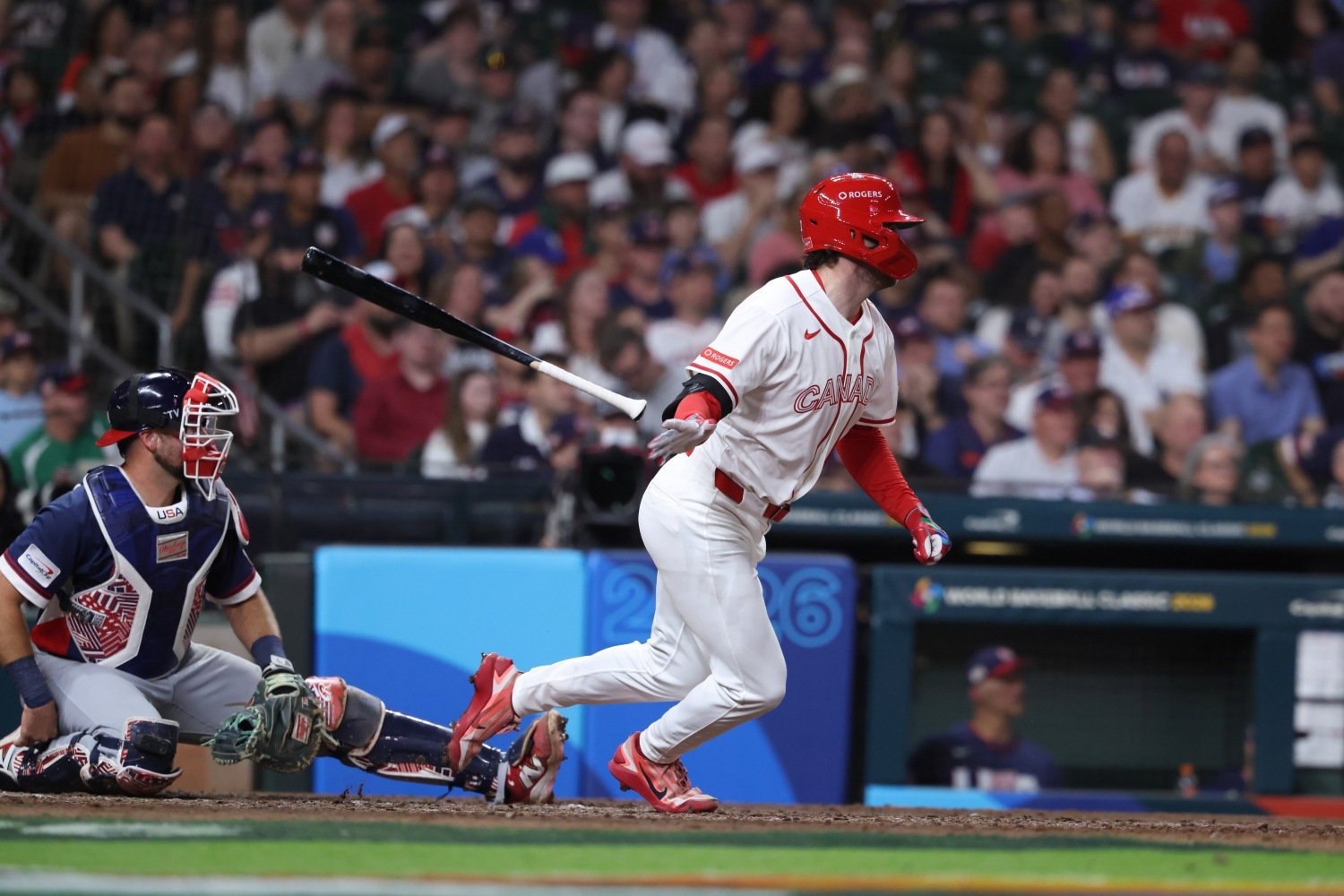
The Brewers track cage reps, live batting-practice reps, and game reps during spring training, to monitor the workloads of all of their position players. That continues even when a player leaves to participate in the World Baseball Classic; they check in daily and document as much as they can.
By their internal count, no member of the organization has gotten more reps this spring than Tyler Black. Even with the increased number of travel and off days inherent in the unfolding of the WBC, Black has kept getting chances, often batting near the top of the batting order during Team Canada’s first-ever run to the quarterfinals of the international tournament. Now, he’s back in camp, and he hit the ground running by appearing against the Dodgers on Monday and against the Mariners on Wednesday.
In game action (between the Cactus League and the WBC), Black has now seen 163 pitches. He’s also a high-volume user of the team’s Trajekt machines, and racked up considerable work early in camp by participating in live BPs and simulated games. And here’s the most important takeaway from that still-small sample of work: Black finally has some punch in his bat.
There are two major things holding Black back as a player. Firstly, he has little defensive value. He’s failed even to impress the team in his time at first base. Though he still got some time at second base for Team Canada, the Brewers don’t view him as a candidate to play that position or third base. He’ll be a first baseman, a corner outfielder and/or a designated hitter, to whatever extent he’s part of the team. Even when he plays a defensive position, though, he won’t help Milwaukee prevent runs.
With his value dependent upon his bat, then, there’s quite a bit of pressure on Black to find some power. Alas, that’s been the other major weakness in his game over the last two seasons. His 2023 breakout season as a prospect feels long ago, and in the time since, he’s been too light on power to deliver the punch even the Brewers (famously light on power and fine with it) demand from players like him. In 903 Triple-A plate appearances, he’s slugged just .425—a fine number if accumulated in the majors, but a sign of trouble in the hitter-friendly Triple-A territory.
Black does have an OBP of .383 during his time at that level, though, and broadly speaking, he shows enough contact skills and a sufficiently patient approach to sustain above-average OBPs even in the majors. It just wasn’t going to matter if he didn’t tap into some power.
Nor was that power in evidence, even under the hood. Black’s 90th-percentile exit velocities at Triple-A have been in the 101-102 MPH range the last two years, a figure that denotes power almost two full grades below the league average. In his brief stints with the Brewers, he’s shown below-average bat speed, to boot. No indicator suggested he was ready to generate significant power on contact in the majors, and he didn’t even make contact at a plus rate last year with the Sounds.
Black knew that. He put in work this winter with the same intent that has driven him to spend so much time in the box this spring: to find his opportunities to hurt the ball. It’s working, too. In a combined sample of just over 20 batted balls, Black’s 90th-percentile exit velocity this spring is 107 MPH. He’s already hit one ball harder than he did all last season, and he’s clustered several balls north of what was his EV90 in the past.
In spring, the samples are small; the environs (especially in Arizona) are conducive to hitting; and the competition is uneven. Still, Black wasn’t showing this capacity for driving the ball even in the minors before now. Hitting it hard as regularly as he has done so this spring alters his scouting report in a crucial way.
That doesn’t mean Black will push past any of Jake Bauers, Blake Perkins, Brandon Lockridge or even Jett Williams to claim a roster spot early in the season. The only player he’s clearly surpassed this spring is Akil Baddoo, who was brought in purely to serve as emergency depth, anyway. Nor does Black suddenly have a star-caliber ceiling. His new upside is more like a poor man’s Bauers, with the balance shifted slightly toward on-base skills at the expense of power.
Still, Black came to Arizona this spring running out of time to make an impression with the organization. He’s now done so. Whether it’s in Milwaukee or elsewhere, he’s gained a much firmer foothold on the ladder to the majors, and is materially more likely to break through as a big-leaguer this season. His chance could come soon, and he’s better-positioned to seize it when it comes, because he’s finally producing some pop.