
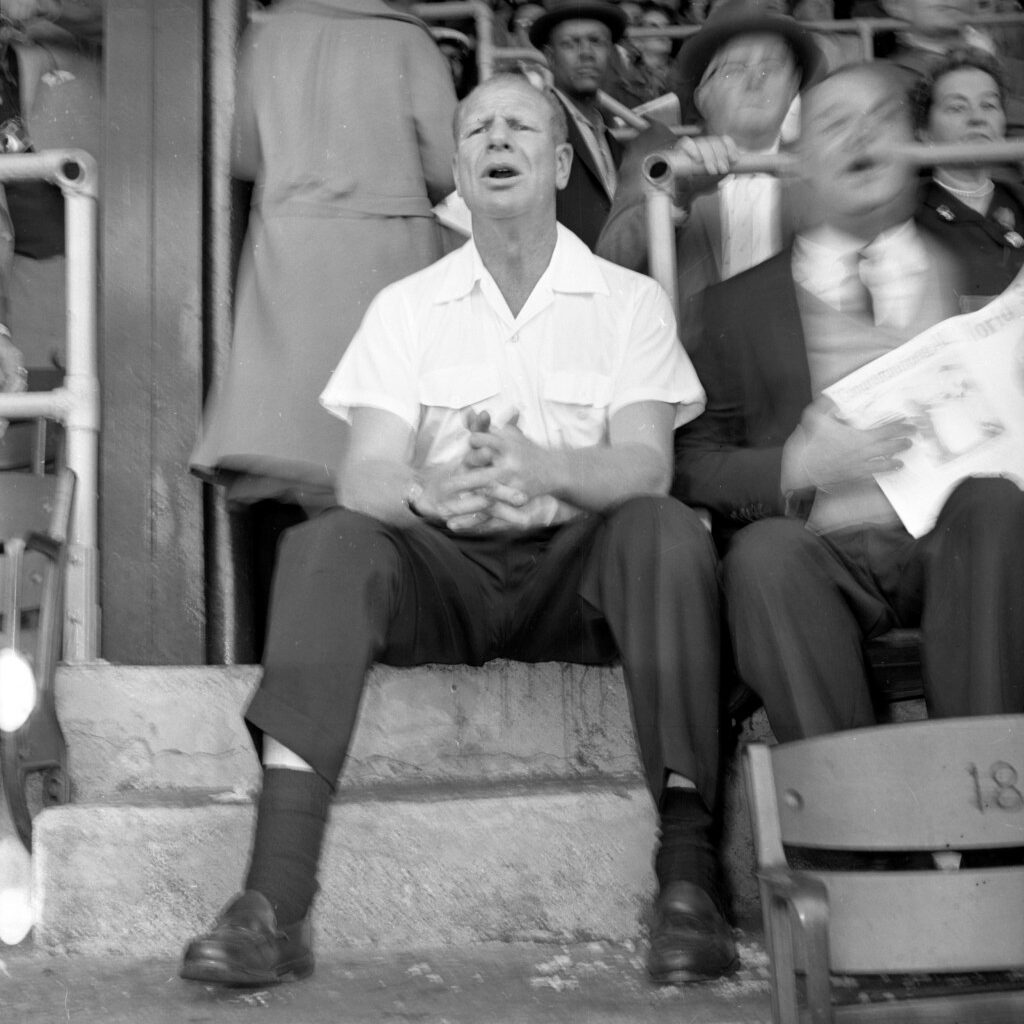
We all know that the Cubs and the White Sox are culturally distinct organisms: by location, fan base, ballpark atmosphere and, alas, budgets. But the two have one extraordinary thing in common, which should be celebrated as we approach baseball’s opening day. And that is the significant but underrecognized impact that William “Bill” Veeck Jr. played in the evolution of both franchises.
Wasn’t that the shameless promoter who, when he was owner of the St. Louis Browns, signed the 3-foot-7 Eddie Gaedel as a pinch hitter? Who allowed Browns fans to decide strategy, with “Grandstand Managers Night”? Who made the Sox play in short pants? Who added 56-year-old Minnie Minoso to the 1980 Sox roster? Yes, that’s the guy, but he was so much more than all that — to baseball, to Chicago and, in many ways, to American culture.
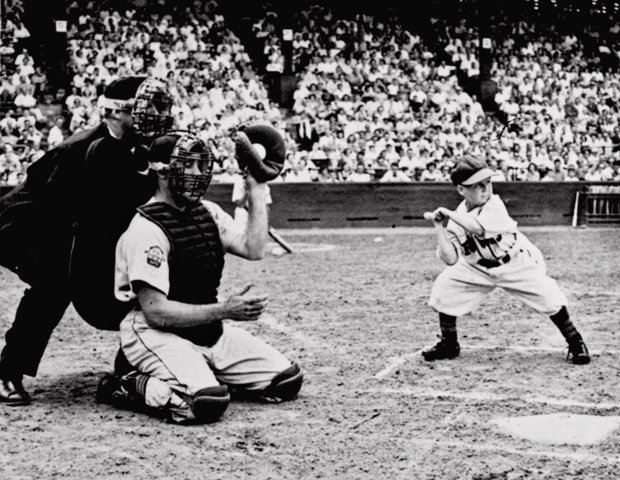 The St. Louis Browns’ Eddie Gaedel, a 3-foot-7 stuntman, pinch-hits in a game against the Detroit Tigers as umpire Ed Hurley and catcher Bob Swift look on at Sportsman’s Park in St. Louis on Aug. 19, 1951. Bill Veeck hired Gaedel for a one-time-only appearance as a pinch hitter. Gaedel wore uniform number 1/8 and bowed twice as he trotted down the first base line after a predictable base on balls. (AP)
A Hinsdale native, Veeck entered the major leagues in 1946 as the owner of the Cleveland Indians, where he moved the team to a newer ballpark, placed all of the team’s games on radio, hired Max Patkin, the future “Clown Prince of Baseball,” as a first base coach, and led the Indians to the 1948 World Series title. He later owned the St. Louis Browns, where he is credited with inventing the “Bat Day” promotion. “I try not to break the rules but merely to test their elasticity,” Veeck would later say.
Several years after selling the Browns, Veeck returned to Chicago in March 1959 to purchase a majority interest in the White Sox from a bitterly divided Comiskey family. In a magical first year of ownership, the team won the American League pennant, setting a new team attendance record. The team had another strong season in 1960, besting the 1959 attendance numbers. During these years, Veeck whitewashed Comiskey Park, added players’ names to the back of uniforms, built the picnic areas and constructed the now-famous exploding scoreboard. Veeck was forced to sell his ownership interest in 1961 due to ill health.
In 1976, Veeck returned to Chicago to repurchase a moribund Sox franchise. While this saved the team from being sold to Seattle interests, his encore performance was not an artistic success. The highlight was the historically enjoyable 1977 “South Side Hit Men” season. But the lowlights were many. He was substantially undercapitalized, which affected the on-field product. A radical uniform redesign attracted widespread ridicule, although the logo remains to this day. The disastrous 1979 “Disco Demolition” promotion stained his reputation and that of the Sox. Recasting Sox Park as the “World’s Largest Outdoor Saloon” damaged the ballpark experience.
Veeck ultimately sold in 1980 to a partnership that still controls the team.
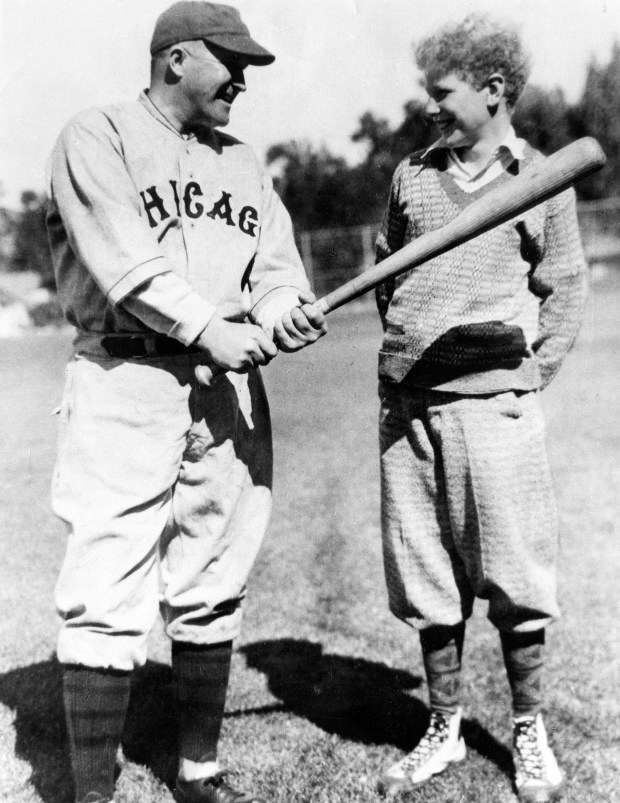 Bill Veeck Jr., right, and Joe McCarthy, manager of the Cubs, at spring training in 1928 while Veeck’s father, William Veeck Sr., was president of the Chicago Cubs. (Chicago Tribune historical photo)
But it is his little-known but impactful relationship with the Cubs that adds so much color to his Chicago legacy. Veeck’s father was a Cubs executive, and young Bill performed many odd jobs in Wrigley Field. Upon his father’s death in 1933, Cubs owner Philip K. Wrigley hired Bill as an office assistant, a title that quickly expanded to cover what we now know as “the fan experience.” In that role, Veeck played a major role in developing many of the most cherished elements of Wrigley Field: the reconstruction of the bleachers, the center field scoreboard and its system of flags, the brick wall in the outfield and, most notably, the 1937 planting of Boston ivy on those walls.
Flashback: Bill Veeck changed look of Wrigley, and it stood test of time
While generally loathed by his fellow owners, Veeck was enshrined in baseball’s Hall of Fame in 1991. His election certainly reflected his promotional genius and his many innovations, which are now widely accepted throughout the sport. But it also recognized his significant contributions to the nation’s social order. With the Indians, he signed Larry Doby as the first Black player in the American League. Veeck also signed 42-year-old Satchel Paige from the Negro Leagues, who was baseball’s oldest rookie and its first Black pitcher. Doby became the second Black manager in baseball when hired to lead the Sox in 1978. Veeck was also the only owner to testify on behalf of Curt Flood in Flood’s famous challenge to baseball’s antiquated “reserve clause.”
Veeck was, in many ways, pure Chicago. His statue would be as appropriate along Wrigley’s Gallagher Way as it would be at Sox park. His plaque at the Baseball Hall of Fame describes him as “a champion of the little guy” — a description Veeck himself would no doubt cherish. For who is “the little guy”? Pretty much the same person it was during Veeck’s time: the person who saves part of his or her paycheck to take the family to the ballpark; the person for whom baseball serves as the great, reliable refuge from the burdens of life.
As Veeck himself once said: “I have discovered in 20 years of moving around a ballpark that the knowledge of the game is usually in inverse proportion to the price of the seats.”
Michael Peregrine is a retired Chicago lawyer and a lifelong White Sox fan.
Submit a letter, of no more than 400 words, to the editor here or email letters@chicagotribune.com.