
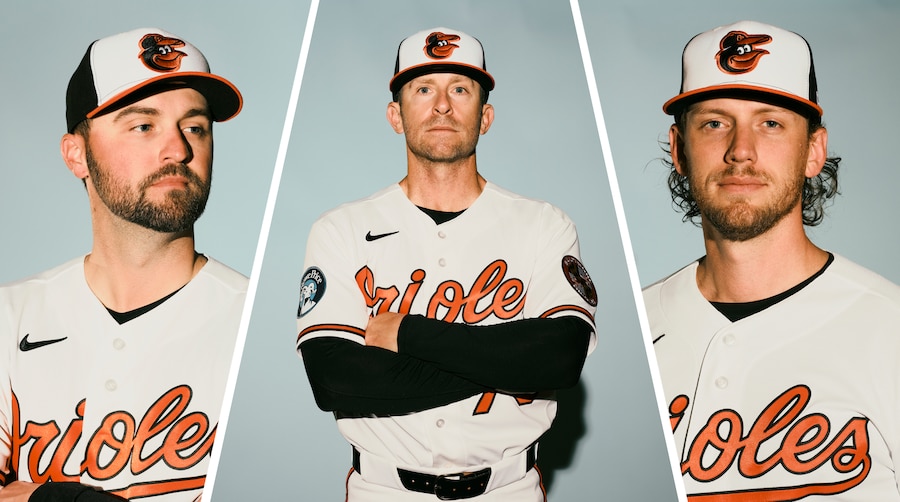
Nothing much changed for the Orioles’ coaches when last season mercifully ended in September. They’d known from Brandon Hyde’s dismissal in May that change was likely coming, and many handled the uncertainty once the season wrapped up and the club accelerated its staff overhaul by doing what they’d have done anyway.
They kept working.
“I’m going to continue to work until they cut my computer off and tell me I can’t come here anymore,” pitching coach Drew French said. “As a staff, we met with players over Zooms and we were having those meetings in terms of talking about development and what the plan was moving forward. I don’t really think for one second that we ever batted an eye that we were going to be back.”
It could be a boon for the Orioles in 2026 and beyond that, in a season when so much is different, the pitching group of French, assistant Mitch Plassmeyer and strategy coach Ryan Klimek was kept intact to build on the progress of the last couple of years.
“The next step [is] for us to continue to find these North Stars for what’s impactful to having success, whether it’s count leverage or altering or changing a pitch type for the sake of handling a certain bat side,” French said. “But I think we’re going to be better off knowing how to handle these conversations and the things that have worked, so we can just kind of cross those off, as this is like a big-ass science experiment. We know, with some of these guys, where to go with certain things, and we also don’t know with certain things. That was the beauty of this offseason — being very direct and very specific about what we’re after and then watching these guys self-organize and ask the right questions to get to those things. All those things are going to equal wins.”
More intimately than most of his peers in the coaching room, French understands what’s happening in other areas of the club, having joined the Orioles from Atlanta after the 2023 season to replace Chris Holt as pitching coach. Plassmeyer was an internal addition to the big league staff after serving as minor league pitching coordinator, while Klimek had been with the major league team for several seasons.
French knew, as the newcomer, there could be apprehension in how ideas were communicated, how roles developed within the group and how the previous work would be factored in.
“You maybe felt like you were behind the eight ball in terms of developing the player or developing the coach,” he said.
There was a feeling-out phase as they learned how players worked and what type of attention they’d given to pitch development and their deliveries. Two-plus years of addressing those things and building a foundation with the team’s pitchers have, French said, made them “stronger and closer together, and ultimately — hopefully — that is impactful for our players and our team.”
As he thinks about what might have been lost if the group hadn’t been kept intact, Plassmeyer cited the “reciprocal trust” they’d built.
“They know that we know them pretty well and can kind of leverage the things they do well but also understand some of the things that we’ve been working on and how we’re going to deploy that over time,” he said.
“You can kind of have a deeper conversation with guys. When you first meet them, first sit down at your first spring training with them, it’s kind of like, here’s the big rocks we have. The guys we’ve had for a couple years, we can get into the more minute things but also remind them of some of the core principles that make them who they are.”
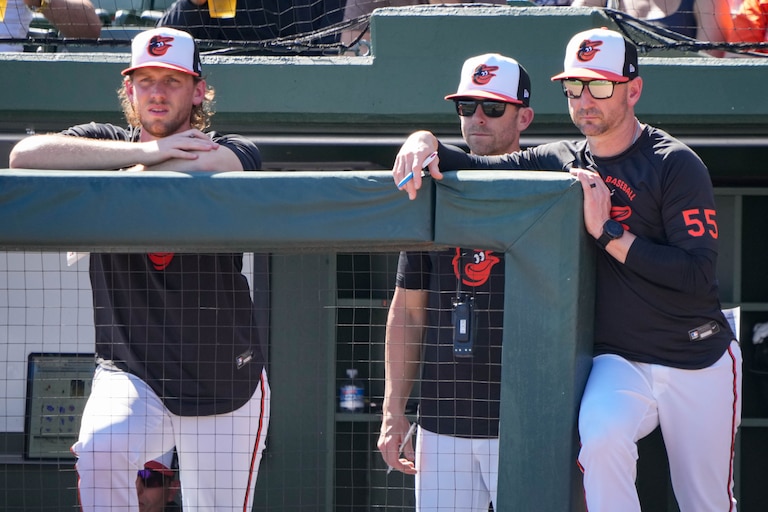 Orioles manager Craig Albernaz, right, watches a spring training game with pitching coach Drew French, center, and pitching strategy coach Ryan Klimek. (Ulysses Muñoz/The Banner)
This year’s pitching staff includes players who have been with this group for years — Kyle Bradish, Dean Kremer, Zach Eflin and Trevor Rogers in the rotation, plus Tyler Wells, Yennier Cano and Keegan Akin in the bullpen. Keeping them progressing will play a large part in the Orioles’ fortunes, but there may be even larger tasks ahead for this coaching group.
New assignments include helping trade acquisition Shane Baz deliver on his top-of-the-rotation potential and helping to develop a bullpen with fewer proven pitchers than years past, creating the opportunity for a lot of turnover.
Manager Craig Albernaz said the pitching coaches were “studs” at December’s winter meetings and called them “elite” both then and at the start of camp. He recalled an early-spring meeting with a pitcher when he didn’t say a word because the prep work and dialogue were so comprehensive.
“It just speaks to how well they’re prepared, how well they review and also how much they’re invested in the pitchers’ development,” Albernaz said. “Everything that was up on the slide decks, it was easily digestible, great back-and-forth with the pitcher and also the pitching coaches. It wasn’t one-sided. It wasn’t a teacher up there with a PowerPoint just dictating everything. It was a very two-way conversation, getting the players’ feedback, checking for understanding, making sure they understand what they’re presenting and what they’re talking about.”
That dynamic has resonated with a lot of pitchers over the years, and opening day starter Rogers is one of them.
“When Alby came in, I’m like, ‘Man, if he just doesn’t touch the pitching department, it’s going to be great,’” Rogers said. “Obviously that doesn’t mean nothing coming from me, but that was my thought. And just to know that nothing changes on our side, I was fired up, because they do such a great job of getting us ready, getting us prepared and just that communication that we have and that relationship that we have.”