
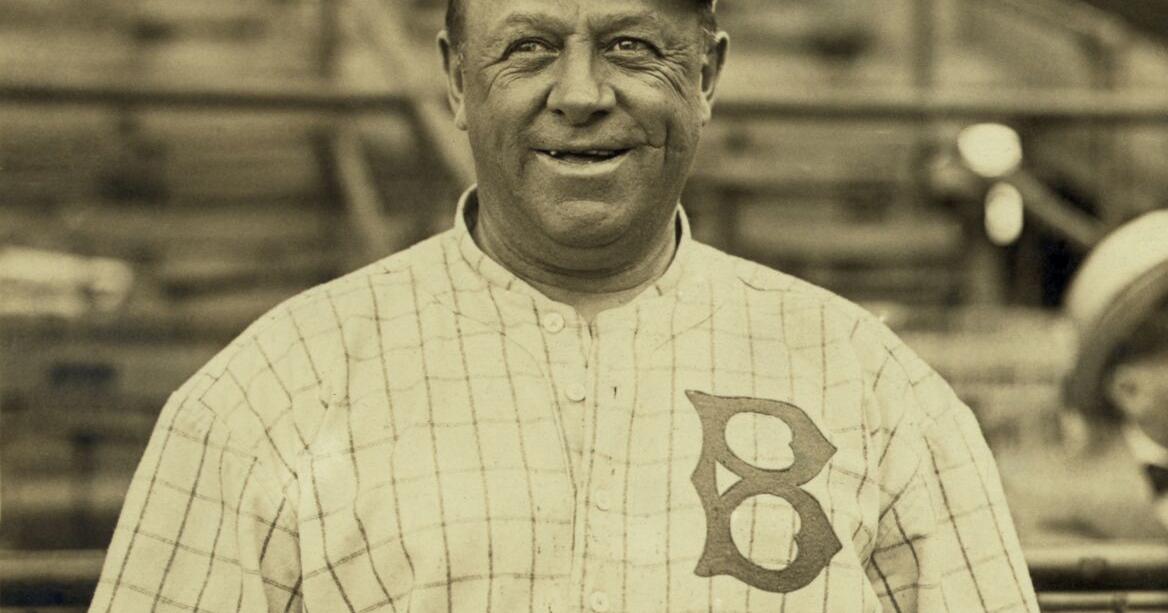

HUDSON – Did you know that Hudson boasts a member of the National Baseball Hall of Fame in Cooperstown, New York? Yes, one of Hudson’s own — Wilbert Robinson, who was born in Hudson in 1864, and died in Atlanta in 1934 — lives forever in the hallowed halls of Cooperstown.
“Uncle Robbie,” who once lived on the corner of River Street and Central Street – a parcel of land Hudson subsequently acquired from Bolton – cut his teeth on Hudson’s stacked semi-pro nines back in 1883. Born to a baseball-loving family, Robinson needed an injury to the established catcher on his older brother’s Hudson Baseball Club to become the backstop of one of the best teams in Massachusetts, even playing the powerful Boston Nationals.
As a catcher in those ancient times, Robinson wore no special equipment besides a piece of rubber between his teeth, and soon parlayed his prowess into a professional stop with Haverhill of the old New England League. From there, this Hudson Hawk – he was on the Hudson High School championship team of 1884, thank you very much – flew the coop to play for the Philadelphia Athletics starting in 1886, and finally nested with the Baltimore Orioles in 1890.
While with the Orioles (of the old American Association), Robinson played alongside another future Hall-of-Famer, John McGraw, with whom he established a restaurant (called “The Diamond,” of course). In Baltimore, Robinson set an all-time baseball record – seven hits in seven consecutive at-bats (June 10, 1892), a feat which has only been matched once since 1900 (by Pittsburgh’s Rennie Stennet in 1975).
McGraw and Robinson’s Orioles earned National League pennants in 1895 and 1896, and in 17 big-league seasons behind the plate, Robinson was a standout. One of the fastest men in the league at his career’s start (again, a catcher!), he stole 33 bases in his first season. Mostly known for his defensive prowess and work with pitchers, “Robbie” hit a very respectable career .273 (with five seasons over .300) in Baltimore and St. Louis before retiring in 1903.
In the meantime, his friend and co-proprietor McGraw slowly ascended to baseball immortality as the manager of the legendary New York Giants, and he coaxed Robinson back onto the field as a coach in 1911. But then fate took a turn at the plate.
None other than journalist Damon Runyon (of “Guys and Dolls” fame) said of Robinson:
“It was Your Uncle Wilbert who kept the Giants cheered up during a couple of bitter pennant drives, and who coaxed work out of pitchers who seemed to be temperamentally swamped. A bluff old boy with a heart in him as big as a watermelon, few sulkers can withstand the blandishments of Your Uncle Wilbert for any length of time.”
Despite having earned three National League pennants together, and after a 1913 World Series loss to the Philadelphia A’s, Robinson and McGraw argued and feuded, and the former crossed town to join the Dodgers as their manager. The Dodgers-Giants rivalry soon intensified into one of the greatest in professional sports.
That said, and despite Robinson’s best efforts, that rivalry was a tad one-sided in the first half of the 20th century.
Before they were called “dem bums,” the Dodgers were called the “Robins” by sports reporters (in deference to their long-time manager). Robinson led his “flock” to two National League pennants over 18 years, earning a 1375-1341 record.
Much later, and following his untimely death in 1934, Robinson was posthumously inducted into the Baseball Hall of Fame in 1945 alongside Roger Bresnahan, Dan Brouthers, Fred Clarke, Jimmy Collins, Ed Delahanty, Hugh Duffy, Hughie Jennings, King Kelly, and Jim O’Rourke.
Eventually, the now nine-time World Series champion Dodgers – with another Hall-of-Fame Robinson playing first base – began play in Los Angeles in 1958, and re-established the Gotham-born Robinson-McGraw rivalry with the Giants in California. The Giants moved with Willy Mays to San Francisco that same year.
It’s nice to think about the fact that a part of such a storied baseball rivalry — which stands second only to the Red Sox and Yankees — began on Hudson’s baseball diamonds.
Thanks to Christine DiMare of the Hudson Historical Society and Melissa Caissie of the Hudson Public Library for their invaluable help with this article.