
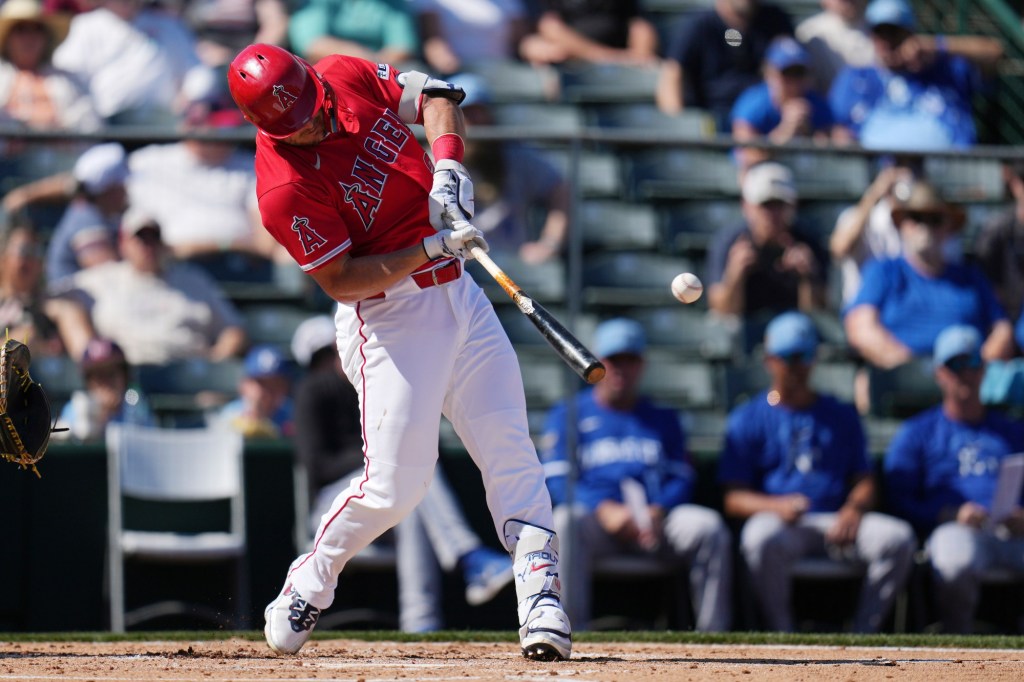
TEMPE, Ariz. — As Mike Trout continues to put a disappointing season in the rear-view mirror, little moments give him reason to be optimistic.
Like his first at-bat Wednesday against Cincinnati Reds right-hander Chase Burns.
Trout fell behind, 0-and-2, and then Burns started pumping a series of 98- and 99-mph fastballs. They were the kind of pitches that Trout swung through often last season.
This time, Trout fouled them off, eventually punching a 98-mph fastball into right field for an RBI single.
It was the continuation of something that Trout discovered late last season, which he describes as a problem with his bat path. That led to a series of issues that also moved his head, making it hard for him to see pitches as well as he should. Trout hit five home runs in his final seven games last year.
“It all comes down to when I’m starting my swing,” Trout said. “I’m retreating, that’s when I lose the ball. I’m late. My swing path is out instead of through. It’s just getting into a position where you’re starting your swing and you’re balanced. My upper body and my head were going forward a lot, and then the only place to go when I started swinging was to retreat.”
For much of this spring, Trout wasn’t seeing the results. He had five hits in his first 26 at-bats, with seven strikeouts. He was 4 for 9 with three doubles in the final week of Cactus League play.
“The first 25-30 at-bats were just trusting it again,” Trout said just before the Angels left Arizona on Friday. “It’s been feeling really good the last week and a half. I feel it where I want to be. The results will be there. I just gotta trust it.”
One of the ways to measure Trout’s change is how he’s done against high velocity.
Last season, Trout whiffed on 28% of his swings at pitches that were 95 mph or harder. The major league average is 22%.
This spring, Trout hasn’t seen that many pitches at high velocity, but he’s whiffed on just one of his 12 swings.
“I love what Mike’s doing,” Manager Kurt Suzuki said. “I love where he’s at. I’m excited for him. All the hard work’s paying off for him.”
The Angels need the 34-year-old three-time American League MVP to be better than he was last season, when he hit .232 with 26 homers and a .797 OPS. Trout struck out in a career high 32% of his plate appearances.
Part of the problem was the mechanical issue that Trout described.
It also didn’t help that he played the final four months on a left knee that, although tolerable, wasn’t well enough to allow him to play the outfield.
This spring, he’s been running as well as he did before he first hurt his knee in April 2024.
That’s also allowed him to get back into center field, the position he manned for his entire career up until last season’s failed attempt to keep him healthy by moving him to right.
“My body feels great,” Trout said.
He said his agreement with Suzuki is that he’ll let him know when he needs a day at designated hitter or a day off, but his plan is to play center field as much as possible, because that’s where he’s most comfortable. Trout is too antsy to handle the down time of being a DH. It was especially tough for him when he wasn’t producing.
“If you’re not swinging well, it’s tough,” Trout said. “For me (when playing defense), if I can’t get any hits, you’re not getting any hits. I try to do that in the outfield. It’s good to be moving around during the game.”
Although Suzuki still hasn’t committed to how much Trout will play center field, he expressed confidence in what he’s seen this spring.
“I know he can do it,” Suzuki said. “He made some great plays. He’s in a good place mentally when he’s out there too. He’s confident. He’s feeling good. And when you put confidence in a guy like Mike, he becomes dangerous. That’s what I love about it.”