
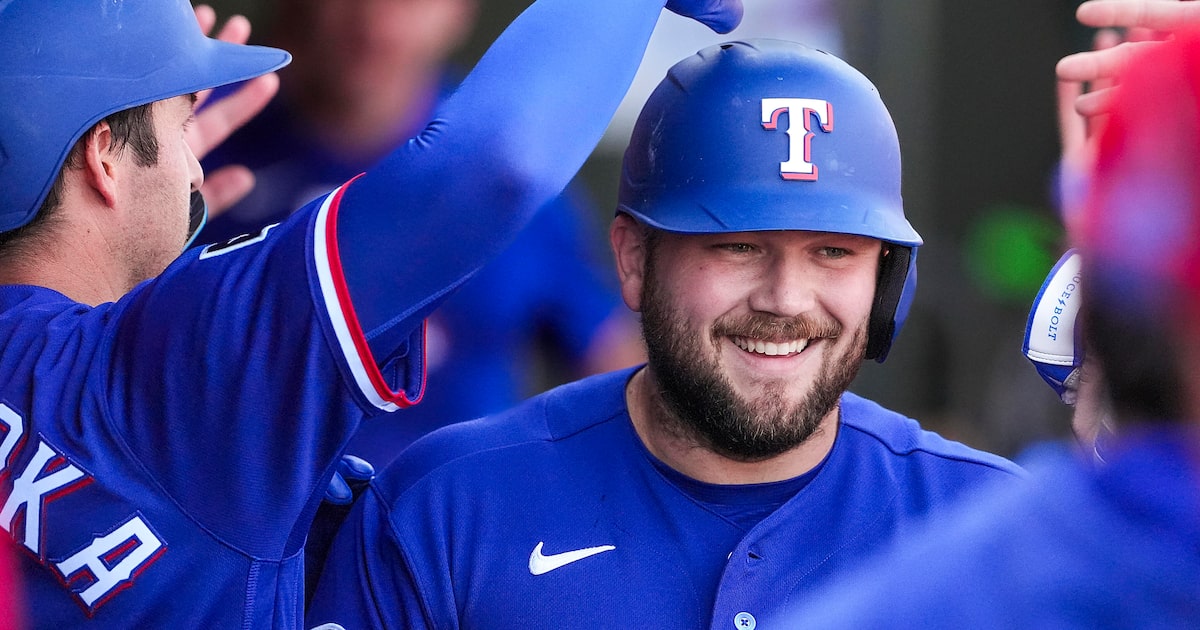
SURPRISE, Ariz. — The Rangers ventured west this spring with a new manager, a reshaped roster and a heap of boxes that they needed to check off.
Clubhouse chemistry was chief among them, and while that can be oftentimes tricky to discern the progress of in a six-week window, the winners of the team’s inaugural table tennis tournament (right-hander pitcher Josh Sborz in singles, right-handers Cole Winn and Jack Leiter in doubles) might argue that the vibes have been up.
“I think ping-pong helped,” Rangers manager Skip Schumaker said, unprompted, Saturday morning, “but there was a lot of good dudes in there that we acquired in the offseason that helped bring the culture alive as well.”
They still need to determine a fifth starter, round out their bullpen and finalize the bench sometime between their flight back to Arlington and their flight to Philadelphia a few days later before they declare that any mission is accomplished. Schumaker acknowledged Saturday that the Rangers couldn’t have predicted that they’d be “this productive and this healthy” in camp which, as the club’s brass makes its final roster cuts, has made some decisions harder to make than they’d have initially imagined.
Rangers
That’s a convenient segue to address one of the largest issues the Rangers have at hand. As much as the Rangers needed to establish a culture — or, as Schumaker described it, “finding joy in the success of others” — they also needed to establish an offensive philosophy that wouldn’t lead to a repeat of last season’s disappointments. In October, when he was introduced as manager, Schumaker declared the club had to find its “real identity” on offense.
They’ll break camp with the belief that they’ve set the foundation for an offense with attractive characteristics. The Rangers rank first leaguewide in on base percentage (.377), first in walk percentage (13.7%), seventh in batting average (.273), ninth in slugging percentage (.462) and ninth in strike percentage (21.9%) through 28 exhibitions. Spring training results can sometimes be fools gold; spring training processes on the other hand can set a tone.
Related

The establishment of those, Schumaker believes, has left the Rangers “pretty encouraged with where we’re at right now.”
“Throughout the course of spring training, there’s been really healthy, productive conversations throughout of what we want to look like and where we want to be,” he said. “We’re not finished by any means. It’s spring training. But I’d rather be in this position than another position right now.”
Schumaker credited the revamped hitting staff of Justin Viele, Alex Cintrón and Eric Dorton for “setting the tone with messaging early.” The group, especially Viele, the lone holdover among those three from last season, didn’t shy away from last year’s offensive failures and the paths the Rangers took that created them. There were “direct” conversations early in camp, Schumaker said, that were had in an effort to address what went wrong and what needed to look different.
The keenest eyes in camp have noticed a shift.
“I don’t know if it’s ABS, or the approach, but I feel like it’s the quality of pitches we’re swinging at,” right-handed pitcher Nathan Eovaldi said when he went out of his way to praise the offense after his last spring start. “I don’t feel like we’re really expanding too much. We’re getting into good counts to drive the ball and we’re driving them.”
The Rangers have swung at the fifth-fewest percentage (24.7%) of pitches outside of the strike zone in Cactus League play, per Baseball Savant, and have the second-highest batting average leaguewide on pitches within the zone. Last camp, the Rangers swung at the second-highest percentage (31.2%) of pitches outside of the strike zone, and it bled into the regular season, leading to chasing power over process too often and too early.
“I think it starts with the top, the best players, with setting that standard and setting that example and talking about it during the course of the game or in the hitters meeting,” Schumaker said. “It’s great to see that we are moving the ball forward inside the strike zone and we’re taking the pitch outside of the strike zone. It’s the best way I can dummy it down.”
Here’s another way to do that: Better discipline can lead to advantage counts, which can force pitchers to throw in the zone and in turn create opportunities for damage. The Rangers have seen 29.2% of all pitches when ahead in the count this spring, which ranks in the top half of all teams, and they’ve posted a ludicrous .564% slugging percentage in those positions. They saw more pitches when behind than two-thirds of the league last regular season and were in disadvantage counts more often than they were ahead. It’s hard to be on the attack when the pitcher has as much or more inclination to operate as the aggressors.
“I feel like there’s definitely an edge with the offense,” third baseman Josh Jung said. “I feel like everyone’s kind of going up there to win every at-bat no matter what.”
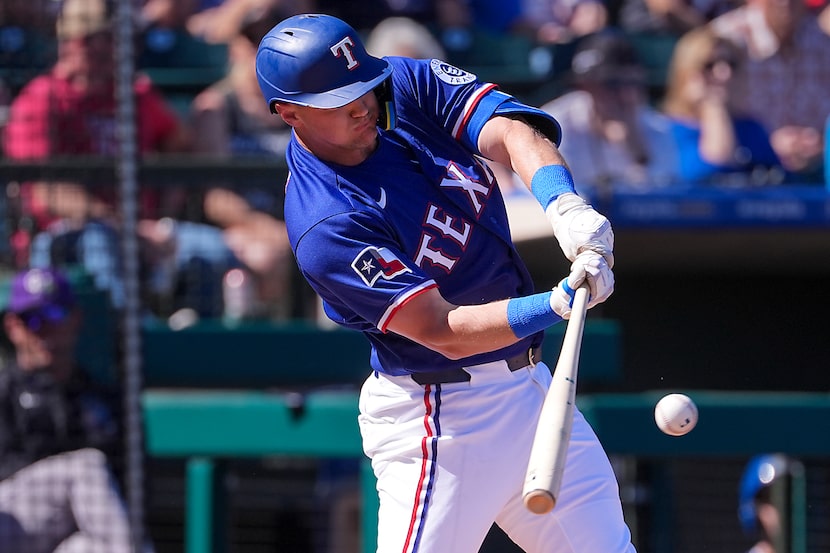
Texas Rangers third baseman Josh Jung singles during the second inning of a spring training game against the Colorado Rockies at Surprise Stadium on Sunday, Feb. 22, 2026, in Surprise, Ariz.
Smiley N. Pool / Staff Photographer
Take Friday’s exhibition vs. the San Francisco Giants, the club’s last with a regular lineup, for proof of concept. They were shut out and trailed by five runs through seven innings before first baseman Jake Burger ignored two cutters away, fouled off a middle-middle sinker, then pulled a slider 418 feet onto the left field berm for a grand slam. Two batters later, with two runners on, second baseman Josh Smith took a called strike, didn’t chase a ball and then pounced on a cutter — a class of pitch that he hit .302 against two years ago in his Silver Slugger season — for a two-run single that gave the Rangers a decisive lead.
It was a less-than-meaningful game from a results perspective, and Burger and Smith faced two pitchers without headshots on MLB.com, but their swings represented legitimate change. The Rangers posted a .623 OPS when behind in games last season, the third-worst leaguewide, and they didn’t erase a five-run deficit until a wild Aug. 11 win against the Arizona Diamondbacks.
“I think that’s the highs and lows of the game and trusting your at-bats and the process of your work,” Schumaker said. “I think, eventually, you’re going to push through. Burger and Smitty, that’s what you need to see over the course of 162, and just because they’re 0 for 3, the 1 for 4 could be really good and help us win games. That’s exactly the maturation you want to see, maturity-wise, of a player.”
It’s what the Rangers came to camp to do.
Consider it a box checked.
Texas Rangers closing in on bullpen staff for opening day with Ryan Brasier releaseTexas Rangers top 30 prospects: No. 4 Josh Owens has potential to be a two-way standout
Find more Rangers coverage from The Dallas Morning News here.