
For a detailed explanation/FAQ regarding this tournament, click here.
For the First Round results, click here.

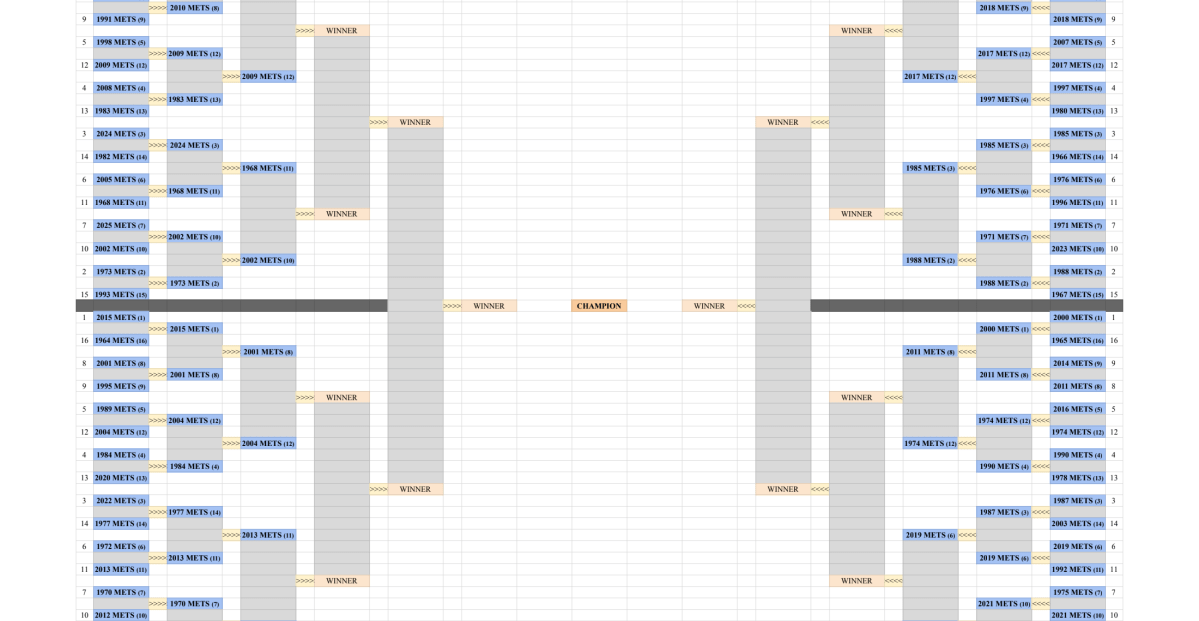
1986 (1) vs 2010 (8)
G1: 2-0, ’10
G2: 3-1, ’86
G3: 6-3, ’86
G4: 6-4, ’86
Series MVP: Ray Knight
Ray Knight’s MVP streak continues, as the veteran third baseman hit two more clutch homers and drove in five runs to propel the 1986 Mets to another series victory. For a second consecutive round, the heavily favored ’86 team unexpectedly dropped a game early. 2010’s sole win was a shutout, with Johan Santana tossing seven innings and Francisco Rodríguez throwing the final two while back-to-back solo homers from Jason Bay and Henry Blanco in the eighth accounted for all the scoring. From that point on, ’86 found their stride, getting a pair of incredible pitching performances from Ron Darling (8.0 IP, 1 ER) and Bob Ojeda (7.0 IP, 1 ER) in Games 2 and 3, respectively. Rookie Ike Davis hit an early homer to give ’10 a lead in Game 4, but a three-run homer from Knight helped ’86 snatch a lead they would not relinquish. Blanco nearly hit his second homer of the game (and third of the series) in the ninth inning, but Mookie Wilson made an incredible catch just in front of the left-field fence to prevent further trouble.
2009 (12) vs 1983 (13)
G1: 5-4, ’09
G2: 17-6, ’83
G3: 10-6, ’83
G4: 6-5, ’09
G5: 7-0, ’09
Series MVP: Johan Santana
When the 1983 Mets won in this series, they won big. Their lineup exploded for 17 runs on 18 hits in Game 2, scoring 14 of those runs in the first three innings (it was not John Maine’s day). In Game 3, they put up another double-digit performance aided by homers from George Foster and rookie Darryl Strawberry (who finished the series with four homers and 11 RBI). But even if their margins were less impressive, the ’09 team won a pair of hard-fought battles. In Game 1, after a Strawberry homer off submariner Pedro Feliciano gave ’83 a 4-3 lead, the ’09 team capitalized on a Wally Backman error to rally, eventually winning on a Daniel Murphy walk-off single flared down the left-field line. In Game 4, a late Strawberry homer was once again overcome, this time with the help of a ninth-inning wild pitch that allowed José Reyes to score the go-ahead run before Francisco Rodríguez slammed the door in the bottom of the frame. When Game 5 arrived, ace Johan Santana was up to the task, tossing eight innings of shutout ball and propelling the inaugural Citi squad to the sweet sixteen. Even if this is likely their last hurrah in Mets Madness (the fearsome 1986 Mets loom in the next round), they’ve certainly had a tournament to be proud of thus far.
2024 (3) vs 1968 (11)
G1: 6-0, ’24
G2: 7-0, ’68
G3: 14-5, ’24
G4: 5-3, ’68 (f/11)
G5: 4-2, ’68
Series MVP: Ron Swoboda
I will admit…even I, the theoretically unbiased tournament simulator, couldn’t help but wish for a redo after seeing the beloved ’24 team get blindsided by the 1968 Mets — especially when the “OMG” magic appeared alive as ever. In Game 1, ’24 scored five runs off Tom Seaver (with a Jose Iglesias homer to boot) before Francisco Lindor took Nolan Ryan deep. What could be a sign of Grimace’s presence more than that? Though they were left flailing in Game 2 against Jerry Koosman, who tossed a complete-game shutout with 11 K’s, Game 3 was a joyous rout, with ’24 clubbing six homers (two from Mark Vientos, two from Iglesias, one from Francisco Alvarez, and one from Brandon Nimmo) before Edwin Díaz struck out five of six batters faced. Game 4 was the kind of tense marathon that ’24 thrived in, except this time it was the other dugout that came away celebrating. The score was knotted at 3-3 from the fifth inning until the eleventh, with each team’s bullpen proving impervious, until Ron Swoboda slapped a two-run homer off José Buttó to force a winner-take-all elimination game. Were anyone else on the mound, perhaps ’24’s offense would be able to rally…but there’s only one Seaver. An Ed Charles homer gave ’68 late insurance, and the team of destiny was eliminated. You could say that ’24 embarrassingly underperformed in this round, but that’s insulting to the ’68 Mets, who have a clear formula for success moving forward. Seaver and Koosman pitched two gems. They won both of them. And they do, after all, represent “The Year of the Pitcher.”
1973 (2) vs 2002 (10)
G1: 7-1, ’73
G2: 4-3, ’02
G3: 6-3, ’02
G4: 5-4, ’02
Series MVP: Mo Vaughn
Game 1 gave the “Ya Gotta Believe” Mets every reason to believe this series would go as planned. The 1973 N.L. Champs tallied seven runs and twelve hits, while Tom Seaver appeared destined for a vintage shutout until Jeromy Burnitz hit a relatively meaningless one-out homer to left field in the ninth (there’s just something about left-handed hitters batting with one out in the ninth that seem to put a crimp in Seaver’s plans). Game 2 was closer, with the 2002 squad getting a phenomenal outing from Steve Trachsel, but the ’73 Mets still held a 3-2 lead entering the top of the ninth. That’s when the pivotal momentum change occurred. With Tug McGraw on the mound, Mo Vaughn and Mike Piazza led off the top of the ninth with back-to-back homers, and Armando Benítez slammed the door to give ’02 a shocking win. ’73 never truly recovered, with Vaughn hitting another homer and Timo Pérez hitting a clutch go-ahead single in the eighth to give ’02 a Game 3 win. ’73 found themselves down 3-2 in the eighth in Game 5, when Ron Hodges was spared a borderline strikeout call on a check swing and promptly hit a two-run single on the next pitch. But before ’73 could blink, outfielder Brady Clark (who played just 17 games with the Mets spread strangely across 2002 and 2008) hit a two-run homer off McGraw. While the Mets’ iconic lefty closer stumbled, Benítez was unhittable, tossing 3 1/3 innings of scoreless ball and inducing a Rusty Staub flyout to secure an upset series win.
1969 (1) vs 2018 (9)
G1: 7-3, ’69
G2: 6-4, ’69
G3: 5-4, ’18
G4: 3-1, ’69
Series MVP: Jerry Koosman
This Series MVP award could have been given to a number of deserving candidates. It could have gone to Cleon Jones, who hit a two-run homer off Cy Young Award winner Jacob deGrom in the seventh inning of Game 1…and then hit a two-run homer off him again the next inning. It could have gone to Don Cardwell, the veteran of the 1969 starting staff who may very well have turned in its best performance with eight innings of one-run ball in the clinching Game 4. But it ends up with Jerry Koosman, who in Game 2 battled to throw 7.1 innings while allowing just two runs without his best stuff (he allowed ten hits and walked five) and helped his cause by hitting a go-ahead, two-run home run off Noah Syndergaard in the seventh inning. Talk about miracles. Koosman only had two career home runs in real life, which came against Bill Hands and John Montefusco (who, according to baseball-reference.com, are nicknamed “Froggy” and “The Count,” respectively). With Thor added to the mix, I think it’s safe to say that Koosman has a penchant for homering off those with striking alter-egos. If this all feels like too light-hearted of a tangent for Mets Madness, I’d argue it matches the way the ’69 Mets have played thus far: they’re having fun, they’re feeling confident, and they’re letting the good times of the ’69 postseason roll on.
1997 (4) vs 2017 (12)
G1: 7-1, ’17
G2: 7-2, ’17
G3: 7-5, ’17
Series MVP: Yoenis Céspedes
Forget about winning back-to-back series as the underdog — the 2017 Mets have won every single game they’ve played thus far. They aren’t just being carried by one facet of their roster either; this series was a full-team effort, with stellar starting pitching (a Syndergaard complete-game performance followed up by eight innings and no earned runs from Jacob deGrom) and a deep lineup powered by Yoenis Céspedes, Brandon Nimmo, and Juan Lagares. Losing to this apparent surprise juggernaut must have been quite frustrating for the 1997 Mets, who entered this series coming off a first-round sweep of their own. It was so frustrating, in fact, that something happened which I didn’t even know was possible in OOTP: a benches-clearing incident. After Zack Wheeler plunked Butch Huskey and Carl Everett in consecutive at-bats during the fifth inning of Game 3, Everett allowed the frustration to boil over by — according to the play-by-play info — charging the mound. It can’t possibly have been intentional, as both hit batsmen brought a run home in a tight game. Plus, I can’t quite see Zack Wheeler being the type to go Hunter Strickland-mode in a game with these kinds of stakes. But hey, why not? It’s “Mets Madness,” not “Mets Let Cooler Heads Prevail.” I have no idea whether warnings were issued by the umpires, but I do know that the ’17 Mets have issued a warning to the rest of the tournament with their six-game win streak. They were a team with lofty expectations, plagued by injury issues…were they secretly destined for greatness after all?
1985 (3) vs 1976 (6)
G1: 3-0, ’70
G2: 2-0, ’85
G3: 9-2, ’85
G4: 8-3, ’70
G5: 5-0, ’85
Series MVP: Dwight Gooden
20-year-old Cy Young Award winner Dwight Gooden went on quite the hero’s journey in this series. He started it by facing off against Tom Seaver (a matchup which, up until now, hadn’t happened yet in Mets Madness), and being outlasted. Gooden was good, allowing just three runs on solo shots from John Milner and Joe Torre and an RBI single from Milner; but Seaver was spectacular, tossing eight innings of scoreless ball. When Gooden and Seaver matched up again in the winner-take-all Game 5, it was Gooden’s time to shine, throwing eight scoreless innings himself and securing a series win for the 1985 Mets. Still, it was Ron Darling who delivered ’85’s best individual start, throwing a complete-game shutout in Game 2. Offensively, ’85 took their cue from Gary Carter, who had a three-hit Game 3 and delivered a two-run double in the left-center-field gap to blow Game 5 open. This series also featured two critical outfield assists. In the eighth inning of Game 1, center fielder Pepe Mangual gunned down George Foster at the plate as ’85 tried desperately to break through against Seaver. In the ninth inning of Game 2, Mangual ambitiously tried to tag at second base on a flyout (despite being the lead runner while his team trailed by two) and was gunned down at third by Darryl Strawberry. If you can hear Keith Hernandez’s voice criticizing that decision in your mind, just know that Mangual probably heard it too from the other side of the diamond.
1988 (2) vs 1971 (7)
G1: 7-0, ’88
G2: 7-4, ’88
G3: 4-3, ’71
G4: 6-2, ’88
Series MVP: Darryl Strawberry
The 1988 Mets continue to cruise through their corner of the bracket, this time riding an eight-RBI display from MVP runner-up Darryl Strawberry, who homered in Games 2 and 4. Strawberry also got ’88’s most pivotal hit: a two-out, two-run triple while trailing 5-4 in the bottom of the eighth inning of Game 2. The hit energized the team enough that Keith Hernandez promptly followed it with a two-run homer, robbing the 1971 Mets of what they hoped would be a series-evening win. The ’71 Mets did muster a victory in Game 3, getting a quality start from Roy Sadecki and scoreless relief from Buzz Capra and Danny Frisella. But Sid Fernandez shut the door in Game 4, and the heavily-favored ’88 Mets waltz on to the sweet sixteen. Plus, for all the attention on aces like Seaver, Gooden, and deGrom, 1988 David Cone might be having the single best tournament of any pitcher so far; with eight innings of one-run ball in the previous round and 8.1 scoreless innings in this one, albeit both against rather soft-hitting lineups, he’s proving he can go toe-to-toe with the best in Mets history.
2000 (1) vs 2011 (8)
G1: 7-2, ’11
G2: 5-1, ’00
G3: 6-5, ’11
G4: 9-6, ’11
Series MVP: Nick Evans
This felt like one of those postseason series where a wild card team goes up against a division winner, and the latter just looks flat-out flat. The 2000 team’s offense was scoring runs, but it wasn’t quite beating up on the 2011 rotation which — aside from R.A. Dickey, who threw a two-run complete game in Game 1 — ought to have been more vulnerable. Meanwhile, the ’00 pitching staff seemed to have no answers for David Wright and batting champ José Reyes. The only ’00 win came in Game 2, when Mike Piazza hit a go-ahead homer, Darryl Hamilton went 3-for-4, and Al Leiter tossed 7.2 innings of one-run ball. Game 3 got off to a thunderous start with a five-run inning for ’00 (Rick Reed hit a bases-clearing double), but a Lucas Duda three-run homer and epic Nick Evans two-run wallscraper off John Franco gave the ’11 Mets a stunning comeback victory while the ’00 lineup complacently went quiet. Game 4 was a slugfest. The 2000 team got a pair of homers (courtesy of Robin Ventura and Edgardo Alfonzo) and scored consistently throughout, but ’11 was putting on a Home Run Derby, with Josh Thole, Wright, Daniel Murphy, and Jason Bay each going deep. The 2000 Mets may have won two series in the postseason, but they are going home after just one in Mets Madness.
1990 (4) vs 1974 (12)
G1: 3-2, ’90
G2: 4-2, ’74
G3: 3-1, ’74
G4: 11-1, ’74
Series MVP: George Stone
You’d think that the 1990 Mets would have an advantage here given that their end-of-season manager, Bud Harrelson, played shortstop for the opposing team. You at least think he’d have the scouting report on himself, yet Harrelson still managed to hit .312 in the series. Meanwhile, 1974’s manager Yogi Berra blew Game 1 by inexplicably leaving a tired Jerry Koosman on the mound for the ninth, when he hit a batter, walked two in a row, and finally walked Mark Carreon to allow the winning run to carry on home. But from then on, ’74 was in complete control. David Cone and Tom Seaver were both working without their best stuff in Game 2, but the more experienced Seaver was able to evade trouble, allowing only two runs while surrendering ten hits. In Game 3, Jerry Koosman tossed a four-hit complete game. And in Game 4, any hope ’90 had was turned to stone by left-hander George Stone, who tossed 6.1 innings of one-run ball while also clobbering a two-run homer to make the game a proper rout.
1987 (3) vs 2019 (6)
G1: 7-6, ’87
G2: 3-1, ’87
G3: 6-5, ’19
G4: 3-2, ’19
G5: 7-1, ’19
Series MVP: Pete Alonso
Of all the upsets in this round, this one felt the least surprising. That’s partially because these two teams have a less significant gap in seeding, but it’s also because the 2019 Mets possess about as much fight as a non-playoff team can have. That showed in this series, with ’19 finding themselves on the brink of elimination before winning three straight against the 1987 Mets. Jacob deGrom and Dwight Gooden both faltered in Game 1, with deGrom getting chased out early and Gooden proving vulnerable as he tired late, but ’87 held on despite a 7-2 lead turning to 7-6. In Game 2, Sid Fernandez (8.0 IP, 1 ER) outdueled Zack Wheeler (8.0 IP, 3 ER), who was tagged with the loss despite making just a pair of bad pitches which Howard Johnson and Darryl Strawberry hit out of the park. With a sweep in their sights, ’87 went up 4-0 on shoddy defensive play in Game 3, but that’s when Pete Alonso and his “LFGM” resilience kicked in. Alonso hit a seventh-inning homer which ignited an electric rally as a Jeff McNeil two-run double and Brandon Nimmo homer helped secure the win. In Game 4, ’19 once again trailed in the bottom of the seventh when Alonso dunked a two-out, two-strike RBI single into left field (shoutout as well to Michael Conforto, who gunned down Lee Mazzilli at third base to end the top of the ninth inning). In Game 5, they didn’t wait to attempt another late comeback, instead seizing an early lead on a McNeil triple and Alonso two-run homer off Gooden. The ’87 Mets have nothing to regret, and they did their best to fend off a rally-happy opponent (especially Lenny Dykstra, who multiple times made stellar plays in center field only to soon see ’19 score anyway). As for the ’19 team, their next opponent will be the toughest yet…
2006 (2) vs 2021 (10)
G1: 8-5, ’06
G2: 4-3, ’06
G3: 8-1, ’06
Series MVP: José Valentín
This series began with the baseball equivalent of an unstoppable force meeting an immovable object in the 2006 lineup facing 2021 Jacob deGrom (that was the year he had a 1.08 ERA in 15 starts). The ’06 offense did damage against deGrom, with José Valentín hitting a homer and Carlos Beltrán hitting two, but that alone wasn’t enough to win them the game. Billy Wagner came on for the save in the top of the ninth and was first greeted by Pete Alonso, who absolutely demolished a 455-foot, 114.4-mph homer to left-center field to tie the game. It was an epic moment for the Mets’ all-time home run king, though he was promptly one-upped by a Paul Lo Duca opposite-field, three-run homer off Edwin Díaz in the bottom of the frame to give the ’06 Mets a patented walk-off win. Alonso would hit another homer off Tom Glavine in the first inning of Game 2, but was once again thwarted by Shawn Green and Valentín’s back-to-back homers in the next inning. A Brandon Nimmo two-run homer in the top of the eighth tied the game at 3-3, but David Wright responded with a go-ahead RBI double, and Wagner redeemed himself with a clean 1-2-3 ninth inning. Game 3 showed just how much of a mismatch this series was, with the ’06 Mets scoring four runs before making two outs. ’21’s only hope was to win their opening deGrom game and steal momentum. It’s hard to imagine the ’06 powerhouse being taken down except by a rotation three or four aces deep — especially when a middle-of-the-order bat like José Valentín is slashing .455/.538/1.273 with three homers (five total now in the tournament).
2015 (1) vs 2001 (8)
G1: 6-2, ’01
G2: 5-3, ’15
G3: 7-0, ’01
G4: 4-3, ’01
Series MVP: Robin Ventura
Much like in the 2015 World Series, the 2015 Mets led the majority of their losses in the late innings. In Game 1, Matt Harvey threw six scoreless while RBI singles from Wilmer Flores and Juan Lagares gave ’15 a 2-1 lead, but the bullpen imploded. Addison Reed surrendered a game-tying solo homer to Edgardo Alfonzo in the eighth, and the 2001 team tacked on four more off Jeurys Familia in the ninth. Game 2 was the N.L. Champs’ only win, with Jacob deGrom providing a dominant outing before a Curtis Granderson homer and RBI doubles from Daniel Murphy and Travis d’Arnaud helped ’15 take the lead in the eighth. In Game 3, Steve Trachsel rained on the parade with 7.2 scoreless innings while the ’01 lineup rained hit after hit upon the norse god Noah Syndergaard. In the deciding Game 4, homers from d’Arnaud and Muprhy gave ’15 a 3-0 lead by the sixth, but Steven Matz suffered a blowup inning — often his Achilles’ heel in New York — and ’01 was suddenly ahead 4-3. That was all they would need. Lucas Duda gave one a ride to the warning track in left off Armando Benítez with two outs in the ninth, but it settled into the glove of Benny Agbayani to eliminate another one-seed. Credit where credit is due: ’01’s big bats came through. Mike Piazza, Edgardo Alfonzo, and Robin Ventura (.538 average) put a hurt on ’15’s vulnerable bullpen, and they’re living to fight another day because of it.
1984 (4) vs 2004 (12)
G1: 2-1, ’04
G2: 7-3, ’04
G3: 8-5, ’84
G4: 5-2, ’04
Series MVP: Mike Cameron
2004’s starting pitching staff, take a bow. For a second consecutive series, ’04 managed to upset a more formidable 1980’s team on the back of their starting rotation, this time getting particularly notable outings from Tom Glavine (eight innings of one-run ball in Game 1) and Jae-Weong Seo (seven innings of three-run ball in Game 2). It’s also the second consecutive Series MVP award for Mike Cameron, a two-time Gold Glove Award winner who delivered perhaps the most highlight-worthy defensive play in Mets Madness thus far. In Game 4, the ’04 Mets clung to a three-run lead with the bases loaded and two outs in the bottom of the ninth. Wally Backman hit a bullet to center off rookie Heath Bell, which Cameron broke in and made a diving catch on to end the series. Offensively, ’04 received particularly strong showings from rookies David Wright (game-tying homer in Game 3) and Kaz Matsui (go-ahead single in Game 2), as well as Cliff Floyd, who hit a tone-setting two-run homer in the first inning of Game 4. If you’re wondering what the ’04 team has going for them as they continue to surprise in the tournament, consider this: perhaps no other team has the number of iconic Mets leaders (Wright, Mike Piazza, John Franco, Al Leiter, etc.) that they do. If there’s one team that can handle the pressure of future rounds against favored opponents, perhaps it’s them.
2013 (11) vs 1977 (14)
G1: 1-0, ’77
G2: 1-0, ’13 (f/10)
G3: 3-2, ’13 (f/12)
G4: 8-3, ’13
Series MVP: Ike Davis
In the first 31 innings of this series, seven total runs were scored. In Game 1, the 2013 team somewhat characteristically managed to lose despite getting eight spectacular innings from Matt Harvey, who was throwing a no-hitter until the seventh and allowed only an unearned run (kudos to Jerry Koosman as well for seven scoreless innings). In Game 2, Jon Matlack met the same fate for the 1977 squad, as the left-hander tossed 8.1 scoreless innings but was matched by ’13’s southpaw starter Jon Niese. The game mercilessly came to an end when David Wright dunked an RBI single just in front of Lee Mazzilli in center in the bottom of the tenth inning, allowing Eric Young Jr. to dash home. Game 3’s score was stuck at 1-1 until the eleventh, when Lucas Duda hit a solo homer and Bud Harrelson responded with an RBI single to send us to the twelfth. A Daniel Murphy RBI double finally did the trick, and 37-year-old Scott Atchison was able to nail down the save. Then, we got the eleven-run offensive explosion that was Game 4, thanks to this series’ MVP by default: Ike Davis, who hit two homers to help ’13 secure a comfortable final win. Relative to this series’ run environment, that basically makes him Barry Bonds.
1999 (2) vs 1970 (7)
G1: 9-1, ’99
G2: 5-4, ’99
G3: 8-7, ’70
G4: 6-3, ’70
G5: 15-3, ’99
Series MVP: Roger Cedeño
I ended the entry for 1999’s win in the prior round by writing that their lineup “put the rest of the tournament on notice.” How do you make good on that warning? You immediately tag Tom Seaver for 7 runs and 12 hits in just 4 innings. That being said, this wasn’t a walk in the park for the ’99 team. Jerry Koosman gave them fits early in Game 2, but the lineup bore him down and crept back from down 4-1 with the help of a Robin Ventura homer and later go-ahead sac fly. Game 3 was one of the most enthralling back-and-forth battles of this round, with Tommie Agee and Mike Piazza trading homers early, ’70 taking advantage of sloppy defensive play by ’99, Edgardo Alfonzo hitting what at one point seemed a decisive homer off lefty Rich Folkers, and Cleon Jones slamming into the left-field fence to preserve the tie in the top of the eleventh. Minutes later, Joe Foy foiled ’99’s hopes of a sweep with a walk-off, seeing-eye single through the right side. But despite ’70 stealing another win in Game 4 by scrapping together a few runs off right-hander Dennis Cook, ’99 ended this series by reminding us who they really are with another absurd offensive display. 15 runs. 13 hits. Another homer from Ventura and…an 8-RBI game from Roger Cedeño? I’ll say it again: the rest of the tournament is on notice.