
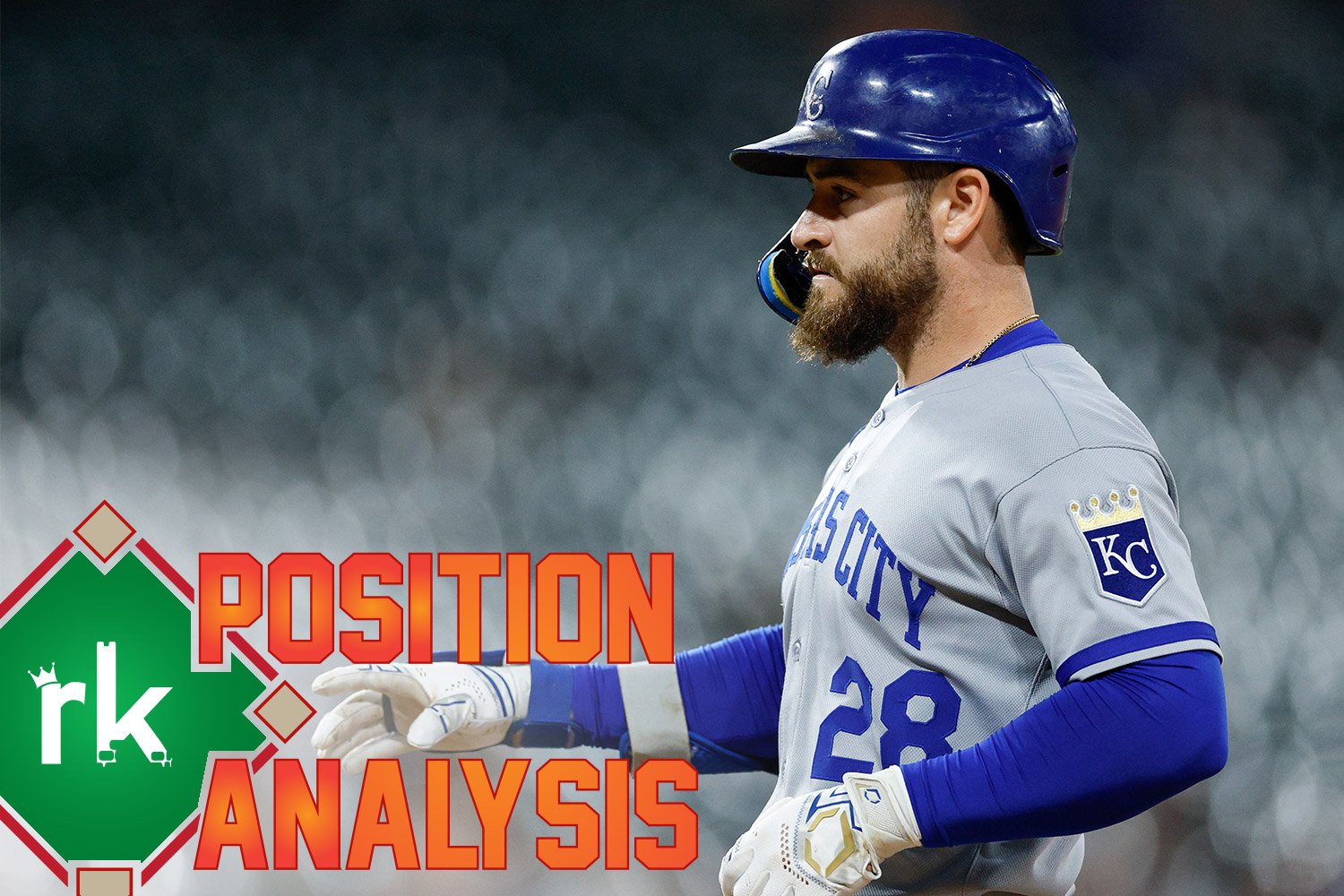
While the corner outfield had a lot of variance in the day-to-day starting lineup, center field was a position of relative stability. Kyle Isbel started 118 games in center field last season. When Isbel was not in the lineup, the Royals did not have a viable option to replace him, to the point that they even experimented with playing Maikel Garcia in center.
Going into 2026, the Royals signed Lane Thomas to a one-year contract. The addition of Thomas gives the Royals a proven Major League depth option and the flexibility to platoon him with Isbel against left-handed pitching.
Royals Second Basemen At a Glance
Starter: Kyle Isbel
Backups: Lane Thomas
Depth: Tyler Tolbert, John Rave, Drew Waters
Prospects: Gavin Cross, Carson Roccaforte
Royals fWAR Ranking Last Year: 24th out of 30
Royals fWAR Projection This Year: 30th out of 30
The Good
Kyle Isbel is an excellent defender. According to Statcast data via Baseball Savant, Isbel grades in the 93rd percentile in fielding run value. In 2025, he was worth 12 Outs Above Average (OAA) based on his range. The Royals know what they are getting with Isbel in the field, and they are willing to live with offensive deficiencies (we’ll get to that later) if he can continue to provide exceptional defense.
Lane Thomas can help pick up the slack for Isbel’s lack of offensive production, particularly against left-handed pitching. From the 2021 through the 2024 seasons, Thomas provided above-average production against lefties, posting a wRC+ of at least 107. That will be a welcome improvement compared to the 56 wRC+ that Isbel had against lefties in 2025.
Historically, Thomas has been graded close to average fielding run value with above-average arm value, arm strength, and spring speed. There shouldn’t be too big a defensive dropoff when Thomas starts against lefties.
The Bad
Isbel has not been good on offense, even against right-handed pitching. He has not posted an above-average wRC+ against righties since his rookie season in 2021. In 2025, Isbel graded in the 9th percentile in batting run value, along with 1st percentile marks in xwOBA, xSLG, and launch angle sweet spot. While Isbel is above average in whiff and strikeout rates, he rarely walks, doing so at just 5.6%.
Ideally, Thomas would mitigate Isbel’s deficiencies, but Thomas dealt with multiple injury setbacks that limited him to just 39 games in 2025. He is only a couple of years removed from a season where he slashed .268/.315/.468, but Thomas will need to prove that he can both return to that level of production and stay healthy for a long stretch of the season. If the Royals only ask him to contribute on the short side of the centerfield platoon, that could help keep Thomas fresh and reduce the risk of additional time on the injured list in 2026.
After Isbel and Thomas, there are prospects who have not yet been able to make a meaningful impact at the major-league level. Tyler Tolbert, John Rave, Kameron Misner, and Drew Waters all have struggled to impress in their limited time in the big leagues. Waters is also out of minor-league options and is more likely to be designated for assignment rather than make the Opening Day roster. While there is still time for any of them to grow into contributors in MLB, the Royals will hope that their services won’t be necessary in 2026.
The Bottom Line
The fWAR projection for Royals center fielders is concerning, and a majority of that production is expected to come from Kyle Isbel’s exceptional defense. While Lane Thomas is a major-league proven option, his injury history casts doubt on whether he can be a reliable option in 2026 for a full season.
If Thomas can stay healthy, his offensive production could be a boon for the Royals in 2026 as a complement to Isbel’s strong defense. If his health remains an issue, however, the Royals may once again look to their minor-league depth for answers in center field.
Previous Installments: