
SURPRISE, Ariz. — This is a story about the Rangers entering their Pitching Era. So, naturally, let us start by talking about something else entirely: Fielding.
It is the middle of the “dog days of spring,” in the words of new manager Skip Schumaker, when players have been in the desert long enough that the novelty of being back together has worn off and playing for something that matters still seems way off on the horizon. On a day when the temperatures are starting to spike and Nathan Eovaldi is fighting a battle with his cutter, he has allowed consecutive hits after the Rangers scored four runs in the long, walk-filled half inning prior.
On the next play, a fly ball, he sprints off the mound to back up third base, a fundamental play that often gets taken for granted. On the one that follows, a grounder between first and second, Eovaldi is at the absent base to take a throw. And then, on the next pitch, he lands in perfect position to field a comebacker at 105 mph for an easy final out.
“True culture is when your best player is your hardest worker and continues to hold the standard,” Schumaker said. “There’s no better guy to continue to showcase that. When people say the standard is the standard, not many people can identify or tell you what exactly the standard is. Well, that’s the standard.
Rangers
“And when our young guys don’t do something, don’t hold to the standard, he holds them accountable. He sets the tone. That’s the dream for a manager.”
Maybe more than just this manager. Maybe the next one, too. Not that anybody is running Schumaker off, but as the Rangers enter 2026, they are in a unique position. They have all the pieces in place to potentially build a pitching dynasty that extends beyond more than just the current generation.
They’ve come a long way, baby, from that first spring training when, as legend has it, manager Ted Williams dismissed a meeting about fundamentals with “Enough of this, let’s go hit.” For the first 50 years, that seemed to be the club’s unofficial motto.
The new era begins with the presence of Eovaldi and Jacob deGrom, two aces with distinctly different personalities and approaches, but with a shared interest in investing in teammates and with young pitchers not only willing to listen, but eager to do so. But there is so much more.
President of baseball operations Chris Young pitched 14 years in the majors and sees the game through a pitcher’s lens. There is a menagerie of mostly homegrown pitchers. There is a home stadium that decidedly favors pitchers. There is a recent track record of identifying and adding cost-effective free agents and a farm system that has recently done better with pitching than hitting. There has been significant investment in additional resources and infrastructure, including a multi-million biomechanics lab that has become an integral tool.
A year ago, the Rangers’ starting rotation performed like never before. Led by Eovaldi and deGrom and the growth of Jack Leiter, the rotation posted an MLB-best 3.41 ERA. It was a first for the club.
Are they poised to do it again? Are the Rangers in their Pitching Era?
“It’s hard for me to answer,” Young allowed in the middle of spring training. “I’m an optimist by nature, but I hate over-promising and under-producing. The minute you feel like you have something figured out or that you are doing something well in this game, it bites you in the butt.”
Then he leaned in.
“But, and I know this from my own personal experience, when you have two of the best in the game to set an example of what greatness looks like, the way young players absorb that and the impact it has is huge,” Young said. “And so in terms of like one day when [deGrom and Eovaldi] are no longer on our team, which I hope is not anytime soon, is there a lasting impression and legacy? You better believe there is, because some of those young guys are going to go on and have good careers and they’re going to remember what they learned from Jacob and Nathan.
“So their presence is really impactful. It’s significant. And it’s real.”

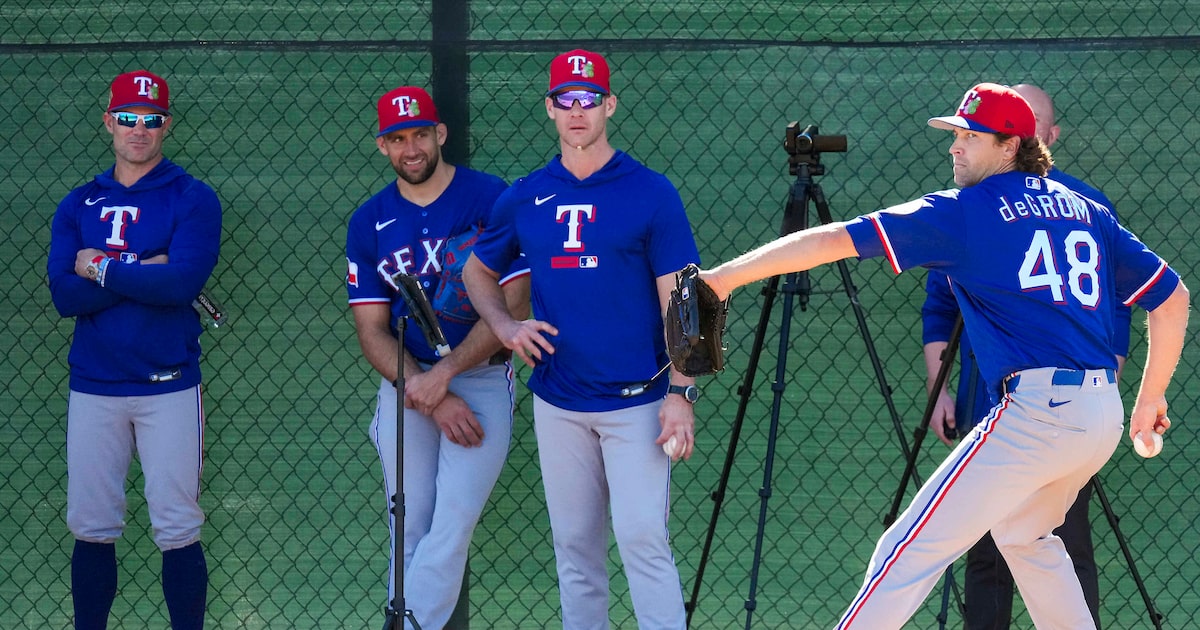
Texas Rangers pitchers Nathan Eovaldi (17) and Jacob Degrom throw in the outfield during a spring training workout at the team’s training facility on Friday, Feb. 13, 2026, in Surprise, Ariz.
Smiley N. Pool / Staff Photographer
‘It’s a perfect combination’
From the outside, they couldn’t be more different.
Eovaldi, 36, is constantly in motion and analytical. He watches every teammate’s bullpen and video, offering input almost as a secondary pitching coach. He has become a master of many pitches. DeGrom, 38, seems to just be a freak of nature. He’s long, lanky and tries to use his entrance music, “Simple Man,” as a central message for how he wants to pitch and how he wants to provide messaging. He’s mostly fastball — and what a fastball it is — and slider.
Eovaldi, with 14 years in the big leagues, picked the brains of a Hall of Fame wing of rotation mates. Clayton Kershaw. Mark Buehrle. CC Sabathia. Chris Sale. David Price. And, now, on occasion, deGrom. DeGrom came up alongside a host of fellow prospects in the New York Mets organization that included Zack Wheeler, Steven Matz, Matt Harvey and Noah Syndergaard. They were regarded as the “Young Guns,” but all had to figure out pitching on their own, without the help of peers.
DeGrom is very complimentary of a number of pitching coaches along the way, but there’s something special about peer-to-peer conversations.
“I often say the best pitching coach I ever had was a teammate,” Young said. “It was Greg Maddux [in San Diego]. I learned as much, if not more, from Greg by being his teammate, as I did from any pitching coach I ever had. There’s something about peer-to-peer engagement, learning and coaching that’s real. I’m just so grateful that these guys set an example.”
But they work together. They stand side-by-side in the dugout, unless they are flanking a young pitcher. They watch bullpen sessions. And they are visible examples of what is necessary in terms of preparation and maintenance.
“I think it’s a balance of both of us,” deGrom said. “[Eovaldi] dives in a little bit deeper on the scouting than I do. I have a game plan going in. Then things may change based on the swings I’m getting. So young guys see how he prepares and executes and they see me and I think they can take a little bit from both.
He continues: “…If it’s a big situation, I’m going to throw my best pitches, and if I get beat on those, then I can live with that.”
Disparate as this combo may seem, they work extremely well, playing off one another in terms of balancing analysis and simplicity in messaging.
“It’s unique because they are two very different personalities who also get along really well with each other,” said Leiter, who became just the third Rangers rookie in this century to throw at least 150 innings, joining Yu Darvish and a guy named Chris Young. “They are different, kind of, in every way, in terms of baseball, pitching, preparation. And you can learn so much from both sides.
“[deGrom] is really good in terms of keeping things simple and what to take from scouting reports, bullpens and stuff like that. [Eovaldi] is a perfectionist in every way, in terms of wanting to be the most prepared guy on the field. It’s a special thing that we have as younger guys in this clubhouse. It’s a perfect combination.”
An example: deGrom stressed in a conversation with Leiter the importance of identifying his best pitch that day and having complete conviction in it. If he gets beat, deGrom said, he’s going to get beat on his best pitch. He can live with that.
Leiter may have been the biggest breakout pitcher in 2025, but others echo his thoughts, including Jake Latz and Kumar Rocker, who have spent the spring fighting for the fifth spot in the rotation.
You could include MacKenzie Gore with that trio as well. The Rangers acquired the 27-year-old lefty thinking he was on the verge of blooming from an All-Star to an ace. It would be hyperbolic to say the Rangers acquired him because of the presence of Eovaldi and deGrom, but their presence certainly is a factor in the belief the Rangers can optimize Gore’s potential.
Beyond them there are the prospects like Winston Santos and David Davalillo, who both mentioned their time around Eovaldi and deGrom this spring as an invaluable teaching tool when they were both sent back to the minor league camp. This is the Rangers’ hope, that the next wave of pitching will also benefit from the pair of aces so that the pitching tree sprouts branches.
Schumaker has seen this kind of thing before. And has proof of it working.
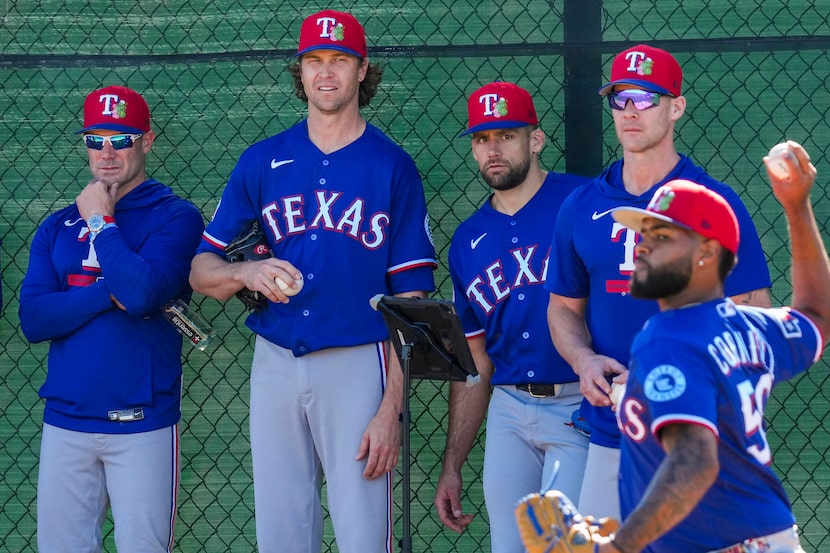
From left, Texas Rangers manager Skip Schumaker, pitcher Jacob Degrom, pitcher Nathan Eovaldi and assistant pitching coach Dave Bush watch as pitcher Jose Corniell (59) throws in the bullpen during a spring training workout at the team’s training facility on Saturday, Feb. 14, 2026, in Surprise, Ariz.
Smiley N. Pool / Staff Photographer
The start of an era?
In 2005, when he arrived in the big leagues with the St. Louis Cardinals, he saw how his best friend from the minors, pitcher Adam Wainwright, soaked up knowledge from Cy Young winner Chris Carpenter. Then he watched an established Wainwright pay it forward to a group that included Lance Lynn, Michael Wacha, Shelby Miller, Jaime Garcia and Joe Kelly.
Over a 15-year period from 2005-20, the Cardinals were second only to the Dodgers in rotation ERA in the majors. St. Louis went to the playoffs 10 times in that stretch, won three NL pennants and a pair of World Series. Seemed to have worked pretty well.
“That’s how this thing becomes sustainable,” Schumaker said. “That is true culture. They made it a point where the starters sat in one place in the dugout. They made it a point that every single starter watched bullpens. So it became part of their identity and part of the pitching culture there. And I think we absolutely have that here because of deGrom and Eovaldi.”
For both deGrom and Eovaldi, too, the legacy is important to them. They helped change the narrative about Rangers pitching and they’d like that to continue for another generation.
DeGrom is signed only through 2027, though there is a mutual option for 2028 when he’d be 40. Eovaldi is signed through 2027. He will be closing in on his 38th birthday when the contract is done. Both know their time with the Rangers is finite, but hope their impact is not.
“I want to see those guys in the big leagues 10-12 years down the road and being able to pass it on down to the next guys,” Eovaldi said. “The guys that helped me out so much coming up, I’m taking bits and pieces that I learned from those guys, that I applied to my career, and I’m passing it down to the younger generation. That’s the goal. Hopefully they get that experience and they aren’t afraid to help somebody else out along the way. That’s what happens in a really good organization.”
Said deGrom: “I guess I’ve played this game for a little while and it is exciting to see those young guys do well. It really is. It’s like, ‘Man, maybe I was a little bit of help.’ And that’s a really cool feeling.”
It might just be the start of an era.
Find more Rangers coverage from The Dallas Morning News here.
Click or tap here to sign up for our Rangers newsletter.