
Recent years across Major League Baseball have shown that you don’t have to be an elite defensive team to make a deep playoff run. But it helps.
The Toronto Blue Jays were the best defensive team in the league last year, according to Statcast’s Fielding Run Value. They posted a mark of 44, which finished four runs ahead of the Chicago Cubs and 16 ahead of the third-place Cleveland Guardians. The Los Angeles Dodgers, meanwhile, ranked 18th in FRV at -1. Of course, they were also one of just three teams that scored over 800 runs in 2025, negating whatever advantage another team could have in the field. More than anything, quality defense helps a team to compensate on the margins for those periods where a different element of their game may not be producing in the way that it should.
In the case of the Padres, the defensive component is now more essential than ever. Last year’s offense was prone to down stretches, and while they’ve taken a volume approach that can keep the lineup afloat, they’re working behind a starting pitching staff that’s been cobbled together by past-their-prime veterans and non-roster invitees. As good as the bullpen may be, the variance at the plate combined with a shaky starting group will help to illustrate the importance of the defensive phase within the broader fortunes of the 2026 team.
The Padres were 20th in the league in FRV last year -1. They were also below average in Outs Above Average (-7) but ranked in the top half of the league in Defensive Runs Saved (28). Each metric measures something different. OAA is about outs recorded and includes range as a factor. DRS is about runs prevented and lacks some of the nuance of a positional adjustment that OAA has. For our purpose, we’ll utilize FRV due to its more comprehensive nature in examining a player range and arm, among other factors.
This is how each projected Padre regular figured in the FRV game in 2025:
One of the things that makes FRV valuable as a defensive metric is that it includes catcher adjustments as part of its calculation (other metrics have a more difficult time integrating catchers). The Padres finished at -4 FRV as a catching group, which was largely held down by Martín Maldonado & Elías Díaz prior to the acquisition of Fermin ahead of last year’s trade deadline. Even at exactly average, Fermin should represent a sizable improvement in the work behind the plate. Maldonado, in particular, was woeful in the metrics posted at catcher. He sat below average in blocking, throwing, and framing. Díaz was closer to average or slightly below in each regard. That means that on the merit of their starter alone, the Padres are looking at improvement behind the plate. It’s when you look past the starter that things get a bit more questionable.
In 2024, Luis Campusano caught enough innings to qualify for the defensive leaderboard. His FRV that year came in at -13, which tied with Shea Langeliers for the league’s worst mark. His defense was bad enough that even a team as thin at the position as the Padres were last year essentially refused to give him a crack at regular work, electing to roll out the Maldonado-Díaz tandem for much of the year instead (despite the upside Campusano possesses at the plate). We’ll have to see if a full spring within the context of being the for-sure backup yields anything positive, but given what the Padres seem to gain with Fermin as the No. 1, it may be difficult to compensate if he goes down or misses time.
The middle infield doesn’t represent a source of concern in the same way. Jake Cronenworth graded slightly below average in range and exactly average with his arm. Where he lost points in the FRV calculation was in his inability to turn double plays, where he finished at -2. There’s some pretty stiff competition on the leaderboard in range at second base, but there are also some regulars held in higher esteem that were far worse off in the field than he was. Factor in the part where his running mate on the middle infield missed almost a full month while readjusting to a position that he hadn’t played full-time in two years, and there’s some optimism that he could be slightly back toward where he was pre-2023 (2 FRV).
Speaking of names about which there is little worth being concerned about, Xander Bogaerts returns after missing most of September of last year with an injury. Since demonstrating marked improvement with the glove between the 2021 and 2022 seasons when he was still in Boston, Bogaerts has yet to post a season where he is below average in the eyes of the metrics. While his weaker arm pins him down a bit in the FRV calculations, his range is undeniable. That becomes a key component when you’re talking about the potential area of concern to his right.
After falling from 10 FRV to 0 between 2023 and 2024, Manny Machado dropped yet again in 2025. His -4 FRV was his worst since 2019, wrought by a poorly-graded arm that was also his lowest since that first year in San Diego. Last May, we wondered if there was a positioning factor at play in such a rapid regression. The conclusion at the time was that Machado’s positioning had certainly changed and may have played a role in his regression. But we also were unsure of the reason for such a change. What we do know, however, is that it’s something worth monitoring. Machado was better from that point on, with a -1 FRV from June through the end of the year, and a leadership change on the bench could have some impact on what positioning looks like for him. His body isn’t what it used to be, so any chance to regain an advantage and capitalize on what remains a quality arm should help him to recover some value there.
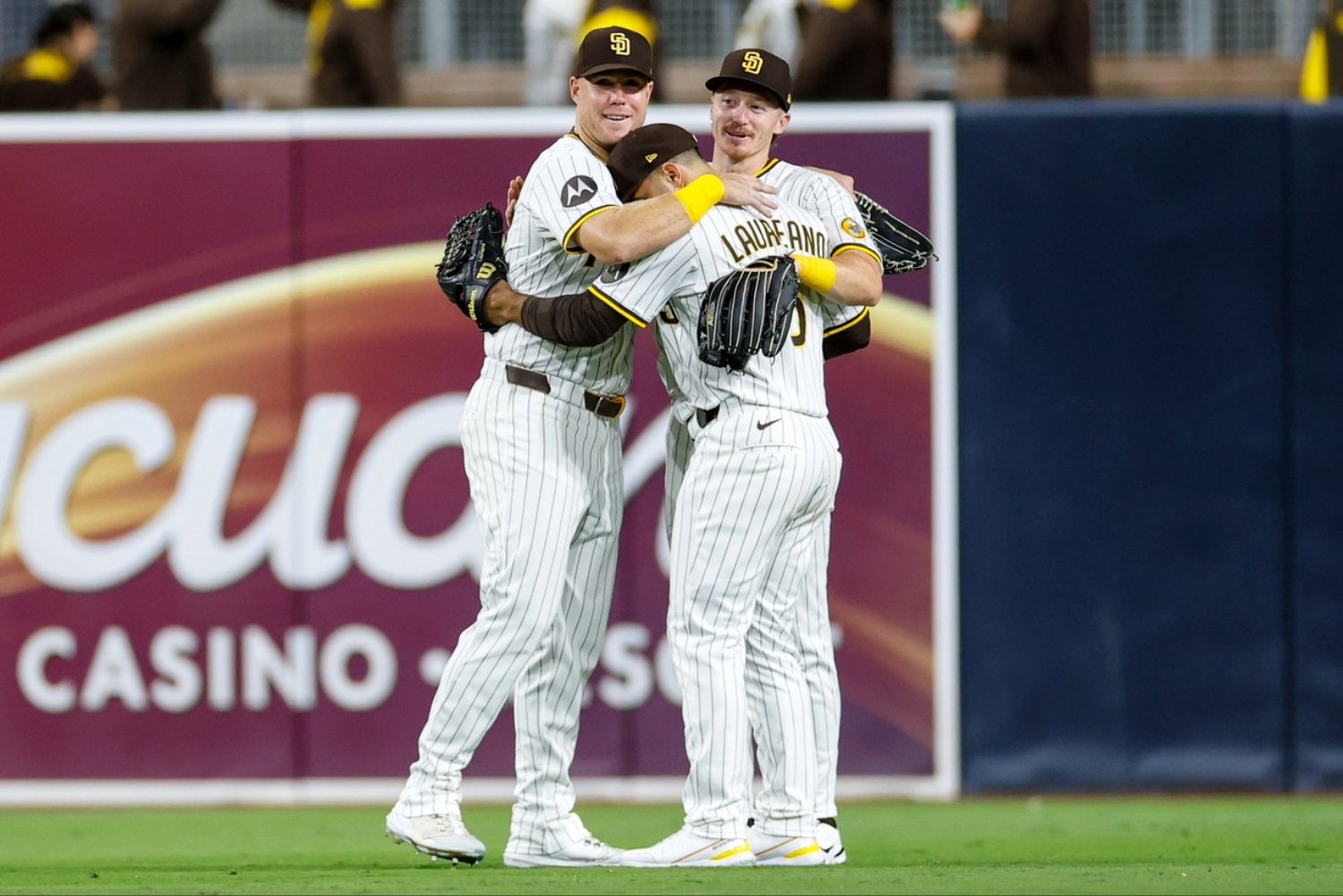
The Padres’ outfield is more unique in this discussion, as two of their three spots are of no concern. Jackson Merrill has thrived with the glove, even when he’s mired in an injury-riddled season like he was last year. Meanwhile, Fernando Tatis Jr. is one of the sport’s premier defenders and has the hardware to back it up. Instead, the only real concern lies in the -5 FRV of Ramón Laureano, who is poised to handle full-time duty after being acquired from the Baltimore Orioles at last year’s trade deadline.
What’s interesting about Laureano in left is that his inclusion on the leaderboard only accounts for his time post-deadline. Even so, his FRV was the worst among qualifying Padres defenders last year. And that’s with an arm value that sits in the 92nd percentile among all MLB players. It’s also important to acknowledge that defensive metrics rely heavily on sample size to find validity. It’s hard to put too much stock in a 400-or-so inning sample. Nevertheless, that so much of his negative FRV is indicative of a range issue — something that was also problematic when his range accounted for -6 of his overall -2 FRV in 2024 — may not bode super well for improving on a position that ranked 15th in FRV last year. It’s a much more enigmatic situation than the team has anywhere else on the field. Can playing next to Merrill help? Can the arm compensate more for the range over a full season? Either way, the fact that there’s stability has to mean something on the defensive front against the rotating cast of characters left field saw last year.
You will note that there has yet to be a discussion about first base as part of this larger exploration of team defense. That represents sort of an important position on the field in its need to effectively support the rest of the infield defenders. The fact is that this position is a complete wild card in matters of the San Diego Padres’ defense in 2026. Each of Gavin Sheets, Nick Castellanos, and Miguel Andujar have either zero or minimal sample on which to hang their defensive hat. Other than a decent showing in a small sample from Sheets last year, there is simply no way of knowing where the numbers may end up in this position by the end of 2026.
It’s because of that that it becomes fairly difficult to state that the Padres can be a better defensive team in 2026 than they were last year. There are certainly things that indicate that they should be. Fermin and Laureano as full-time contributors, Cronenworth back in a full-time position, Machado’s improvement after a brutal start, and Sung Mun Song‘s presence as a utility fielder all paint a rosier picture this time around.
The defense should be, at worst, league average. First base, however, will have a lot to say about how far above or below they land on that threshold when it’s all said and done.
Think you could write an article like this one? We’re looking for additional contributors, and we pay for all our content! Please click here, fill out the form, and someone will reply with more information.