
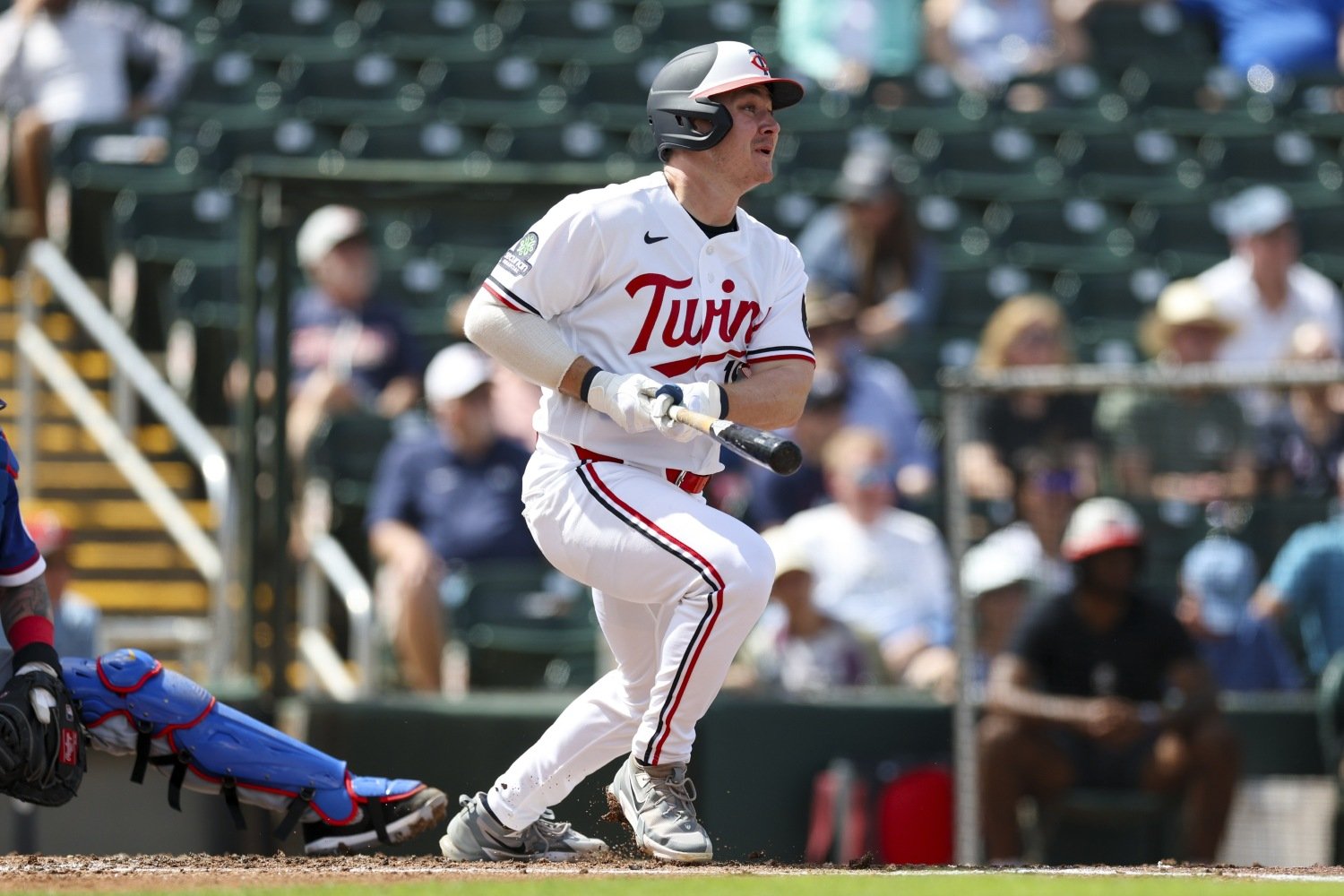
Acquired at last year’s historic trade deadline sell-off, Alan Roden was an athletic 25-year-old outfielder whom the Twins chose to target in the Louis Varland trade. With a .917 OPS across over 100 games in Triple-A, Roden has little to prove in the minor leagues. That, paired with his age, means the next step in his career is proving he can produce in the majors, where he’s struggled in 153 plate appearances. Unfortunately, the Twins aren’t providing him that opportunity.
In a vacuum, Roden should be a lock to make the Opening Day roster of a team projected to finish well below .500. He’s likely the second-best defensive outfielder they have, after a strong showing in the field in 2025 by Outs Above Average. Despite his small sample of offensive struggles, he’s shown significant upside in his Triple-A performance and could contribute to an MLB roster in several ways. He’s a logical answer for a team looking to get faster and better on defense, while also having a chance to bloom offensively.
Unfortunately, Roden had a minor-league option remaining, which led to his demotion on Sunday. His strong spring performance was not enough to beat out the Twins’ insatiable urge to hoard left-handed-hitting outfielders. Trevor Larnach and James Outman would have to be exposed to waivers if they don’t make the roster. Now, the team can stash the 26-year-old Roden in Triple-A for his third stint at a level he has already dominated. Meanwhile, the 40-man roster remains overstocked with left-handed outfielders, with Walker Jenkins set to add to that group later this season.
Of course, this could have been avoided at several junctures. It’s worth asking why Roden was targeted by the Twins at all, as opposed to a player at literally any other position. The timeline of his career doesn’t align with what the Twins need or what they can offer him in terms of opportunity. They also acquired Outman at the deadline, knowing his out-of-options status would contribute to a logjam in short order.
Perhaps they saw good value and disregarded the fits. It all could have been solved this offseason by non-tendering Larnach, or trading him for just about anything. Instead, they chose to pay him $4.475 million, despite health concerns and the fact that he’s little more than a DH with a career OPS of just .726. It’s a baffling decision, in hindsight, considering the team’s surfeit of this player type and need for as much payroll space as possible.
Roden may not be a strong bet to be a big part of the next great Twins’ team, but he’s an interesting player who deserves a real chance. His window of opportunity will be incredibly small—potentially limited to the time between whenever he’s called up and when Emmanuel Rodriguez and Jenkins debut.
This is an example of how the Twins simply cannot do a thorough job of sorting through these types of players, given how many of them they continue to collect and retain. Almost 1,700 plate appearances into Larnach’s career, they’re either still chasing some kind of undiscovered upside or see his career 103 wRC+ as too good to risk trying to improve upon. Alan Roden will be fortunate to get a quarter as many plate appearances to prove himself.
Today, Roden is the loser in the Twins’ philosophy regarding left-handed-hitting outfielders. The team ultimately loses out, as well. They declined to take steps toward their goals of getting faster, more athletic, and better defensively. Their roster is extremely left-handed as a whole, and is certain to see that weakness attacked regularly. They’re choosing not to pursue upside for a roster that is in desperate need of it if they want to contend in 2026. It’s just bad roster construction. And the lack of opportunity they’re creating by holding onto every player of this type will have lasting effects on players in future seasons.
Roden will likely appear in 2026, but the current roster structure gave him no chance to earn a job this spring. His already limited window has likely shrunk further. The Twins could have avoided this, but their pursuit of left-handed hitters comes at a cost. Do you agree?