
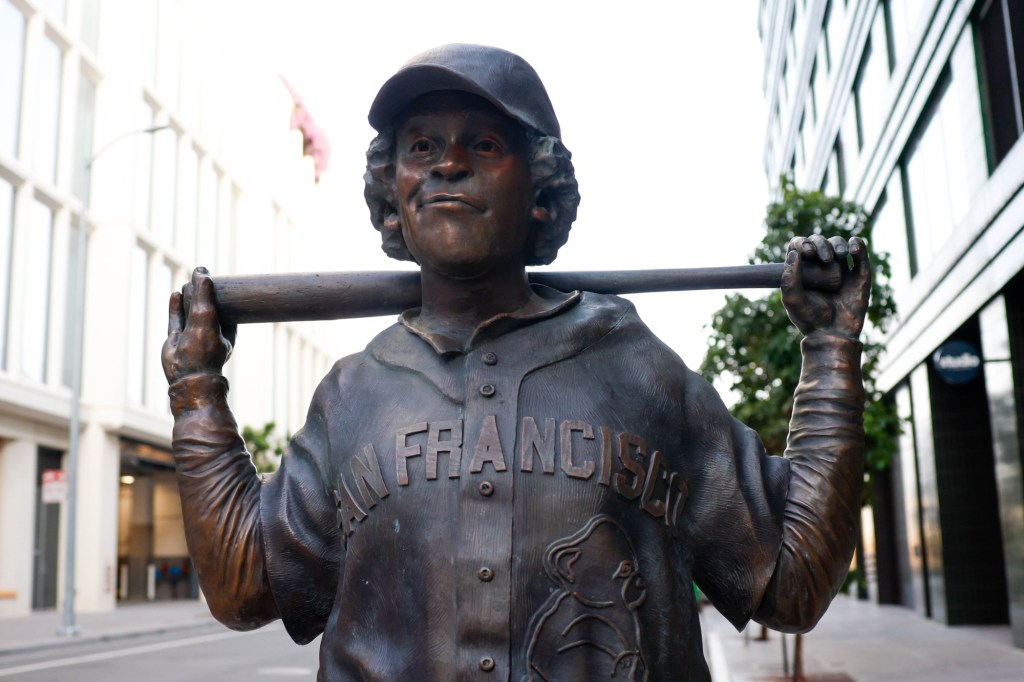
You’ll find her if you stroll south of Oracle Park to get something to eat or run along the promenade on the south side of McCovey Cove.
That is, you’ll find Toni Stone in bronze sculpture form. It’s a tribute by the Giants to one of the most remarkable unsung heroes in the history of baseball – a longtime Oakland resident who was the first woman to ever play professional-level baseball and a trailblazer for Black American athletes during the dawn of the Civil Rights era.
Stone enjoyed a brief moment of celebrity in the early 1950s in the Negro Leagues before she mostly fell back into obscurity and died at age 75 in 1996. Growing up in Minnesota, Marcenia Lyle “Toni” Stone ascended in all-men’s leagues, starting with the San Francisco Sea Lions, and eventually replaced Hank Aaron on second base with the Indianapolis Clowns, a professional touring team where her skills as a ball player were once compared by a Miami newspaper to Jackie Robinson.
Unlike the towering Willie McCovey sculpture in nearby China Basin Park, the statue of Stone isn’t positioned on a pedestal or presented as larger-than-life. Rather, this more human-sized figure is meant to invite passersby to walk up, read the inscription at the base and get to know her life and legacy, according to the artist, Dana King.
In this form, Stone stands with a baseball bat slung over her shoulders, sporting the rumpled, repurposed uniform that would have been typical for the Negro Leagues. She’s looking straight ahead and wearing a hint of a smile. It’s not a smirk, as if to rebuke the doubters and haters she faced at pretty much every game she played, but a confident, determined expression that says, “I’m here, and I’m ready to play.”
 Dana King’s sculpture of Toni Stone, the first woman to ever play in a men’s professional baseball league, stands near Oracle Park in San Francisco, pictured on Jan. 31, 2026. Stone, a Black woman who lived part of her life in Oakland, came up in the Negro Leagues in the late 1940s. (Shae Hammond/Bay Area News Group)
A large part of the Stone narrative is that she was a woman playing a sport that was generally considered unsuitable for females in the first half of the 20th century. The story might have been different if she had been white and, therefore, eligible to play in the All-American Girls Professional Baseball League, which was started during World War II and made famous in the 1992 film, “A League of Their Own.”
Instead, Stone had to navigate her sport as a Black athlete when segregation was still the law of the land. Up until Jackie Robinson signed with the Brooklyn Dodgers in 1947, talented Black players were barred from Major League Baseball.
“I just love everything about her,” King said. “She wanted to play baseball since she was a little girl, and she got pushed back at every turn. And she kept going and following her dream, and that’s so inspirational and aspirational, especially for anybody who’s trying to do something and they’re told you can’t do that.”
King, who left her long career in Bay Area TV news to become a sculptor, admitted she knew little about Stone before she was commissioned by the San Francisco Giants to create a monument to her. Unveiled in 2024, the sculpture was part of the Giants’ efforts to honor prominent Black historical figures — including naming streets — at its new four-tower Mission Rock office-retail-residential development. Stone’s monument stands at the corner of Toni Stone Crossing and Dr. Maya Angelou Lane.
“Toni’s story is about gender inequality, and it’s obviously a story about Jim Crow America, and it’s a human story,” said Martha Ackmann, who wrote an acclaimed 2017 biography about Stone. “Curveball: The Remarkable Story of Toni Stone, the First Woman to Play Professional Baseball in the Negro League” became the inspiration for the play, “Toni Stone,” which premiered in New York City in 2019 and briefly played at the American Conservatory Theater in San Francisco before the COVID-19 lockdowns in 2020.
In certain ways, Stone’s story “is not triumphant at all,” Ackmann said. “She was hired as a gate attraction. She also knew that she was hired at a time when the Negro Leagues were losing their fan base. Major League Baseball was becoming integrated, and the talented Black players were moving (there). As to what Toni’s story says about us as human beings, it tells us what you do when you are given one lousy chance to grab your dream.”
Stone knew she was never going to get rich playing baseball, and she had to constantly deal with disparaging behavior by some of her male colleagues, including sabotage and the threat of sexual assault. And she had to endure racist taunts from fans and other second-class treatment.
“She paid a mighty price for wanting to do what she felt in her bones that she was born to do,” Ackmann said.
Born in 1921, Stone, known as “Tomboy” around her St. Paul, Minnesota neighborhood, excelled in many sports, including basketball, skating, golf, swimming and hockey. But baseball captured her heart. In a 1991 interview, quoted by Ackmann. Stone said that baseball “was like a drug, whenever summer would come around [and] the bats would start popping, I’d go crazy.”
 Sculptor Dana King (Suzanna Mitchell/San Francisco Giants) speaks at the Sept. 25, 2024 unveiling of the statue she created of trailblazing Negro League baseball player Toni Stone, at Mission Rock in San Francisco near Oracle Park.
Stone’s parents, Boykin and Willa Stone, resisted her playing baseball, though not for the usual concerns, Ackmann said. “They didn’t think she could make a living at it. They were very pragmatic.”
The Stones finally relented, realizing their daughter needed a way to channel her prodigious energy. Around age 16, Stone began playing with the semipro Twin City Colored Giants and eventually dropped out of high school in the hope of making a living playing baseball. She rejected any expectations that she’d try to find a husband, saying, “When you finish high school, they tell a boy to go out and see the world.”
For Stone, seeing the world meant joining her recently married younger sister in the Bay Area in 1943, which was in the midst of its World War II boom. She also experienced the possibility of a more egalitarian society when she became a “Rosie the Riveter,” one of the thousands of women who worked alongside men in the Bay Area’s defense industry.
Stone also continued to play baseball when she could. After the war, she talked her way onto the roster of the San Francisco Sea Lions, a barnstorming former team in the West Coast Negro League. She told the owners that the novelty of a woman on the team could draw crowds.
Ackmann said Stone was always met with resistance when she inserted herself into traditional male spaces. “But somebody would also say, we’ll just give her a try, and once she showed how good she was, then, for the most part, her teammates wanted her on the team,” Ackmann said.
Always certain of her worth, Stone became discontented with the Sea Lions after learning she was being paid less than her teammates. She then signed on to the New Orleans Creoles through 1952, where she had to “steel herself” against the daily humiliations of playing in the South, often being called the N-word from the stands.
Stone got her big chance to play professional baseball when Syd Pollock, the owner of the Indianapolis Clowns, signed her in 1953 to replace Hank Aaron, who had just been signed by the Milwaukee Brewers. Once again, Stone’s big break was initially thought of as a way to attract crowds.
 ** ADVANCE FOR WEEKEND, MAY 20-23 **FILE**This is an undated file photo of Toni Stone, the first woman baseball player in the Negro Leagues. (AP Photo/Courtesy of Negro Leagues Baseball Museum)
That’s how Pollock promoted her in a press release, which declared: “The latest masculine enterprise to fall before the advance of wearers of skirts and panties is the baseball diamond. The Indianapolis Clowns signed the first female baseball player in the history of the Negro American League.”
But Stone refused Pollock’s request to wear a short skirt in games, as the women of the All-American Girls Professional Baseball League did. Among other things, Stone said skirts were “foolish” if a player was expected to slide.
However, there were other indignities. As her team traveled the South, they often were barred from whites-only restaurants and hotels. The situation was even worse for Stone, because some hotel owners assumed she was a sex worker traveling with the team, so they would tell her to find the nearest brothel.
Despite these challenges, Stone excelled during the 1953 season, achieving a .364 batting average, which put her fourth in the league behind Ernie Banks. “She gives not an inch of ground as she executes double plays with the finesse of Jackie Robinson,” the Miami Times reported. “She’s agile, has good baseball instinct and knows what a Louisville Slugger is for.”
Stone played 50 out of 175 games for the Clowns before Pollack sold her contract to the Kansas City Monarchs. For her only season with the Monarchs, she spent most of her time on the bench and decided to retire.
She returned to Oakland to her husband, Aurelious Alberga, a survivor of the 1906 earthquake, a World War I veteran and a politically active businessman whom she met at a Fillmore Street jazz club and married in 1950. He supported her when she left the Bay Area for months at a time to play baseball, though their 37-year age difference made people wonder about their marriage.
Stone had always been independent, seen as never having “a romantic bone in her body,” Ackmann said. But she and Alberga stayed married until he died at the age of 103 in 1988, and when she died in 1996, she was buried with him.
Leaving baseball was initially difficult for Stone, but she “found pieces of herself” when she began coaching baseball for teenage boys in the 1960s, according to Ackmann. She also worked in home health care and was known for riding her bicycle around Oakland.
Stone had long given up on being recognized for her baseball accomplishments, though the San Francisco Giants invited her to throw out the first pitch at a game in the early 1970s. Then in 1991, she was honored by the National Baseball Hall of Fame along with other Negro League Players, and in 1993, she was inducted into the Women’s Sports Hall of Fame.
After becoming the subject of an acclaimed biography and of a new play, she now has a street named after her, meaning that any business or resident on Toni Stone Crossing will further remind people of her legacy when they send or receive mail from their addresses, said Yennga Khuong, the director of public space and programming for the San Francisco Giants.
Plus, there is the sculpture in Mission Rock, accessible to anyone walking in this burgeoning San Francisco neighborhood. King noted that Stone always liked to be available to her fans, “who wanted to come up and talk to her after her games.”
Ackmann added Stone certainly put up with a fair amount of sexism and racism from people in the stands, but she also had a devoted fan base, mostly women. “They hung out to meet her after the game, and some even wanted to touch her to confirm that this really was somebody, somebody who was real.”