
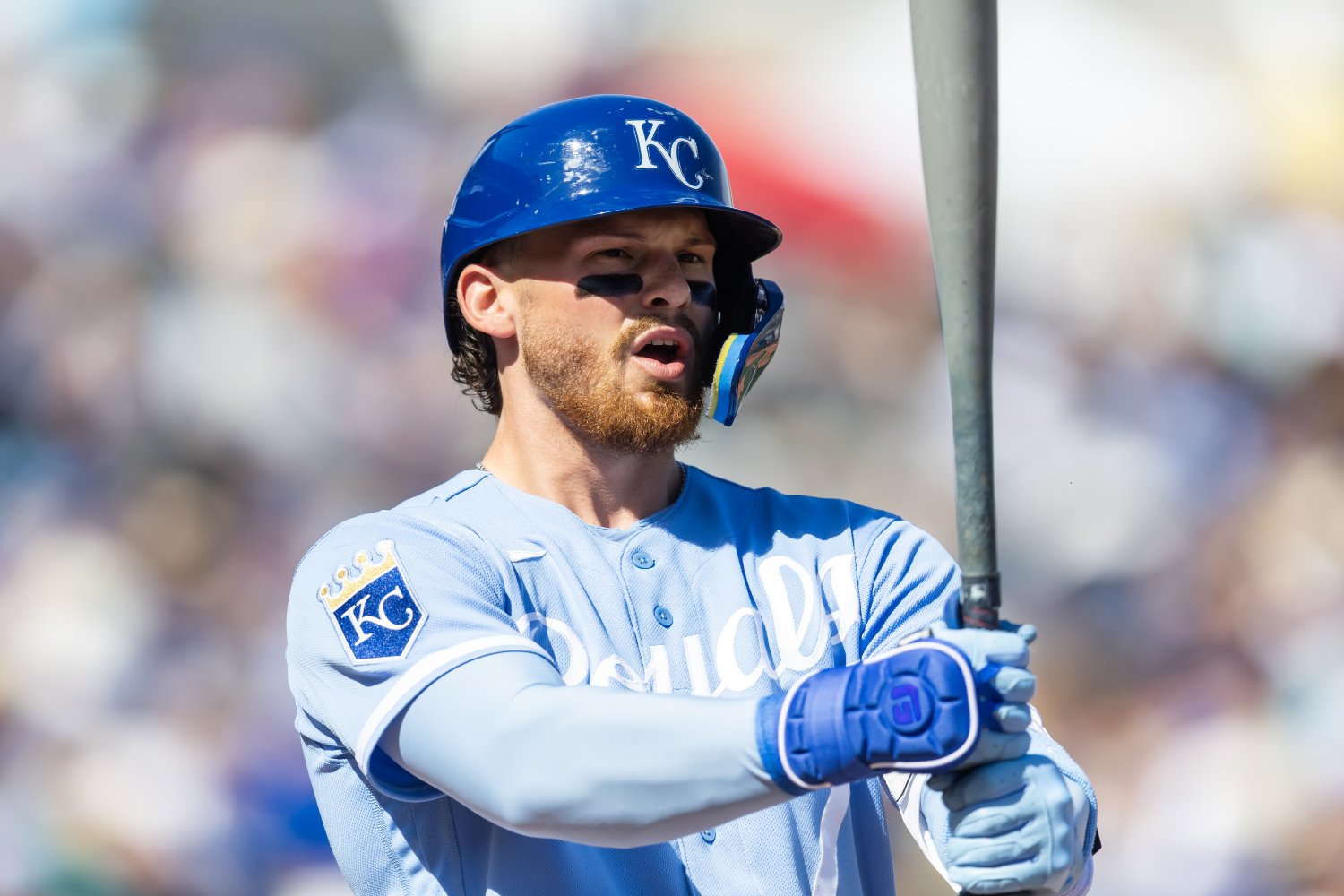
The Royals’ Opening Day will be Friday night in Atlanta. Kansas City is hoping for an improvement upon its 82-80 record a season ago. While it was only the second winning season for the Royals since 2015, they missed out on the postseason after going 86-76 in 2024 (they made it to the ALDS, where they lost to the Yankees in four games).
For the Royals to return to the postseason after a one-year hiatus, certain players will have to step up and have productive seasons. Of course, while some positive regression is due for a handful of Royals players, there will also be some negative regression.
Thus, which Royals will be key to their postseason chances this season? And which ones may be due for disappointing campaigns?
In this post, I will share my five bold Royals player predictions for the upcoming season, which begins this week, and how they could impact the 2026 season.
Let’s start really bold with the first one.
Yes, I know the chances will be tough for Witt to win the AL MVP, especially with Aaron Judge and the Yankees’ media “bias” working against the Royals franchise star. However, I think many chips will fall in Witt’s favor, helping him earn his first-ever AL MVP award in 2026.
Witt did have a “down” season in 2025, especially compared to his sensational 2024 campaign.
In 2024, he hit .332 with a .977 OPS, and he hit 32 home runs, scored 125 runs, collected 109 RBI, and stole 31 bases. He also played stellar defense, which contributed to his 10.5 fWAR. Thus, people who valued “overall” play may have favored Witt over Judge in the AL MVP race.
In 2025, many of Witt’s offensive metrics regressed. His average and OPS were .295 and .852, respectively. Furthermore, he only had 23 home runs, 99 runs scored, and 88 RBI. He stole 38 bases and was caught only 9 times (compared to 12 in 2024), and he earned his first Platinum Glove award. That said, his decline in hitting numbers put him out of the AL MVP discussion early on (though he did finish fourth, behind Judge, Cal Raleigh, and Jose Ramirez).
However, according to TJ Stats, Witt’s 2025 Statcast percentiles indicate his skills were among the most elite in the league, as shown below.
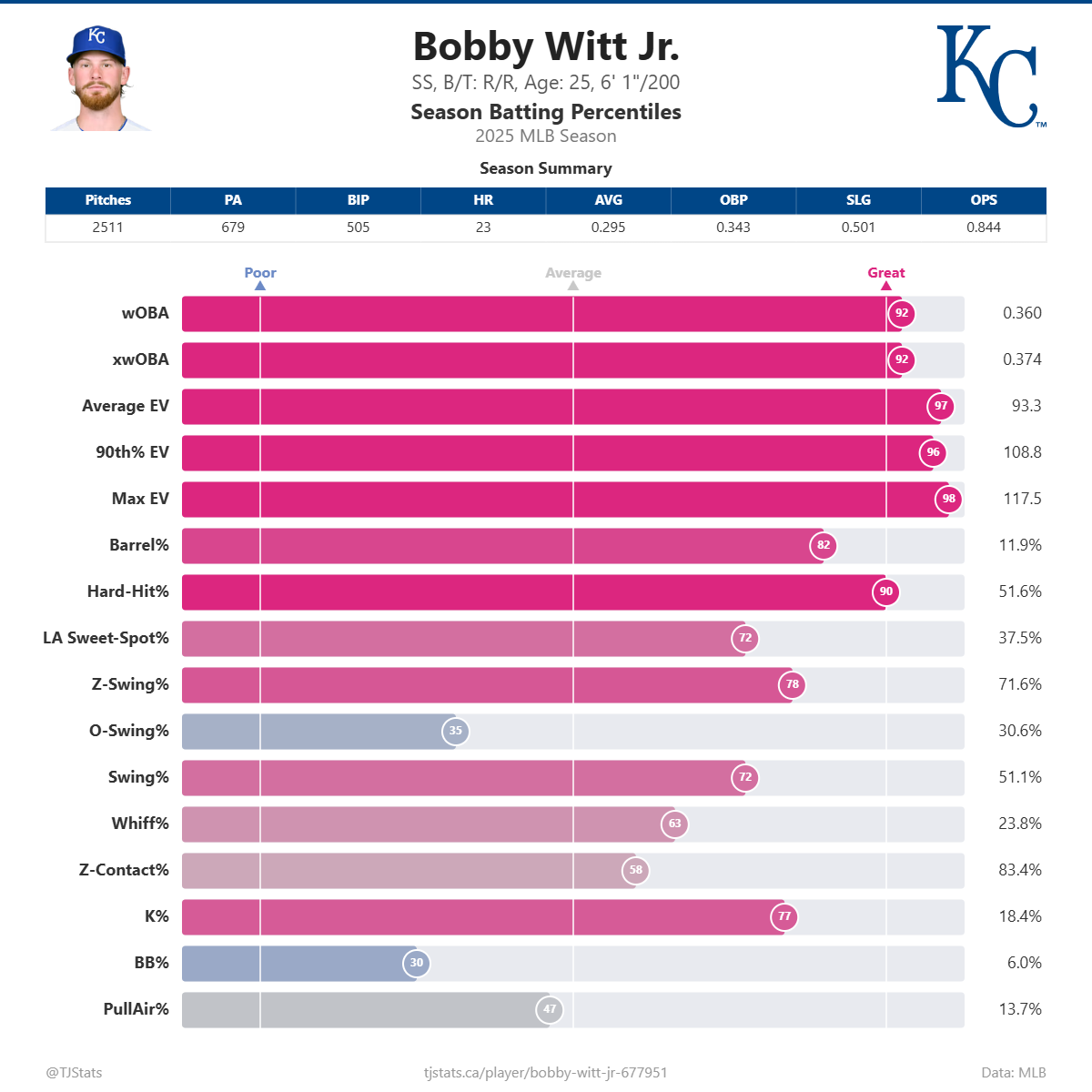
Not only did his wOBA and xwOBA rank in the 92nd percentile, but his .374 xwOBA was 14 points higher than his actual wOBA. That suggested Witt may have suffered from some poor batted-ball luck, and his .334 BABIP, 20 points lower than his 2024 BABIP, seemed to support that.
In addition to the difference in wOBA and xwOBA, Witt ranked in the 98th percentile in Max EV, 90th percentile in hard-hit%, 82nd percentile in barrel%, and 72nd percentile in LA Sweet-Spot%. While he could pull the ball more (47th percentile PullAir%), he showed the skills of a hitter who would benefit in a more “homer-friendly” home ballpark.
Thankfully, that will be the case in 2026. Kauffman Stadium will have friendlier dimensions for home runs, especially those balls hit in the gaps. When considering the new gaps of the K for 2026, which mirror Target Field in Minneapolis closely, Witt will seem to see more hits go for homers in those gaps, which is a strength of his as a hitter.
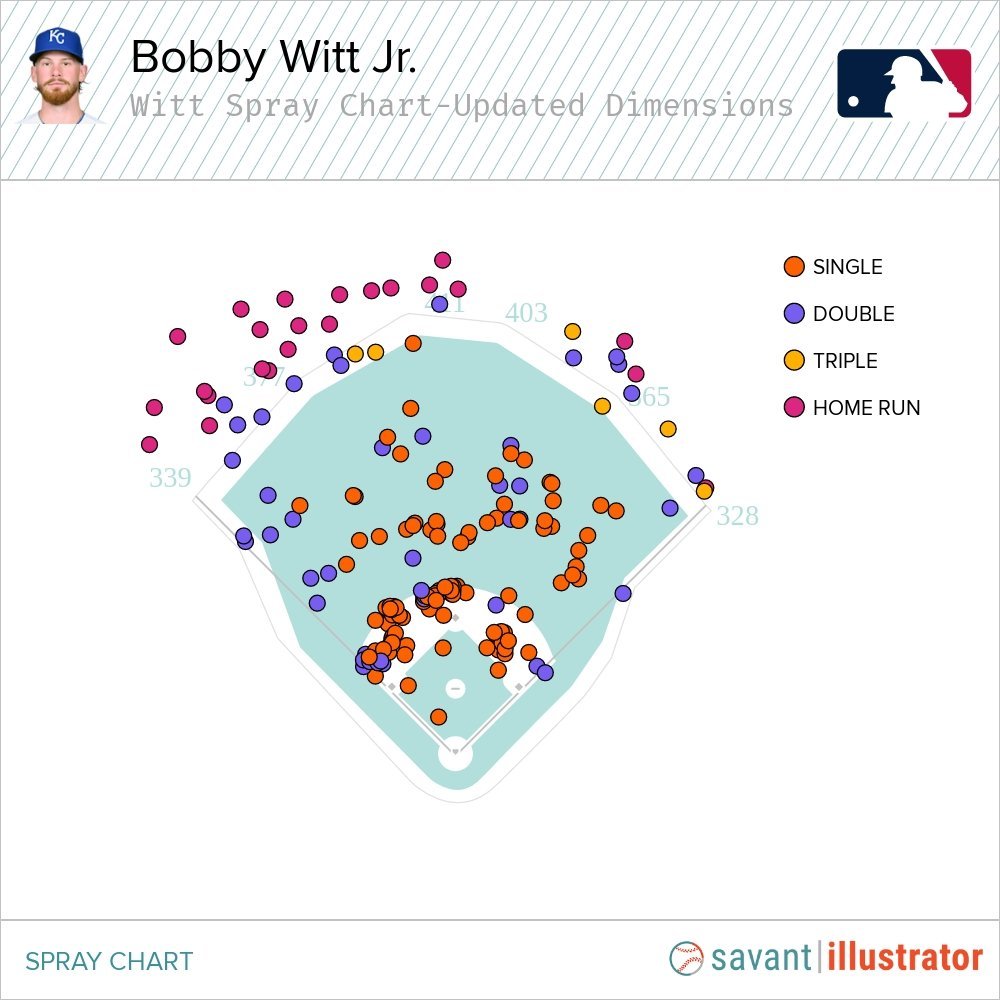
Witt has already proven that he is a stellar fielder and baserunner, and it’s unlikely that either of those skills will decline in 2026 (barring injury). Thus, a tick up in power numbers, which I think is bound to happen with another year of maturity and a more hitter-friendly home ballpark, will help give him the edge that he’s been missing against the Yankees slugger for the past couple of seasons.
Cags had a nightmare debut with the Royals in 2025.
In 62 games and 232 plate appearances, he hit .157 with a .532 OPS. He hit seven home runs, but his LA Sweet-Spot% was only 30.4% (5th percentile), and his O-Swing% was 38.5% (5th percentile). Due to these two factors, Caglianone couldn’t fully tap into his power profile despite prodigious power tools (97th-percentile 90th EV and 70th-percentile barrel rate).
This spring, in both Spring Training and the WBC with Italy, the former Florida product has made all the right adjustments at the plate. He’s still showcasing that unique power, but he’s showing positive gains in launching the ball, as well as swinging and chasing less. That is illustrated in his TJ Stats summary this spring.
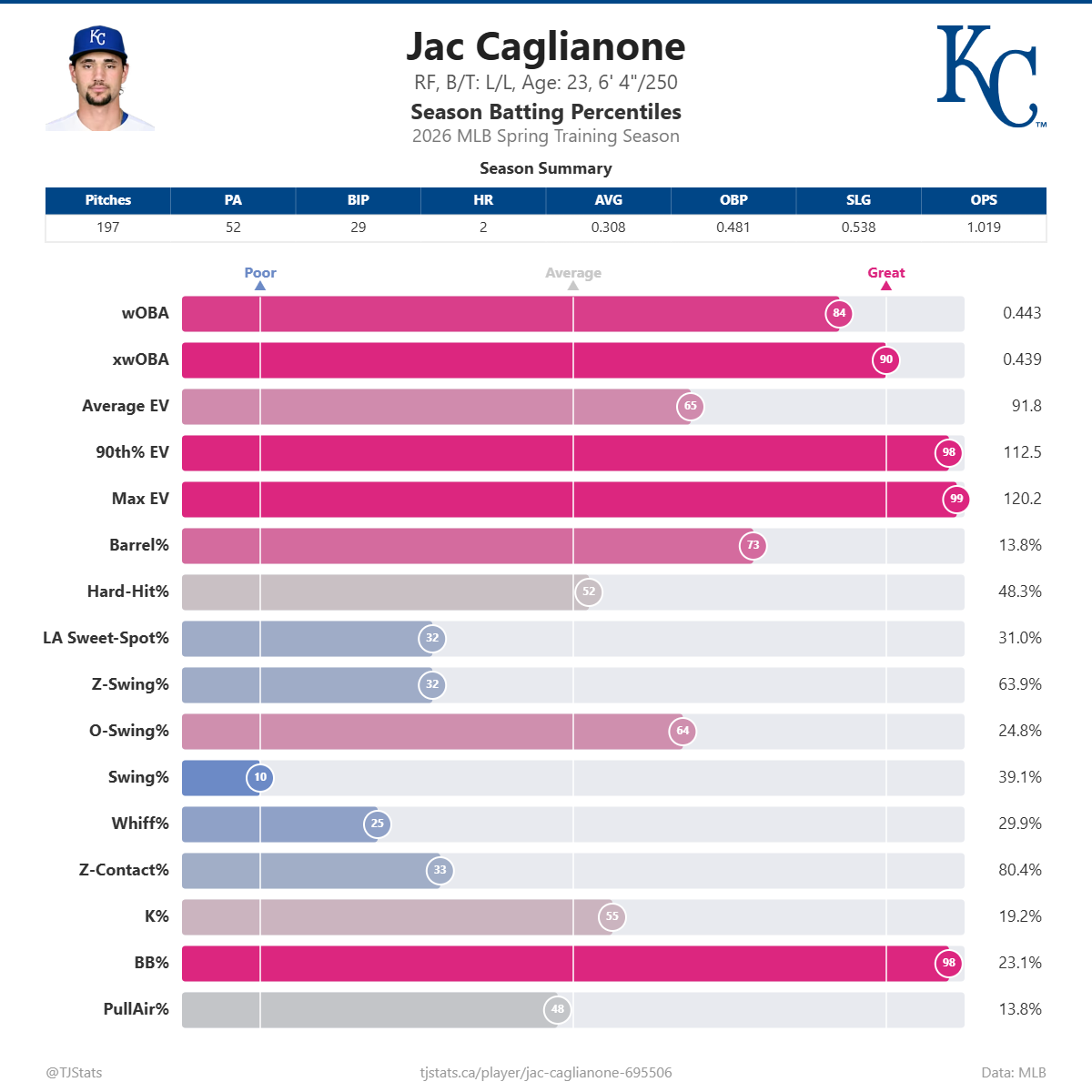
The LA Sweet-Spot% is only marginally better percentage-wise, but the 32nd percentile is much better than the fifth percentile. Conversely, his 24.8% O-Swing% this spring has been a major improvement, ranking in the 64th percentile. Thus, not only is his walk rate higher (23.1%), but he also produced better results in Arizona, with a .443 wOBA and .439 xwOBA.
With less pressure on him in 2026 than in 2025, I think Cags will thrive, especially now that he’s more in tune with a patient and selective approach. I am not sure if Cags will be a high-average hitter, and the projections are mixed with that as well. ZiPS and OOPSY project averages of .254 and .258, while the BAT X projects an average of .232. That said, they all seem to think he’s capable of 20+ home runs, especially if he can play in 140 or more games.
If Caglianone can stay healthy, I think he will lock in and hit 25 or more home runs in 2026 as a No. 5 or 6 hitter in the Royals lineup. That will help solve the outfield production problem that has plagued the Royals over the past couple of seasons.
It has been an alarming spring for Estevez, who begins his second year in Kansas City. The 33-year-old Dominican closer has traditionally been slow to ramp up, and after saving 42 games and posting a 2.45 ERA last year, fans want to give him the benefit of the doubt. That said, the metrics are pretty tough to stomach, even for his standards.
In four innings of work this spring, Estevez has a 9.00 ERA and 15.15 FIP. Furthermore, he has failed to get a strikeout and is averaging under 90 MPH on his four-seamer, as illustrated in his TJ Stats summary below.
.png.0c502cecfa6e86a239d8bc27eae70c23.png)
When looking at TJ Stuff+, Estevez has an overall 91 TJ Stuff+, with his four-seamer having an 88 TJ Stuff+. Considering he leans heavily on his four-seamer, that kind of regression on the pitch is concerning, even if it may increase in velocity over the course of the season.
A red flag with Estevez is that he struggled to generate whiffs last year. Despite solid ERA numbers, his whiff rate ranked in the 9th percentile, and his CSW ranked in the 8th percentile, via TJ Stats. He also showcased plenty of concerning Statcast percentiles last year, as evidenced below.
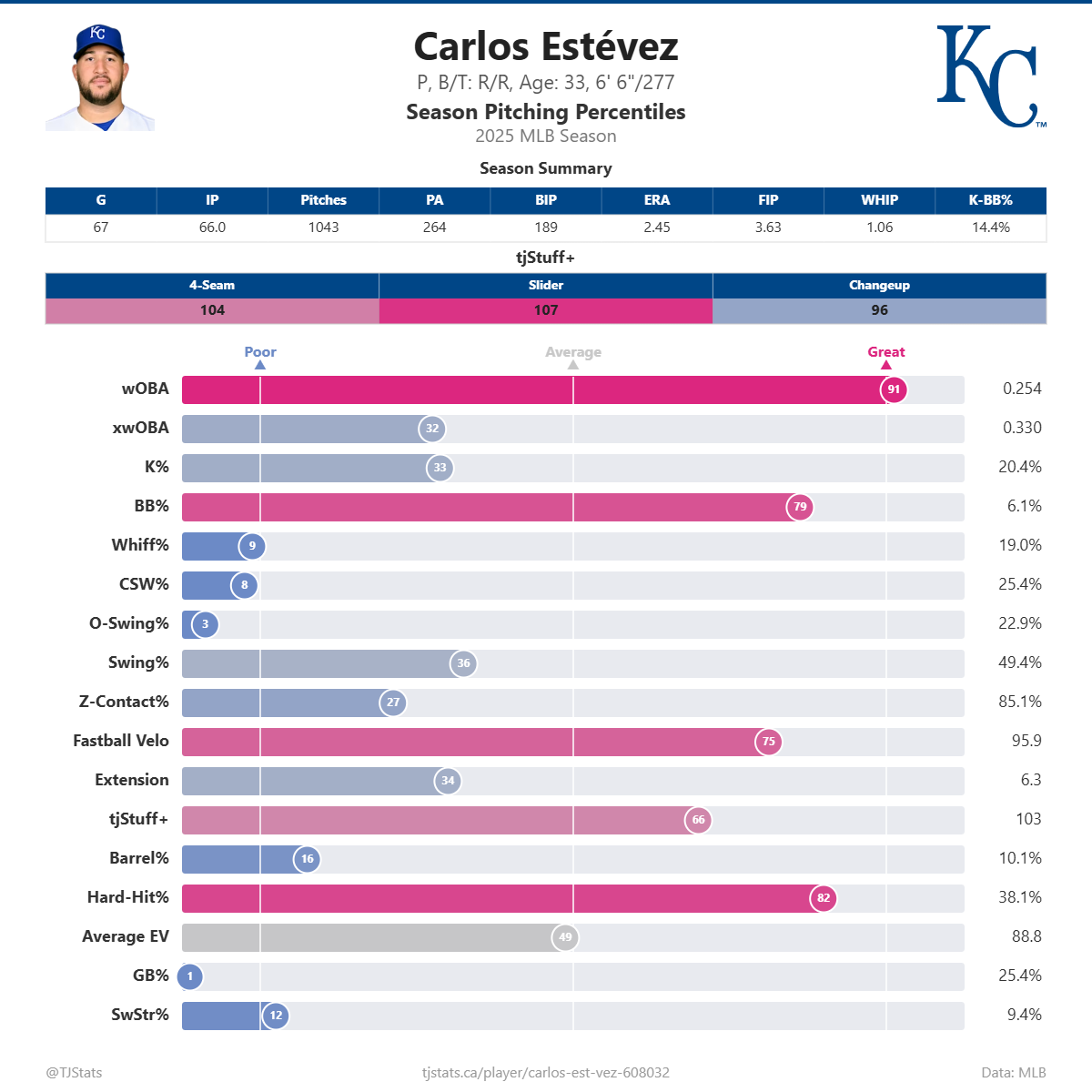
Those are the kinds of numbers that are more typical of a setup man, not a closer. These percentiles were with strong TJ Stuff+ numbers, as his 103 overall mark ranked in the 66th percentile. Any decline in TJ Stuff+ quality in the regular season could produce disastrous results in 2026.
Conversely, I think Erceg is ready to bounce back after a down 2025 and could take the closer spot from Estevez at some point in 2026.
After posting a 28.5% K% in 2024 (32% with the Royals), his K% declined to 19.6% in 2025. Despite this decline, his ERA went from 3.36 in 2024 to 2.64 in 2025. While the strikeouts were down, Erceg learned to pitch better overall, and it’s likely that he never was 100% following an early back injury, which may have affected his ability to hit spots to generate whiffs and chase, as illustrated below in his TJ Stats season summary.
.png.ed0b7a1252ea6e848956b25953bcf011.png)
This spring, he’s still getting ramped up, so the TJ Stuff+ isn’t as high as it was a year ago. That said, his chase rate is up, and his xwOBACON is down, both encouraging signs.
.png.3d634178ad5beb96f1bd4a06cf0c3275.png)
With Matt Strahm now in the Royals bullpen, manager Matt Quatraro has another arm to serve in the fireman role that Erceg had a season ago. Because of that, Erceg may be in line for more saves, which could come even earlier in the season if Estevez isn’t 100% back stuff-wise.
The Royals made some headlines with their trade for Collins and Nick Mears from Milwaukee in exchange for Angel Zerpa. It seemed like a win-win deal that addressed two much-needed areas for the Royals this offseason. While Collins doesn’t offer much power (nine home runs in 441 plate appearances), he didn’t chase last year (97th percentile O-Swing%) and got on base (.368 OBP).
This spring, Collins has had an uneven campaign, missing some time due to nagging injuries. As a result, he hasn’t produced much at the plate. In 28 plate appearances, he is hitting .120 with a .374 OPS and has 11 strikeouts to 3 walks. While the O-Swing% has been solid, per usual, his other Statcast percentiles have been pretty mediocre.
.png.71a8ed738ef90d113ae3d87ec5d95382.png)
It’s not that Collins won’t be a factor for this Royals lineup in 2026. He will be a crucial part. That said, I think he will end up being more of a rotational one than an everyday one, as many Royals fans initially believed when he was acquired.
As a result, Marte and Thomas have had solid Spring Training campaigns. In 23 plate appearances, Marte is hitting .300 with a .741 OPS and three walks to five strikeouts. He also has shown excellent plate discipline and contact skills in his limited sample with the Royals this spring.
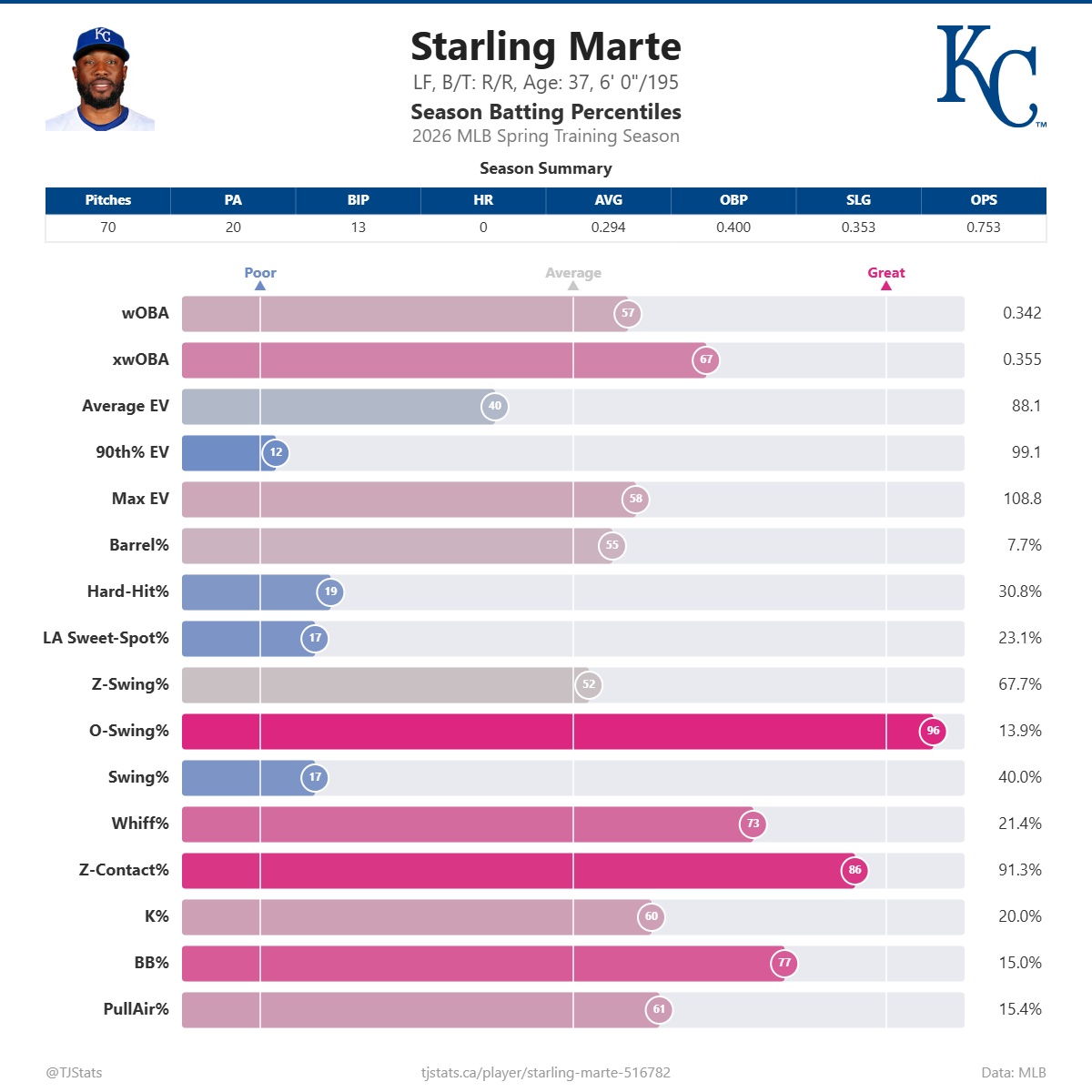
As for Thomas, he’s struck out a lot, but he’s hit two home runs and has posted an .839 OPS in 49 plate appearances. There’s a lot more risk with Thomas, but there’s also more upside power-wise than Collins. Thomas’ barrel and exit velocity numbers have been encouraging this spring.
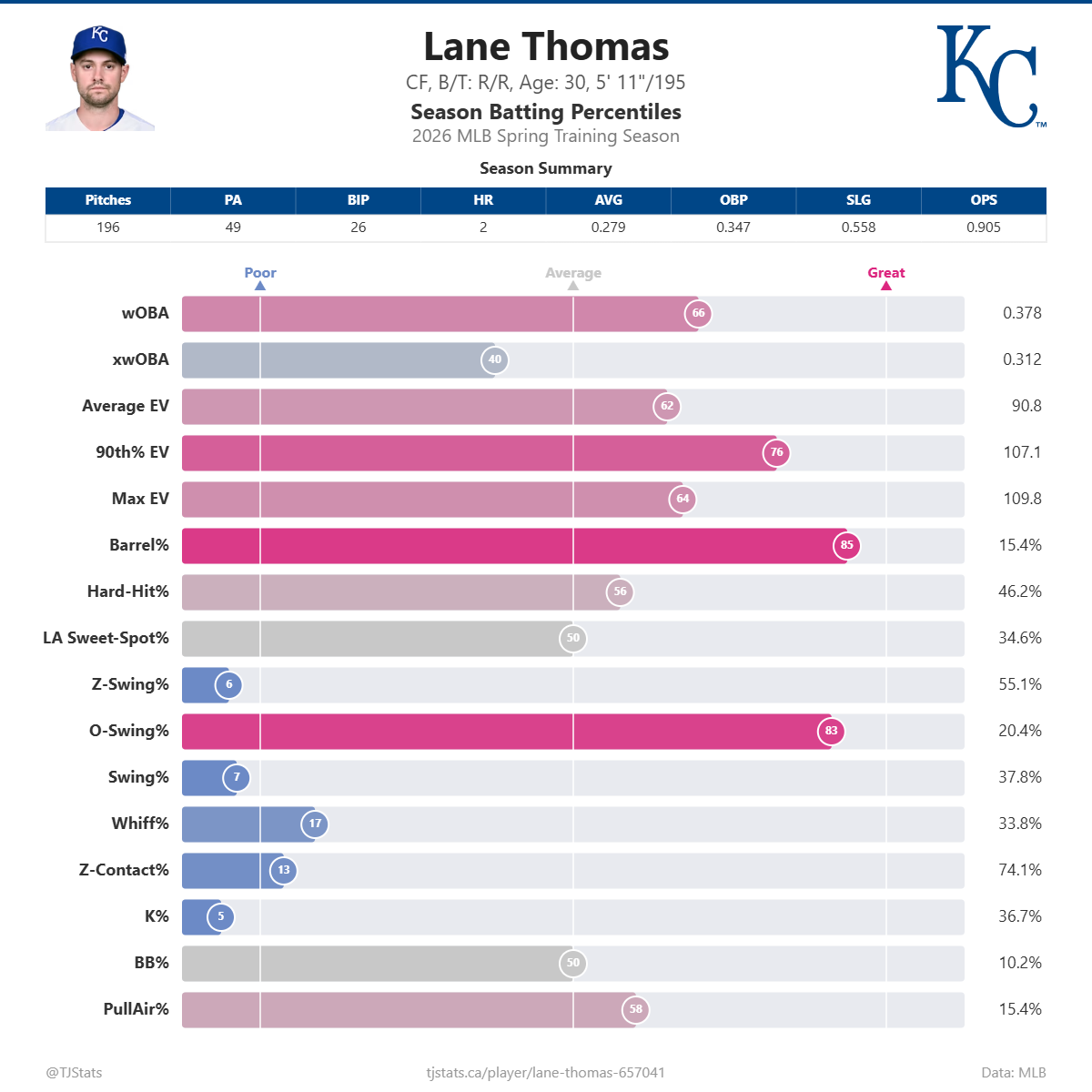
I don’t think Thomas will match his 2023 numbers again (28 home runs, 20 stolen bases, and .783 OPS). However, it’s looking like Thomas may be able to match his 2024 metrics (15 home runs, 32 stolen bases, .709 OPS), which is more than satisfactory for a rotational outfielder.
Ryan Bergert Becomes the Royals’ Third-Best Starter
Bergert was optioned to Triple-A, thus eliminating his chance of making the Opening Day roster. That said, Royals fans shouldn’t sleep on Bergert despite the early demotion.
In Cactus League play, the former Padres pitcher was hit hard, as evidenced by his 7.24 ERA, 8.84 FIP, 1.54 WHIP, and 35.3% HR/FB rate. He also allowed an xwOBACON of .403 and only had a zone rate of 43.4%. Thus, the command just wasn’t there for Bergert in Arizona this spring, and it makes sense that the Royals sent him to Omaha so he could work through those issues while pitching innings.
However, despite the command problems, the stuff was good, as illustrated by his TJ Stuff+ metrics below.
.png.9e636d44cb1fb69b73688cc5e29ea65a.png)
Not only did Bergert post a 103 overall TJ Stuff+, but four of his six pitches had TJ Stuff+ marks over 100. He also generated a chase rate of 34.1% and a whiff rate of 32.8%, both above-average marks.
Hence, the stuff is there for Bergert. He just needs to get his control in check. I believe he is more than capable of doing that, and once he is ready, he will be able to succeed at the Big League level immediately.
So why will Bergert be the Royals’ third-best pitcher in 2026? Well, his stuff has been much better than the other Royals’ starters this spring. Here’s a ranking of Royals starting pitchers by TJ Stuff+ via TJ Stats’ leaderboards.
Bergert: 103 TJ Stuff+
Cole Ragans: 102 TJ Stuff+
Stephen Kolek: 102 TJ Stuff+
Kris Bubic: 100 TJ Stuff+
Mitch Spence: 100 TJ Stuff+
Bailey Falter: 99 TJ Stuff+
Ben Kudrna: 99 TJ Stuff+
Seth Lugo: 98 TJ Stuff+
Mason Black: 95 TJ Stuff+
Michael Wacha: 95 TJ Stuff+
Noah Cameron: 94 TJ Stuff+
Not only did Bergert lead all Royals starting pitching candidates on the 40-man roster in TJ Stuff+, but he also had a TJ Stuff+ that was nearly double digits better than two starters slated to be in the Opening Day rotation (Wacha and Cameron).
Bergert will be one to watch in Omaha. If he’s able to get the zone rate up while still maintaining excellent stuff, chase, and whiff rates, he will not just be an early call-up, but a huge impact pitcher in the Royals’ rotation both in the short and long term.