
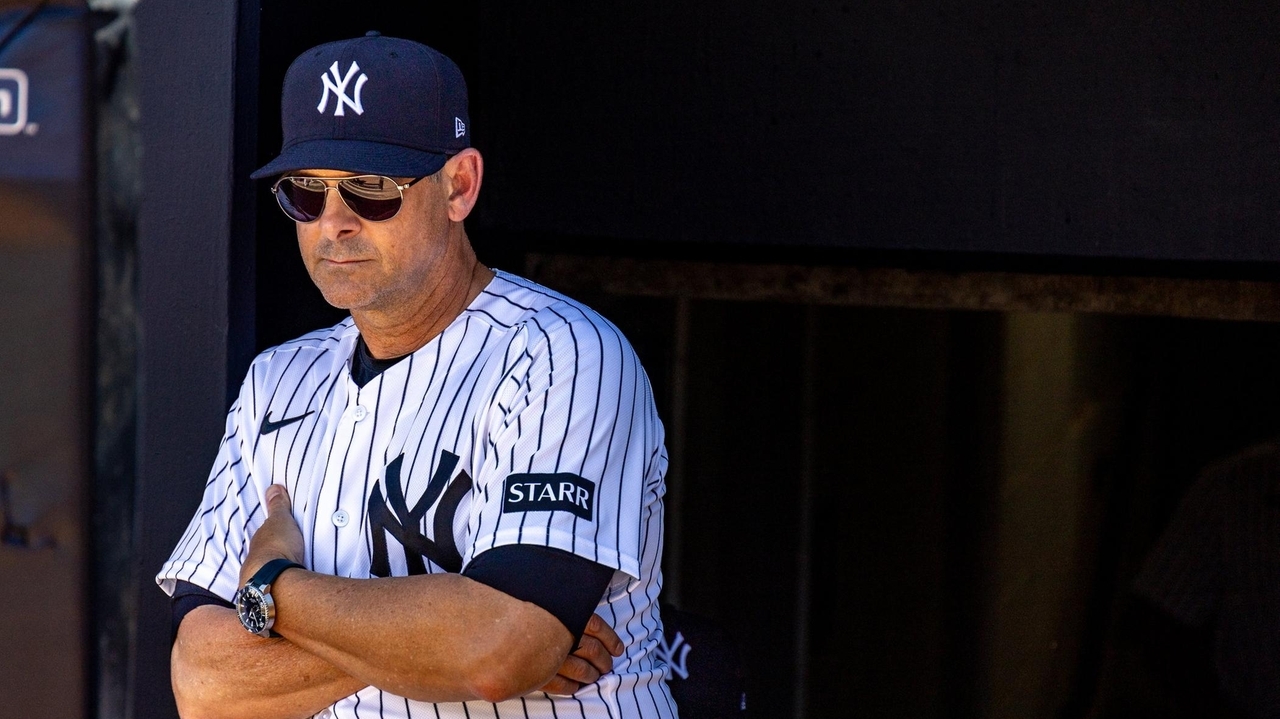
TAMPA, Fla. — Aaron Boone is entering his ninth season as Yankees manager, the club doing a lot of winning in that time, yet with no World Series titles. The closest Boone came to ending the franchise’s title drought, which dates to 2009, was 2024 when the Yankees won their first AL pennant since the ‘09 championship season. And that World Series was a dud, the Yankees losing the first three games en route to a loss in five games. Boone sat down with Newsday for a Q & A on his learning curve in the manager’s chair, influences from his past on how he does the job, public criticism of players and his most recent October disappointment.
NEWSDAY: Entering last October, you said this was “the best” you’d ever felt about one of your teams going into the playoffs. Did that make the ALDS loss sting even more?
BOONE: “Last year stung a lot. ’19 [the six-game ALCS loss to Houston] hurt because I do think we were really good. But last year, yes, more so than even ’22, we got to the ALCS [against Houston] and got swept and not that that doesn’t sting and not [that] I didn’t go in wanting to win that, but we were a shell of ourselves from when we were at our best that year. And then losing a World Series [in 2024] obviously stings. So ‘19, ‘24 and ‘25, for different reasons, all were difficult to get over.”
What do you know entering Year 9 of this job that you couldn’t have known in Year 1?
“I guess I get asked a version of that question every spring, and I don’t really have a good answer for you. Because you just live it and you’re constantly kind of moving forward. I probably have a way better idea of how I want to use my time during the course of the day, what I prioritize.”
Were you surprised the amount of things that come across your desk that you, as manager, have to handle?
“I use that line a lot, like, ‘How can you possibly know what’s going to come across your desk?’ And that’s real. I mean, we had COVID [in 2020], we had social uprising [summer of 2020] . . . like how could you possibly account for some of that or know and how do you handle that? I’d like to think as much as anyone I’m equipped to handle that going in, and I think part of that is my life experience in the game, growing up in the game, having a dad [Bob Boone] that played, managed. I think I came in going, ‘I know there’s going to be things I can’t account for; how do you know how you’re going to handle them?’ And that’s true, but I do feel like I was equipped to and probably more so now having real-time experience.”
Which managers influenced you the most, whether it be managers your dad played for or managers you played for?
“Guys my dad played for, I think I’m a product of all that. I remember Danny Ozark, Gene Mauch, Dallas Green . . . and I got to play for my dad, which was special. I would say as far as modeling, I think Joe [Torre] for me was the most [influential], just because he sat in this chair [Torre managed the Yankees from 1996-2007]. Even though I was only here with him for a few months [in 2003] . . . just like the way he handled it all is how I hope to handle things.”
What do you mean by “handle it all”?
“Just, you know, New York’s different. New York’s on the very, very short list of different challenges that some markets don’t bring. Obviously, Joe by the time I got here had already had a ton of success and gravitas already . . . but watching him handle the day-to-day and the environment that he, I think, helped drive and the tone he set where it’s very easy for distractions to come in and mess with our product and mess with our team, especially in an everyday game. And I thought he was a master of keeping the game the game for the players.”
As you know, among the criticisms of you from some media and fans is you don’t take players to task in public in media appearances. Is that fair?
“I don’t know. I don’t think it’s entirely true. I think there’s many nights I go in there [the news conference room] . . . I usually do it in the context of ‘we.’ ‘We didn’t swing it well,’ ‘we didn’t do well,’ ‘we’ve got to make that play.’ But if people want to see me publicly confront a guy in the media or to a camera, I think you have to be authentic in who you are and I don’t think that’s leadership, I don’t think that’s any way of doing something. You’ve got to be able to have difficult conversations behind closed doors and to somebody. And I think that’s how you handle things. I want to eliminate distractions in the course of a long season. Period. And I’m upfront with our guys about wanting to do that, and I have those conversations ahead of time, like ‘this is something that would be a distraction.’ We want to eliminate unforced errors. Is it fair? That’s not for me necessarily to decide. I disagree some with that. I may not come off the top rope on someone, that’s certainly fair. But I think there’s plenty of nights I go in there and it’s ‘we weren’t good enough tonight,’ ‘that wasn’t good enough,’ ‘we gotta make that play,’ whatever. I think that’s more effective.”

Erik Boland started in Newsday’s sports department in 2002. He covered high school and college sports, then shifted to the Jets beat. He has covered the Yankees since 2009.