
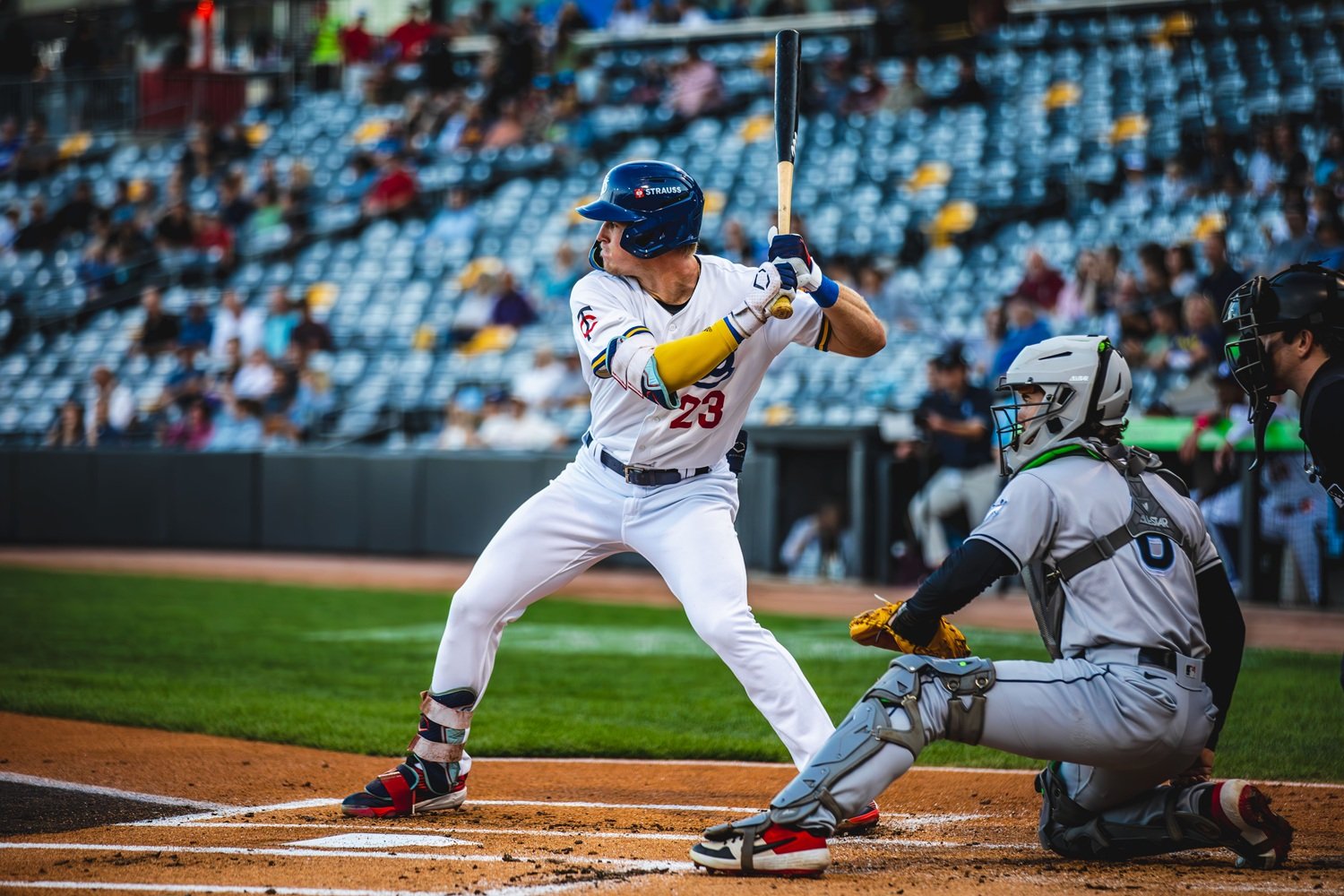
As prospect season ramps up, outlets across baseball are refreshing top-100 rankings for 2026, and for the local nine, the news is relatively good. Despite several Minnesota prospects battling minor injuries this spring, the system’s overall talent remains impressive.
Using the traditional 20-to-80 scouting scale (where 50 represents major-league average), several Twins prospects stand out for their pure hitting ability. To qualify for this list, each player appears on MLB Pipeline’s Top 30 Twins prospects.
Hit Tool Standouts
Honorable mentions include Marek Houston, Billy Amick, and Bruin Agbayani, each of whom has shown promising bat-to-ball skills with a 50-grade hit tool, but just missed the cut. Houston has a lot to prove with his hit tool this season after being Minnesota’s first-round pick in 2025. Amick has been floating around on top Twins prospect lists, but hasn’t put all his tools together. Agbayani might be a new name to Twins fans, as he was Minnesota’s sixth-round pick in 2025 from high school in Hawaii—but, like fellow 2025 draftee Quentin Young, he has big-league bloodlines and a high ceiling. That said, here are the top five hit tools in the Twins system.
5. C Khadim Diaw: 50-grade hit tool
Diaw’s development has been interrupted more than once, but his ability to hit has shown up whenever he’s been healthy. He produced at a high level in college (.348 average, .985 OPS) and carried that same approach into pro ball. Even in limited action, he has consistently found ways to get on base (.422 OBP) and control at bats (11.8 BB%).
His game is not built around power, instead prioritizing contact and a polished approach early in counts. Diaw demonstrates a mature understanding of the strike zone, rarely expanding unnecessarily and effectively limiting swing-and-miss (17.8 K%). The challenge for him moving forward is simply staying on the field long enough to let that skill play out over a full season.
4. SS Kaelen Culpepper: 55-grade hit tool
Culpepper has translated his college approach (.314 BA) well into professional baseball (.294 BA in 2025). He maintains consistent contact and shows the ability to use all fields, helping him avoid prolonged slumps. His bat speed allows him to handle velocity, and he does damage when pitchers challenge him in the zone, with a .585 slugging average on contact (SLGCON).
There is still some refinement needed. Offspeed pitches can give him trouble, particularly when he expands the zone. However, if he tightens that area of his game and lifts the ball more frequently, there could be another level to unlock offensively.
3. OF Hendry Mendez: 55-grade hit tool
Few hitters in the system demonstrate Mendez’s feel for the strike zone. He has built a reputation for controlling at-bats, often walking (13.6 BB%) as much as he strikes out (13.2 K%). That kind of balance is rare, and points to a hitter who understands exactly what he’s trying to do at the plate.
The next step in his evolution is adding impact. Mendez has historically put the ball on the ground too often, limiting his extra-base production. In 2025, he slashed .299/.399/.439, with 31 extra-base hits in 118 games. Encouragingly, there were signs last season that he is beginning to elevate more and tap into his strength without sacrificing his elite contact ability. His SLGCON rose from .468 in 2024 to .522 last year.
2. OF Gabriel Gonzalez: 55-grade hit tool
Gonzalez rebounded in a big way last season, climbing multiple levels to Triple-A and forcing his way into the organization’s long-term plans. His calling card has always been his natural ability to put the bat on the ball, and that skill remained intact even during tougher stretches. In 123 games last season, he hit .329/.395/.513 with 38 doubles and 15 home runs.
What stood out most in his recent performance was the added balance. He cut down on strikeouts (14.5 K%), showed a bit more patience (8.7 BB%), and paired his contact ability with sneaky pop. He will likely always be an aggressive hitter, but if he continues to refine his pitch selection, there is everyday upside here.
1. OF Walker Jenkins: 60-grade hit tool
Jenkins sits at the top of this list for a reason. When healthy, he looks every bit like a middle-of-the-order hitter with both average and power upside. His left-handed swing is smooth and repeatable, allowing him to consistently square up pitches and drive the ball with authority. Last season, he slashed .286/.399/.451, with 29 extra-base hits in 84 games. There will likely be comparisons to Joe Mauer’s swing (whether fairly or unfairly) throughout his career.
Despite missing time early in his career, Jenkins has advanced quickly and already reached the upper levels of the minors at a young age. He combines strong plate discipline (13.5 BB%) with the ability to impact the baseball, a rare blend that gives him one of the highest offensive ceilings in the system.
Minnesota’s farm system continues to lean on polished hitters who bring a mix of contact ability and developing power. While injuries have slowed a few of these players at different points, the underlying tools remain strong across the board.
The encouraging part for the Twins is the variety within this group. From high-contact table setters to potential middle-of-the-order bats, there is a blend of skill sets that could complement each other at the big league level. If even a couple of these hitters reach their ceilings, the organization will be in a strong position to sustain offensive production for years to come.
Do you agree with the rankings above? Who has the best hit tool that isn’t on this list? Leave a comment and start the discussion.
Interested in learning more about the Minnesota Twins’ top prospects? Check out our comprehensive top prospects list that includes up-to-date stats, articles and videos about every prospect, scouting reports, and more!