
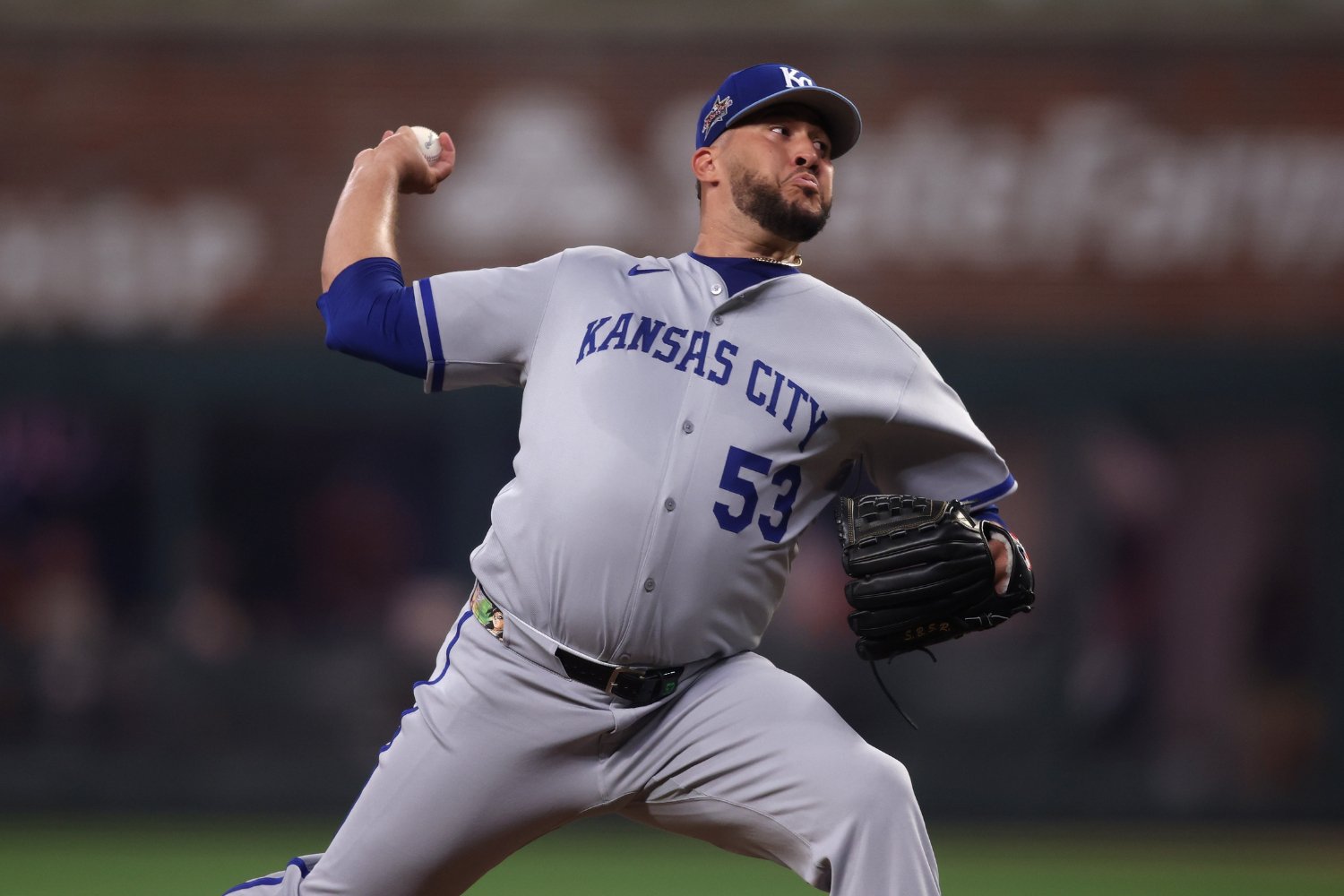
The Kansas City Royals have finished their Spring Training season, which concluded with a two-game set in Arlington against the Texas Rangers. The Royals went 9-21, which was the worst record in the Cactus League. However, as Royals Review mentioned today, poor performance in Spring Training doesn’t always correlate to regular-season futility.
Despite the poor results in Arizona (mostly due to many key Royals players participating in the World Baseball Classic), Kansas City is looking to improve on its 82-80 record from a season ago. A key to that will be the bullpen, which ranked 7th in reliever ERA last season. Carlos Estevez, acquired in free agency, was key to that bullpen’s overall success in 2025.
In 67 outings and 66 IP, he posted a 2.45 ERA, 1.06 WHIP, and saved 42 games. Those stellar metrics helped him earn a spot on the American League All-Star roster.
Additionally, Estevez was the first Royals closer to lead the league in saves since Dan Quisenberry. Thus, the Dominican-born righty became a fan favorite in Kansas City due to his late-inning prowess and end-of-game celebration (which was a hat tip to Dragon Ball Z).
Unfortunately, it has not been a rosy spring for Estevez in his second season in Kansas City.
In five outings and innings pitched, he posted a 7.20 ERA, 1.80 WHIP, and 12.70 FIP. He also had a -4.0% K-BB%, a 30% HR/FB rate, and a mere 49% strike rate. Safe to say, even for a veteran pitcher, who is “ramping up” this spring, the results were especially poor and have gotten the attention of worried Royals fans.
Thus, let’s dive deeper into what Estevez has produced this spring, and why the Royals may need to brace for some serious regression from their 33-year-old closer in 2026.
The TJ Stuff+ Metrics Have Been Brutal for Estevez This Spring
When it comes to evaluating pitchers in the spring, looking at pure results can be misleading at times. Often, pitchers toy with different grips or pitch mixes to prepare for the upcoming season. They do this because Spring Training results matter a whole lot less to the club than regular-season ones. As a result, they try these changes in a relatively pressure-free environment.
However, one constant that can give fans an idea of how a spring went for a pitcher is their velocity and “stuff”. When using TJ Stuff+, TJ Stats’ pitch modeling metric, Estevez fared pretty poorly this spring, as illustrated in his TJ Stats summary below.
.png.eddcc4ab935953daa99a17ec740be4b2.png)
Overall, Estevez posted a TJ Stuff+ of 92, which is eight points below average. His four-seamer, which he threw the most at 49.6%, had an 89 TJ Stuff+, which is alarming. Furthermore, his slider and changeup didn’t fare much better in TJ Stuff+, with marks of 95 and 94. The highest grade he had of his three pitches this spring was his changeup, which had a 46 grade (his four-seamer and slider had 37 and 33 grades, respectively).
For context, here’s a glance at his TJ Stats summary last season.
.png.7346811b97aab038716b917feb547bd4.png)
Estevez’s four-seamer was 15 points higher in TJ Stuff+, and his overall TJ Stuff+ was 11 points higher. His slider had a 107 TJ Stuff+, which was 12 points higher than his mark this spring. There wasn’t much difference between last year’s changeup and this spring’s. His changeup had a 95 TJ Stuff+ a season ago, only one point better than his changeup TJ Stuff+ in Spring Training.
A big factor in this TJ Stuff+ difference is velocity.
His four-seamer last year averaged 95.9 MPH. This spring? It averaged 89 MPH. The slider averaged 87.4 MPH last year, but only 81 MPH this spring. Lastly, the changeup averaged 87.9 MPH last season and only 82 MPH this season.
Basically, he’s seen a 5-6 MPH decline in all of his pitches, a huge red flag. A couple of MPH difference? Okay, maybe he’s still getting ramped up. However, those bigger MPH differences signify either a lingering injury or that the stuff just isn’t there.
Some have pointed out that this is “normal” for Estevez and that he has traditionally shown these kinds of velocity issues as he ramps up and prepares for the regular season. However, his TJ Stuff+ and velocity last spring, while down, weren’t as alarming as what we have seen this spring.
Below is his TJ Stats summary for 2025.
.png.af5bfd38980160a8ad7e425fd245a882.png)
His overall TJ Stuff+ was 98, with his four-seamer having a 95 mark, his slider having a 104 mark, and his changeup having a 99 mark. Those are all considerably better than what Estevez demonstrated stuff-wise this spring. Furthermore, Estevez’s four-seamer velocity was four MPH higher, his slider was 4.9 MPH higher, and his changeup was 1.5 MPH higher. Even though his pitch TJ Stuff+ and velocity were down last spring, they were at reasonable levels where a bounceback was feasible.
In terms of TJ Stuff+ and pitch velocity, unfortunately, Estevez hasn’t demonstrated that same promise this spring.
What Has Contributed to Estevez’s Stuff and Velocity Issues?
I wanted to see, in his last outing of the spring against the Rangers, if the TJ Stuff+ or velocity would look any better than what we saw in Arizona or at the World Baseball Classic. However, it was more of the same in those two areas, though Estevez did a good job generating whiffs against Texas.
.png.75fb4bbe58247006dfd8c3085d1474c1.png)
Now, the TJ Stuff+ was two points better than his Spring Training average, which was encouraging. However, the velocity was pretty much the same on the pitch (89.3 MPH), and the TJ Stuff+ wasn’t that much better on the slider or changeup. Overall, Estevez posted a 92 TJ Stuff+, which matched his overall TJ Stuff+ this spring.
In terms of velocity in his last outing, his pitch velocity chart showed him sitting around 89-90 MPH, with him topping out around 91 MPH by the end of his outing, as illustrated below.
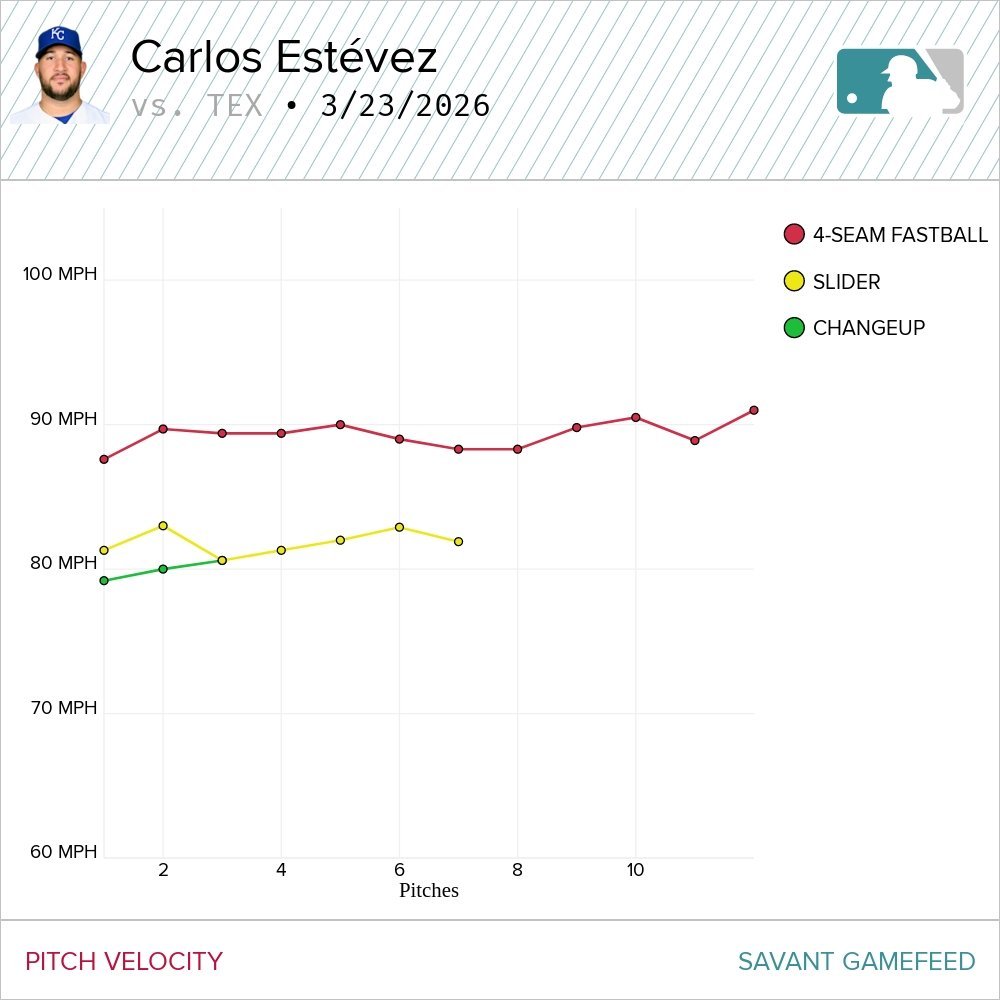
For a power pitcher who relies on his four-seamer, that kind of middling velocity is concerning. It becomes even more maddening when compared to his pitch velocity chart from Opening Day a year ago.
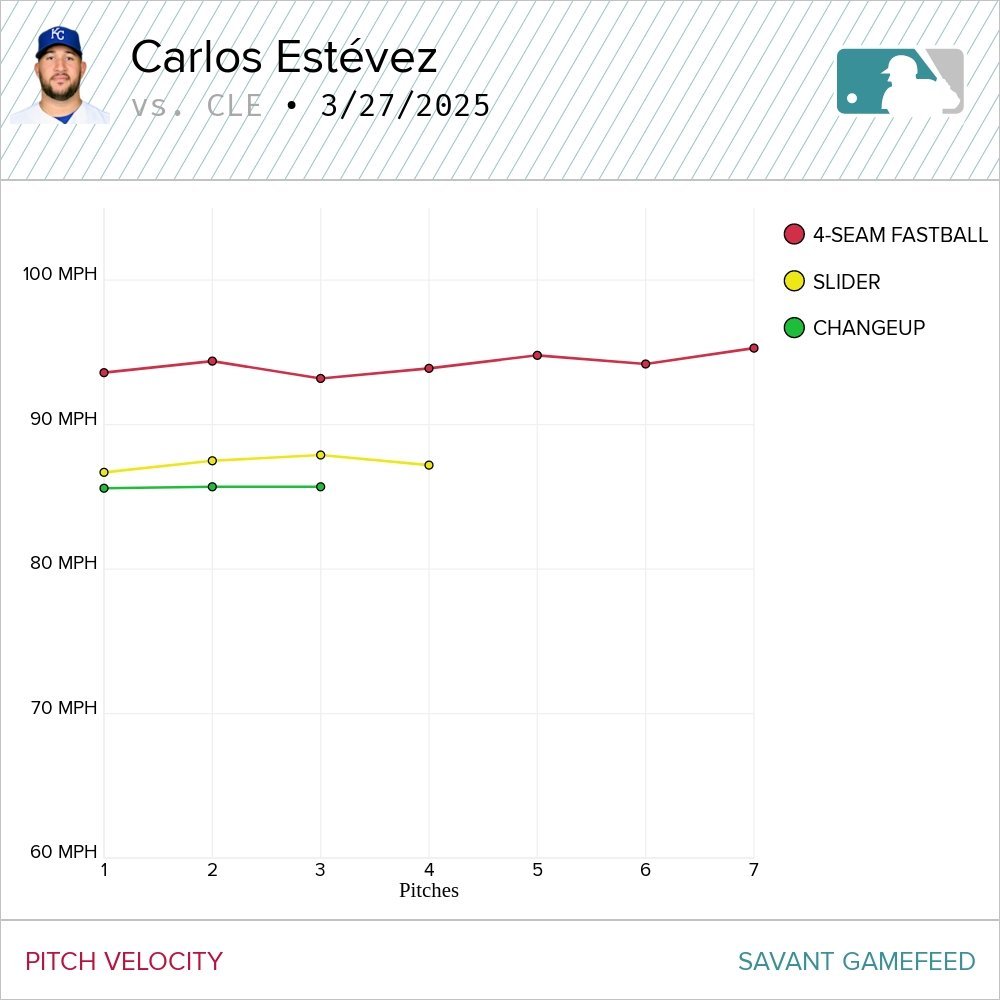
Last year, his four-seamer sat in the mid-90s. And that was DOWN from what fans were expecting, mostly due to Estevez overcoming some nagging injuries in the spring. He saw an uptick later in the year, once he was fully recovered.
Which makes one wonder: Is Estevez dealing with a lingering injury that is causing this velocity problem?
If so, the Royals have kept a lid on it. To be fair, that has been a trademark of the Royals since JJ Picollo and Matt Quatraro took over as general manager and manager, respectively. They have often shared little detail about injuries, keeping the media and fans in the dark until the last possible moment. A key example of this is Michael Massey, whose Opening Day status remains in flux even though he’s been out of commission with a calf injury sustained a couple of weeks ago.
Is it possible that Estevez is dealing with something that’s affecting his velocity and stuff? It’s hard to imagine that he’s seen such a dramatic drop from last year to this spring due to “age” or “not being warmed up.” While regression was to be expected for Estevez this year, this kind of stuff and velocity decline feels like a massive anomaly.
The Royals will need to finalize their roster by Wednesday. Thus, one has to wonder if Estevez may be put on the IL to deal with whatever is affecting his velocity.
What Do the Royals Do With Estevez?
If Estevez is dealing with an injury, even a minor one, he will likely be put on the 15-Day IL. The Royals can’t afford to give away losses, especially in a division that will remain competitive, especially in the wake of the Detroit Tigers adding their top prospect to the Opening Day roster.
Thankfully, the Royals have reinforcements in the bullpen to handle a short Estevez stay on the IL. After all, Picollo made adding to the bullpen a priority this offseason, which made sense when looking at Estevez’s Statcast percentiles from a year ago. While he was effective, many of his lackluster Statcast percentiles suggested he also benefited from some luck a season ago.
.png.c53e97653a4ad74ab5365fb16f2d7f71.png)
His .330 xwOBA last year, especially given his .254 actual wOBA, is a sign that he was due for regression in 2026. Thus, Picollo was wise to add to the bullpen this offseason with Alex Lange and Matt Strahm, both of whom have closing experience. They also have Lucas Erceg, who closed games in 2024 and returns for his third season with the Royals.
(Spoiler alert: In my Bold Predictions piece, I predicted that Erceg would have more saves than Estevez.)
Another one who could contribute in Estevez’s possible absence is Eli Morgan, who’s had a fantastic spring as a non-roster invitee.
In nine outings and 10.1 IP, the former Guardians setup man is posting a 0.87 ERA, 1.06 WHIP, 1.94 FIP, 29.3% K%, and 19.5% K-BB%. While the fastball velocity isn’t great, and he doesn’t generate as many groundballs as one would hope for a pitcher with his stuff profile, he pretty much exceeded in every other area this spring with the Royals, as illustrated below.
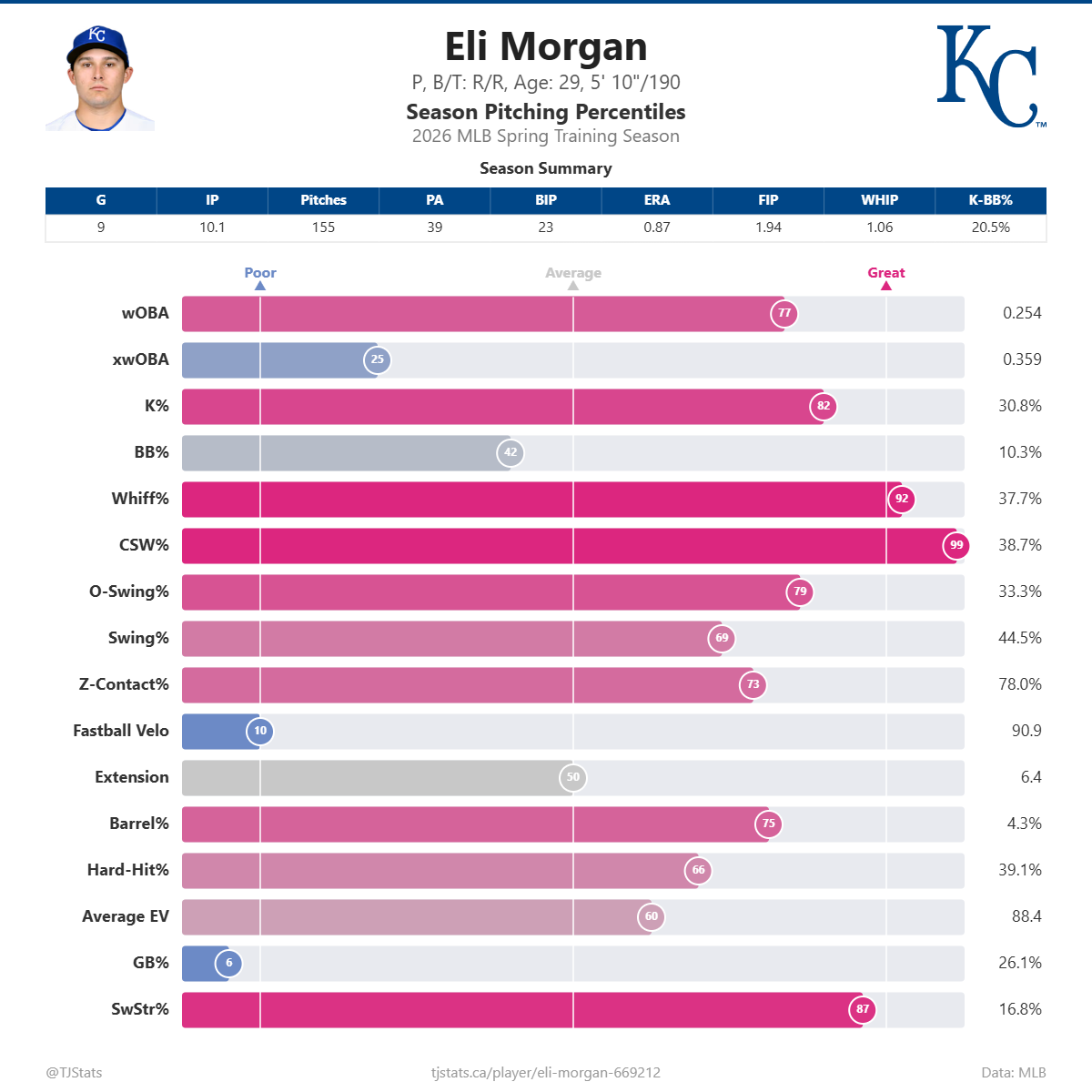
Morgan has earned a spot on the Opening Day roster, and he would be a nice fill-in for Estevez as he recovers on the IL. Furthermore, when Estevez is ready to return, the Royals can send Morgan to the Minor Leagues because he still has a Minor League option remaining. If they do not add him to the 40-man roster on Wednesday, he could opt to become a free agent and could sign with another team. After his stellar spring, a team likely would take a waiver on Morgan.
Starting Estevez on the IL wouldn’t be the start the Royals expected back when pitchers and catchers reported in February. However, the Royals’ bullpen has the depth to absorb this loss for now, especially with Erceg, Strahm, and Lange all capable of handling spot duties in the ninth inning. Furthermore, resting Estevez for a little bit also gives an opportunity to Morgan, who could be a sleeper reliever for this Royals bullpen in 2026.