
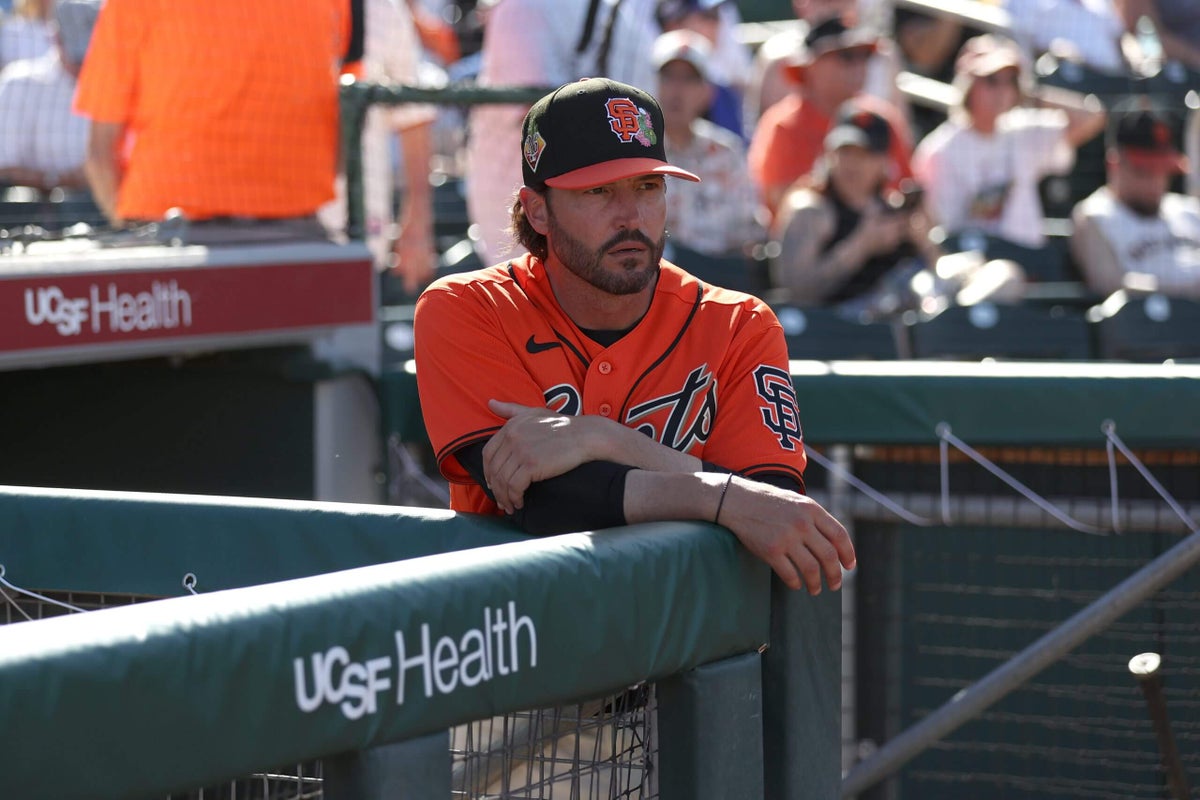
SAN FRANCISCO — Tony Vitello loves to read about sports. He does not love to read about himself.
If there’s a criticism leveled his way in 280 characters or less, he’ll probably hear about it secondhand. If there’s a column that questions his credentials or his readiness to manage a major-league game, it’ll reach him through the grapevine if it reaches him at all. Some professional athletes and coaches who claim to put on blinders will turn around and quietly sit at their locker, ravenously scrolling through their mentions on social media.
Vitello has neither the time nor the appetite for that. He was hired away from the University of Tennessee to manage the San Francisco Giants with the clear instruction to be himself, and that isn’t going to change based on an external opinion. Sure, maybe some leadership strategies need to be amended now that he’s navigating a regular season that’s 100 games longer than the NCAA schedule. Maybe some coaching philosophies have to change now that he’s managing professional athletes with life responsibilities instead of sophomores who are majoring in organizational studies. Maybe some of the ways he communicated with the media in Knoxville won’t work as well when speaking to reporters who serve as a conduit to a much different audience.
But if Vitello has signaled anything in the run-up to his major-league managerial debut, it’s that he isn’t the type to dwell on unsolicited or unsophisticated criticism. If he listened to every voice that underestimated him because he was a college walk-on who just hoped to be good enough to make the travel roster at the University of Missouri, then he wouldn’t have risen through the major college coaching ranks. He wouldn’t have transformed Tennessee into a powerhouse program with players who took no prisoners while streaking their faces with more eye black than a KISS concert. He wouldn’t have commanded a coaching salary so lofty that the Giants had to give a 47-year-old with entry-level pro experience one of the richest contracts among major-league managers — and dole out $3 million more to buy out his Tennessee commitment — to hire him.
Here’s the thing: When you are a major-league manager, criticism is the internet’s resting face.
It doesn’t matter how accomplished you are. The second-guess applies universally. It applied to future Hall of Fame managers like Bruce Bochy and Dusty Baker. And it’ll apply to a rookie manager whose first assignment in professional baseball will come under a retina-searing spotlight Wednesday night: leading the Giants against Aaron Judge and the New York Yankees, who arrive on the shores of McCovey Cove to play the first game of the season in a standalone window.
No matter how many games the Giants win or lose, and no matter how well Vitello acquits himself, he’s certain to be criticized. How does he plan to handle it?
It’s simple, he said. Not by pretending he doesn’t care about being liked or respected. But by caring about something else more.
“I care about the people in the locker room,” said Vitello, who began bonding with players prior to spring training and even made offseason trips to the Dominican Republic and South Korea to visit them in person. “It’s happened very fast. I’ve really enjoyed this job. The organization has lived up to everything. … Now, part of it is we’re 0-0. I get it. There’s going to be times where I tell (a PR representative), ‘Give me two minutes to throw a clipboard up against the wall. Then I’ll come in here and talk to you.’ I understand all the ups and downs that can come with it. Any criticism, you know, some of it’s hard to avoid, and we’re all human beings. We all want to be liked and all that stuff.
“But the only thing I’m really wrapped up in right now is the guys in that room.”
As Vitello continued, his voice started to quaver.
“That part’s important to me, because of the guys I had to walk away from,” he said, referencing the players he recruited and coached at Tennessee. “I’m pretty blessed, but I wouldn’t wish (those goodbyes) on anybody. That’s a weird conundrum. I don’t get to pour into those guys anymore, so I feel like I’ve tried to do double with these guys. So they probably think I’m crazy. I know a couple guys in that locker room or on the roster that think I’m crazy. But we’re both wearing the same uniform starting tomorrow.
“So bring on the good, bring on the bad. Part of the deal.”
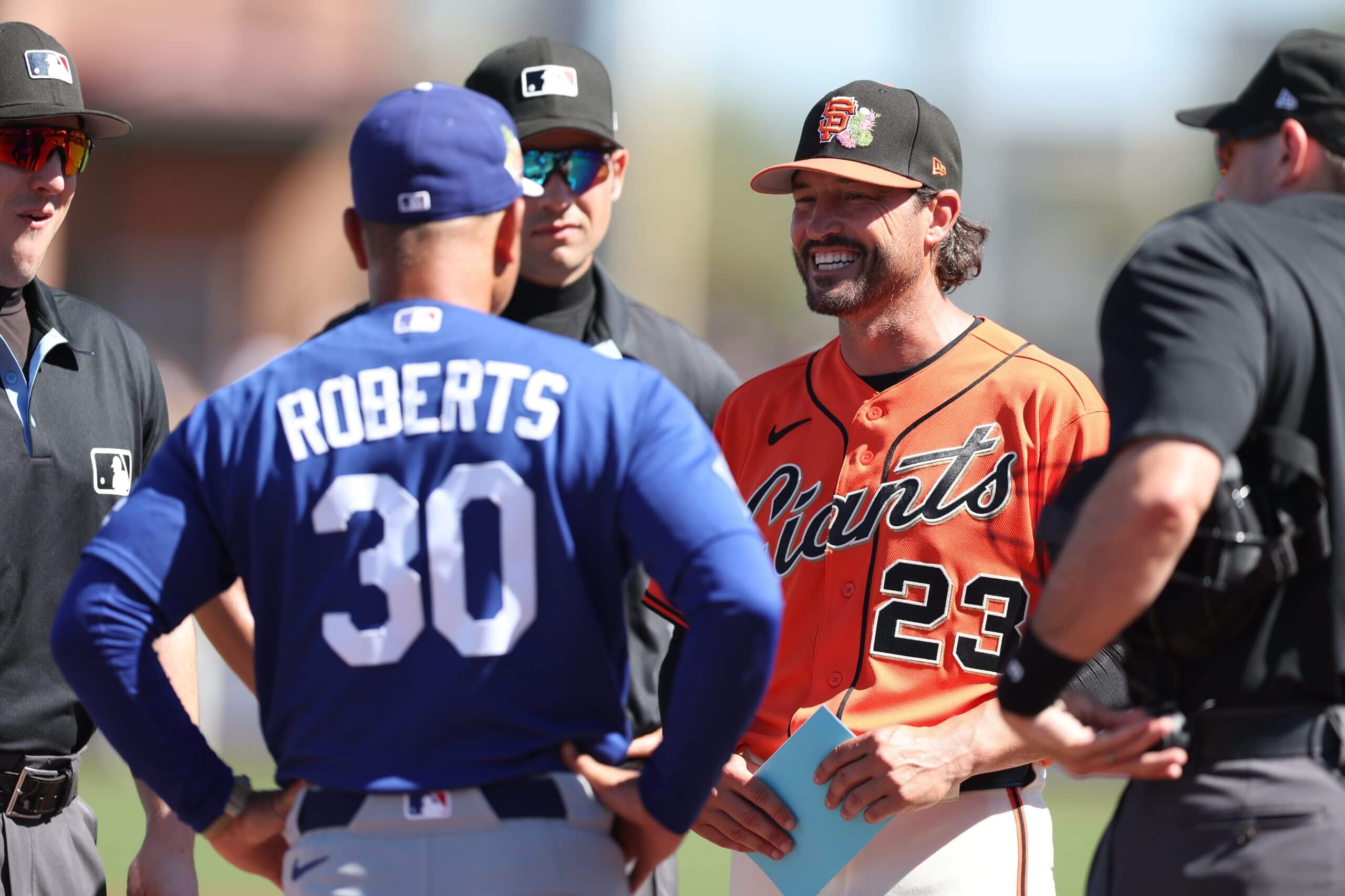
In his first year managing the Giants, Tony Vitello isn’t acting like he has the major leagues all figured out. (Jeremy Chen / Getty Images)
Perhaps the most interesting thing about Vitello is that he doesn’t adhere to the tropes you might expect from a manager who didn’t have a glossy career in the big leagues. There isn’t a hint of “little man syndrome.” He doesn’t overcompensate for his lack of pro playing background by acting like a taskmaster or overemphasizing his authority. From the day the Giants introduced him as their manager this past October, instead of using bombast to paper over perceived inadequacies, Vitello leveraged humility and humor to create connections. He disarmed his doubters by agreeing with them, to a point, acknowledging that he was as unsure as anyone else whether this out-of-the-box situation will succeed.
The first week or two of spring training was bound to be awkward in some respects. That’s because Vitello is a relational communicator. He won’t merely agree with a point someone is making or say that he understands. He’ll demonstrate that understanding with an anecdote from his life or his coaching career, sometimes in circuitous fashion while dropping in random tangents before landing his point. For example, after Tuesday’s exhibition, he deviated into a riff about his addiction to Netflix when it was a DVD-by-mail service that helped get him through the downtime while he coached in a wooden-bat league in Salinas. His storytelling is a powerful way to form connections with others, and it has served him well.
The awkward part is that Vitello lacked any frame of reference beyond his experience as a college coach and recruiter. Whether he was talking to Giants reporters or his new players, he drew upon the only experiences he had, and references to SEC baseball and recruiting trips didn’t always land with his audience. He didn’t come into this job with experience as a minor-league field coordinator or a Triple-A infielder, and he certainly never experienced the cauldron of a major-league playoff series from anywhere other than the stands.
It was going to take time to learn names and evaluate players, sure. But it was also going to take time to gather the anecdotes and experiences that are most relevant to his current occupation.
Now that those six weeks in Arizona are over, it’s a credit to Vitello that his first spring training felt remarkably unremarkable. There weren’t any miscommunications in exhibition games or mixed messages sent to players or complaints from the clubhouse about a manager who lacks feel. With plenty of help from a collaborative coaching staff with diverse experience, the Giants were just another team doing drills and putting in the work to prepare for a season.
Now, they’ve picked their players. Vitello is fully authorized to deploy them. And he has arrived at the real proving ground.
“It’s been plenty of tough decisions, a lot of travel, a lot of going back and forth, a lot of different things to handle, … and when the game starts, it’s just the game,” Vitello said. “I’m well aware of the ups and downs in this game — and there will be on Wednesday, too — and decisions to be made, and all that stuff. Frustrations, happiness, all that will come. But it’s also why everybody is here. … You want to get to the game and feel prepared, but you can’t do any more preparation once inning one comes.
“So yeah, there’ll be nerves for guys and things like that, but I think I’m as anxious as anybody.”
Anxiety isn’t a word you’ll hear managers say often. It suggests weakness. Better to say you feel nervous, or even better, you’re feeling some butterflies. But nerves had an important role to play in Vitello’s journey through baseball, too. It took an understanding of those nerves to be able to recognize them in others and help coach them out.
“As a player, unfortunately, I was nervous a lot, and I think I learned from it,” said Vitello, who transitioned into coaching immediately after college. “It’s a painful personal story to tell, but by the time I got a handle on how important mentality is, it was probably too late. The cool thing was, I got to stick around the University of Missouri. Tim Jamieson was good enough to give me an opportunity to coach.
“I know how tough the game is. I know how hard it is to live with mistakes or regrets. So the way I’ve always coached is to try and help guys, regardless of their age or what level they’re at, to avoid those so they can perform at their best and also look back without regret. That doesn’t mean, as a coach, I haven’t had moments. But I’ve been surrounded by good players, starting at Missouri, TCU, Arkansas, Tennessee.
“When you’re around good players, they make you feel more confident than maybe you already are. And we’ve got a group of players in the locker room (here) that not only can build up my confidence, but with the way the camaraderie factor has been, it makes you feel like you can go into battle and you can accept any kind of outcome, whether it’s on a pitch or an at-bat or a series or a given day or a month, whatever it might be.
“I’m rambling on, but for good reason, and I’d like to bring up the coaching staff, too. I always was the one trying to out-hustle everybody. There’s a little different job description for my role with this. And I don’t think even if I wanted to, I could out-hustle some of these guys who’ve put the extra hours in. My ultimate point is, when you’re prepared, you’re more confident, and I’ll do my best to be prepared before first pitch (Wednesday). But I know our coaching staff is prepared because of the way these guys have worked.”
While his players were getting reps on the field in the spring, Vitello gained his own reps in twice-daily sessions with the media. So much was made of his snap decision Feb. 16 to commandeer his morning session and challenge the narrative over how and when he made the decision to leave Tennessee — a process that got emotionally tangled after The Athletic reported that the Giants were closing in on hiring him.
If Vitello came off as a bit unhinged, or left some people feeling like he regretted leaving Knoxville, then they missed the point he wanted to make: He cared deeply about the people he left behind. He was upset that he couldn’t break the news gently and have the private conversations with coaches and players that he wanted to have before the news got out that he’d been offered the job in San Francisco. It bothered him that he couldn’t spare some measure of anguish to people who had been as loyal to him as if they were immediate family.
Over the weeks that followed, Vitello made several other small but revealing comments during his media sessions that didn’t end up in hundreds of aggregated headlines. He made a point to praise Wes Rucker, a reporter who covered him at Tennessee and died in a car crash, leaving behind a wife who was eight months pregnant. He talked of his admiration for his father, Greg, not merely because of his reputation as a legendary high school baseball coach in the St. Louis era but because he took ownership of field maintenance at De Smet High and spent countless hours conditioning the surface and chalking lines.
“My mom always thought I should help, but I didn’t know what the heck I was doing, and he’s got higher standards than I do,” the younger Vitello said. “Maybe I offered to help, but if I did, I usually screwed it up or it had to be redone anyway. So more times than not, I just watched him do his thing. Yeah, he’s a handyman and I’m a worthless man. I’m joking, but yeah … A lot of respect for those guys that take care of the field.”
He shouted out the spring training ushers and stadium staff for their friendliness whenever he left tickets for friends and family, simply in the hope that it would get back to them. He echoed his boss, Giants president Buster Posey, when he made it clear that he cares about the fan experience and that it’s important to him not only that the Giants win games but put an entertaining product on the field.
Starting with Wednesday’s season opener and Logan Webb on the mound.
“For everybody, no matter what your role is, (Opening Day) is going to be … as festive as you could ever want something to be,” Vitello said. “I mean, in this city, in this ballpark, two of the winningest organizations, both tied to New York, the players that are involved, Netflix … I don’t think it’s bad to say they got a lot of money. All’s I keep hearing is how much money they got.
“I tell you what, when I was in Salinas, I loved Netflix. These guys in the locker room, I’ve asked them, and they don’t know what it started out as back when poor old Blockbuster started to fade a little bit. You could get three or five discs (in the mail), and you had to swap them out. And I was staying with the Cole family and …”
OK, so maybe Vitello isn’t the most efficient communicator. Maybe his proclivity for mental footnotes will remain charming and entertaining only so long as the Giants are winning baseball games. When fans are angry and the team is losing, even the most authentic manager can be perceived as having a schtick.
But when you’re willing to refer to yourself as a guinea pig, when you acknowledge you’re uncertain how this experiment will turn out, and when you’re willing to admit that you find the third deck of a major league stadium as intimidating as a rookie standing on a big league mound for the first time, maybe you blunt the spears of your critics before any of them are loosed.
Or you simplify it. You choose to focus on what you really care about.
“First impressions of the group, I like the way they pull for each other,” Vitello said. “I know things can change once the season starts and … I don’t have a different pro team I’ve been in the dugout with to fall back on. But it seems to me it’s on the higher end of camaraderie.
“It’s been talked about so much. It’s just time to get to that moment.”