
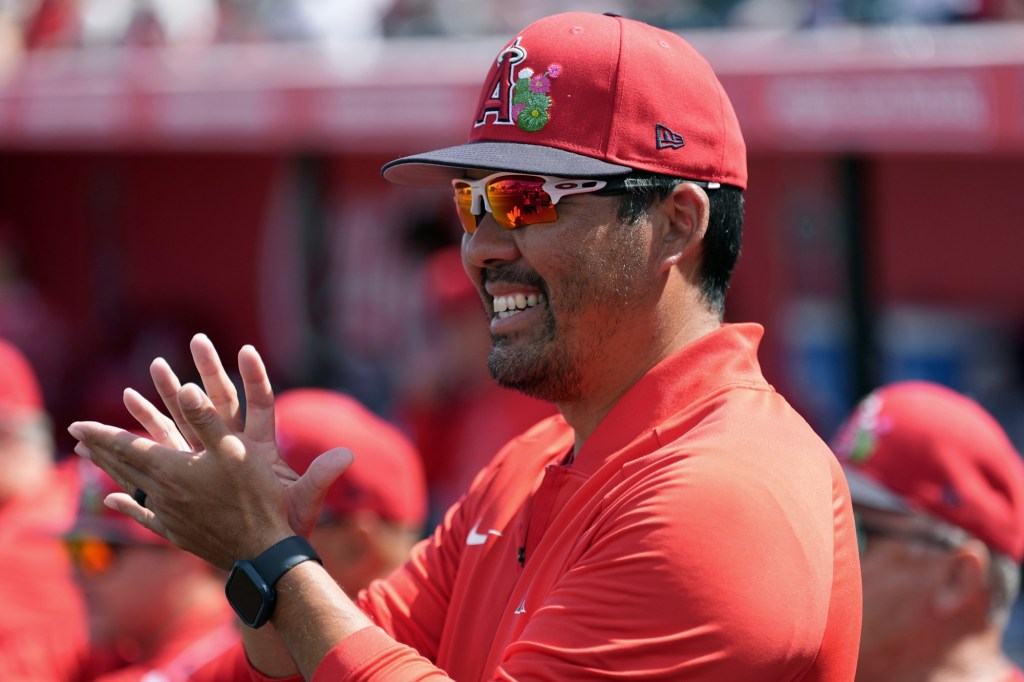
HOUSTON — Kurt Suzuki set a tone in his meeting on the morning of the Angels’ first full-squad workout of spring training.
It wasn’t what he said. It was what he didn’t say.
The whole thing took about five minutes.
“It was short and simple and then off you go,” outfielder Jo Adell said. “It wasn’t some long-winded story of greatness, you know what I mean? It was more of ‘Hey, get what you need to get. I’m here for you guys. We’re all here for you guys. You know what you need to do.’
“Can’t complain about that. That’s awesome.”
As the Angels prepare to play their first real game under Suzuki on Thursday against the Houston Astros, no one knows exactly how the first-year manager will handle the in-game decisions. So far, his job has been one of creating an atmosphere and a culture that will lead the Angels out of their decade of disappointment.
While the atmosphere can’t be accurately judged without the backdrop of games that matter, the early verdict is that the players have appreciated the tone set by someone who was one of them not long ago.
“I haven’t forgotten how tough this game is or what’s important in a clubhouse to a player,” Suzuki said. “When I played, it was communication.”
Suzuki said the most important thing a manager can do for his players is let them know that he cares about them, beyond what they do between the lines.
Catcher Logan O’Hoppe feels that.
“It’s been really nice coming to field every day knowing I can walk into his office and talk to him about anything,” O’Hoppe said. “I went in there the other day and he asked me what I had for him, and I was like ‘I’m just here to shoot it.’ I was just hanging out. It’s been really cool.”
O’Hoppe and Suzuki were teammates briefly just a few years ago, with O’Hoppe making his Angels debut just before Suzuki retired, at the end of 2022. Center fielder Mike Trout, pitcher Reid Detmers and Adell were on the Angels with Suzuki for extended periods in 2022.
“It is a little different,” Trout said of having a manager who was so recently his teammate. “But I loved Kurt when he was here. It’s been great. We’ve been on the same page with everything. Just overall the whole vibe has been really open and everything.”
Trout said Suzuki still “understands everything” about being a player.
One of the ways that’s been evident is the occasional “show-n-go” day in spring training. Normally, players are all at the facility by 7:30 or 8 a.m. to be on the field around 9:15 for drills and batting practice that run until about 11:30, followed by a game at 1 p.m. On a “show-n-go” day, players are essentially on their own. They show up whenever they need to show up to be ready for the game.
That’s not uncommon for a day game during the regular season, but it’s rare in spring training. This spring, the Angels did it a few times, which was much appreciated by the players.
“It’s just getting off your feet,” Trout said. “We’re working every day. We’ve got a long season coming up.”
Adell added: “He understands the workload.”
Suzuki, 42, is just a few years past a career that began after he helped Cal State Fullerton to a national title in 2004. He reached the majors with the Oakland A’s in 2007, and then spent the next 15 years bouncing around the majors, with both the A’s and Washington Nationals bringing him back for second stints.
His leadership was one of the reasons he was so popular with the teams that employed him, so it was no surprise that Angels general manager Perry Minasian kept him on a special assistant after he retired.
When the Angels were hiring a manager last fall, former Angels star Albert Pujols was the first person publicly connected to the job. Once it became clear that the future Hall of Famer and the Angels couldn’t reach a deal, Suzuki was an obvious choice.
Owner Arte Moreno explained this spring that Suzuki got just a one-year deal because Minasian has just one year left on his deal.
Suzuki has said all along that he’s comfortable being in a position to prove himself.
He carries himself with the confidence that he’s been prepared for this, even though he’s never managed at any level.
“I think the one thing that I have on my side is that I played this game for a long time, and I’ve got a great staff around me,” Suzuki said.
Pitching coach Mike Maddux is entering his 24th consecutive season as a major league pitching coach. Assistant pitching coach Darryl Scott is in his 27th year in baseball. Bullpen coach Dom Chiti has been in the game as a player or coach for 50 years.
Hitting coach Brady Anderson spent 15 years as a major league player and another nine working in the front office. Assistant hitting coach John Mabry played 14 years and spent 12 years as a coach.
Bench coach John Gibbons managed the Toronto Blue Jays for 11 years.
“I don’t have all the answers,” Suzuki said. “I’m not the smartest guy in the room when it comes to everything. Now, I’ve got a lot of input when it comes to game planning with the catchers and what they do, but it would be irresponsible if I was just like ‘No, Mad Dog, this is what we’re going to do here,’ or if I told Brady and Mabry, ‘No, this is what we’re going to do.’”
At the other end of the spectrum, the Angels also have two coaches – first base coach Adam Eaton and catching coach Max Stassi – who were active major league players within the past five years. Third base coach Keith Johnson and infield coach Andy Schatzley managed almost all of the Angels’ young players at Double-A or Triple-A the past few years.
All of which is to say that Suzuki goes into his rookie season surrounded by a group that should be able to help him learn the ropes of managing, while still remembering what it’s like to be a player.
“I kind of look at it as when I was a player,” Suzuki said. “What did I like, what did I want to experience as a player culture-wise, vibe-wise?”
It was a loose camp, thanks also to major league staff assistant Tim Buss keeping the players laughing during his morning talks before the players stretch in the outfield. Suzuki bounced around the field checking in with players and even joking with the media regularly.
“He’s just bringing unity to everybody in the clubhouse, pitchers, catchers, infielders, outfielders,” shortstop Zach Neto said. “Just making sure everybody’s one. … It’s a matter of being loose, having a good time and coming to the field every day and wanting to get better every single day.”