
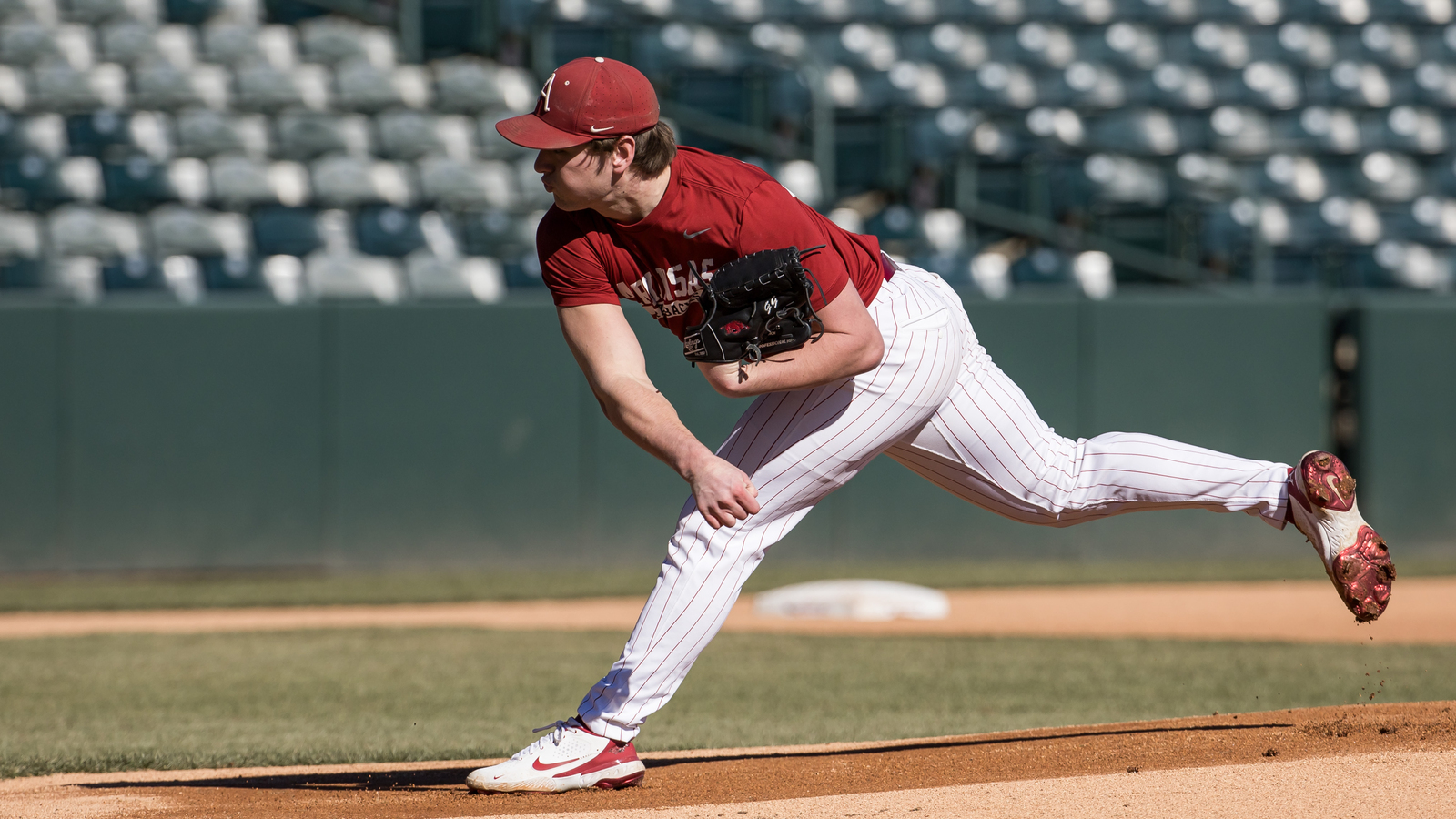
He kept the fastball in the back pocket for most of the outing, which is a change from previous starts. His command of the offering can waver at times, especially when trying to command it on the top rail, but the pitch sat in the mid-90s throughout with good shape. He used it more to set up his secondaries, utilizing his misses to his advantage.
Dietz’s low-80s curveball has hammer qualities, though he struggled to land it consistently against South Carolina. A few pitches popped out of his hand, while others were spiked in the dirt.
At its best, it’s a true 12-6 curveball with up to fifteen inches of depth, which gives him considerable vertical separation off the fastball. Dietz did throw one change-up in the outing, getting a whiff in the second at-bat of the game.
Like Gaeckle, Dietz might wind up being a tough evaluation, especially considering the lack of a track record. However, the breaking balls are legitimate weapons, and some mechanical cleanup can help him find more fastball command. He might end up in a leverage spot in the bullpen, but he should be given every chance to start, and he’s in contention for LHP1 in this college class.
2B/SS Cam Kozeal, Arkansas
Final Line: 4-12, 1 HR, 4 RBI, 1 HBP, 2 BB, 1 K
Kozeal has been on my radar for quite some time, having first seen him as a prep on the USA backfields. He took current Pirates farmhand Zander Mueth deep back there, and that impact has continued to grow as he’s gained experience in the SEC.
Kozeal is on the smaller side of the spectrum and lacks the kind of projection that some of his peers do, but he does make up for it in the power department. He showed off pop to both sides of the park, including a home run to right field off a curveball during Friday’s three-hit performance. He’ll lace line drives, too, including one he scorched at 107 MPH.
His swing path has loft and a flatter entry into the zone, which does help with high velocity. It’s tough to say he’ll add much more power, but he’s capable of average power when all is said and done.
The hit tool does lag behind the power, as Kozeal’s swing tends to get long and his hands get outside of his body at times. He took aggressive hacks all weekend, though he was foiled by velocity at the letters.
One change I noticed was that he’s toned down the aggression that he was known for a year ago, building up a bigger affinity for walks. It’s a welcome sight, as he now boasts an even strikeout-to-walk ratio on the season.
Defensively, Kozeal has manned shortstop all season for the Razorbacks, though I think he’s better suited for second base as a professional. While calm and collected, he doesn’t attack the baseball, and his movements aren’t as twitchy as some of his teammates.
He does have the arm for the left side of the infield, but to alleviate concerns about how his tools work on that side of the bag, second base would be a much better spot for him.
I’m not sure if I would place Kozeal in Day 1 territory just yet, but he’d be a nice get for someone in Rounds 4-6.
C Ryder Helfrick, Arkansas
Final Line: 2-10, 1 HR, 3 RBI, 5 BB, 2 K
Helfrick is another Arkansas bat that I can trace live looks back to high school for. Since then, the transformation he has made is astounding.
It starts with the swing change. When he was a prep in California, Helfrick had more of a squatted stance, sinking into his back leg in particular. Now, Helfrick has an upright stance with a closed front leg, which helps him generate considerable leverage in his swing.
The power is the big selling point here. Utilizing a pull-heavy approach, Helfrick tattooed a couple of balls over the weekend, including a 111 MPH lineout to left field. It’s huge bat speed with a heavy barrel and loud hip/shoulder separation that helps him generate leverage once his foot hits the dirt.
His flatter angle into the zone and lofted path allow him to smother high fastballs, and he did just that on Sunday, back-spinning a baseball 444 feet away to left center. It’s every bit of plus power at the next level.