
The initial field for the 2026 National League Rookie of the Year award is crowded. One of the entrants is Chicago Cubs catcher-designated hitter Moisés Ballesteros. The 22-year-old made his debut in 2025 but kept his rookie status, as he stayed below the thresholds of 130 at-bats and 45 days on an active roster.
Ballesteros’s competitors include New York Mets right-hander Nolan McLean, Cincinnati Reds first baseman Sal Stewart, Miami Marlins outfielder Owen Caissie (hey, we know him), Mets outfielder Carson Benge and St. Louis Cardinals second baseman J.J. Wetherholt. Pittsburgh Pirates shortstop Konnor Griffin will join this group as soon as he’s promoted from the minor leagues, but the head start the others will have is sure to make things tougher on the teenaged Griffin.
If Ballesteros bests his competition, he will become the seventh Cub in franchise history to be voted Rookie of the Year. Previous winners include a Baseball Hall of Famer and a franchise icon. Three Hall of Famers got votes, but fell short.
The Rookie of the Year award, which is voted on by members of the Baseball Writers’ Association of America, was first given out in 1947. Jackie Robinson was the first recipient, for both leagues. Awards for each league began in 1949.
North Side Baseball went through club and Rookie of the Year history to determine the Cubs’ 10 best rookie seasons since the award’s inception. Results are ranked based on season stats, excitement surrounding the player, and the players who finished behind or ahead of them in the voting. The player’s finish in the voting is listed in parentheses.
Chicago Cubs 10 Best Rookie Seasons Since 1947
10. Ken Hubbs, 1962 (Rookie of the Year)
Hubbs pulled off a huge feat in his ROY season: he beat out Bill Mazeroski for the National League Gold Glove at second base. Mazeroski had won the award the previous two years and would take home the next six. Teammates saw star potential in Hubbs, but tragedy kept it from being realized. Hubbs died on Feb. 13, 1964, when the single-engine Cessna 172 plane he was piloting crashed into Utah Lake in Provo, Utah. He was 22 years old.
The Cubs acquired Hundley in a trade with the San Francisco Giants in December 1965 and named him their No. 1 catcher the following spring. He ran with the opportunity, taking 144 starts behind the plate; hitting 19 home runs; and nabbing a major league-leading 51 baserunners. In hindsight, he deserved better than fourth in the voting. He finished behind middling middle infielders Tommy Helms, Sonny Jackson and Tito Fuentes.
8. Jerome Walton, 1989 (Rookie of the Year)
Walton had two things going for him in the voting: he played center field for a division winner, and he set a modern (since 1900) franchise record with a 30-game hitting streak that began in July after the All-Star break. (He still holds that record.) His main competition in the balloting was teammate Dwight Smith, but Walton won comfortably, receiving 22 of the 24 first-place votes. Smith received the other two. Walton also finished 13th in MVP voting.
7. Geovany Soto, 2008 (Rookie of the Year)
Soto was a September callup in 2005, 2006 and 2007, so he already knew his way around Wrigley when the club anointed him its No. 1 catcher in 2008. At the plate, Soto delivered premium production: a 120 wRC+, an .868 OPS and 23 homers in 583 plate appearances. Behind the plate, he was a workhorse, making 131 starts. He was an All-Star and he finished 13th in MVP voting. Oh, and he also beat out a fellow named Joey Votto for ROY (probably indefensibly, because Votto batted .297/.368/.506, already flashing his Hall of Fame talent), garnering 31 of 32 first-place votes.
6. Shota Imanaga, 2024 (Fourth in voting)
Imanaga joined Kosuke Fukudome and Seiya Suzuki as Japanese stars who had big rookie seasons for the Cubs. The left-hander put up a 2.91 ERA, a 3.72 FIP, a 25.1% strikeout rate and a 4.0% walk rate in 173 1/3 innings; made the NL All-Star team; and finished fifth in NL Cy Young Award voting. He just ran into a loaded rookie class, finishing behind Pittsburgh Pirates ace Paul Skenes, San Diego Padres center fielder Jackson Merrill and Milwaukee Brewers outfielder Jackson Chourio in the voting.
5. Mark Grace, 1988 (Second in voting)
Grace gave Cubs fans a preview of what he would bring to the field during his entire 13-year run in Chicago: elite line-drive hitting and bat control, and Gold Glove-caliber defense at first base. That combination wasn’t enough for him to beat out Cincinnati Reds third baseman Spuds McKenzie—er, Chris Sabo (as always, Google it)—for Rookie of the Year. In the end, however, Grace had, by far, the better career. Between Sabo beating out Grace and Soto beating out Votto, we can call it even between the Cubs and Reds.
4. Ernie Banks, 1954 (Second in voting)
Banks made history the previous September when he, along with fellow infielder Gene Baker, integrated the Cubs. In 1954, he established himself as the franchise’s long-term answer at shortstop. Banks played in all 154 games, hitting 19 home runs and a posting a 7.7% strikeout rate. Curiously, he finished 16th in NL MVP voting but second in Rookie of the Year voting to St. Louis Cardinals outfielder Wally Moon, who received no points in the MVP balloting.
3. Billy Williams, 1961 (Rookie of the Year)
The sweet-swinging Williams was still eligible for the award in ’61 after being up with the Cubs in both 1959 and 1960. He broke camp as the starting right fielder, and then he made the most of the chance: 25 home runs and a .278/.338/.484 slash line in 147 games. The ’61 season launched Williams’s Hall of Fame career, which ended with him collecting 2,711 hits and 426 home runs. He is, beyond debate, the greatest living Cub, and the proudest remaining symbol of the team’s long history.
2. Kris Bryant, 2015 (Rookie of the Year)
Imagine how good his rookie season would have been if he had debuted on Opening Day, instead of 12 days later. (That’s for the people who are still salty about the service time manipulation). The delay did not affect Bryant. He posted a 136 wRC+, an .858 OPS, 26 home runs and 13 stolen bases in 151 games. He snagged an All-Star berth and finished 11th in MVP voting. Maybe the club was right about his defense at third base, though. Manager Joe Maddon played Bryant at third, first and all three outfield positions, and didn’t always play stellar defense at the hot corner.
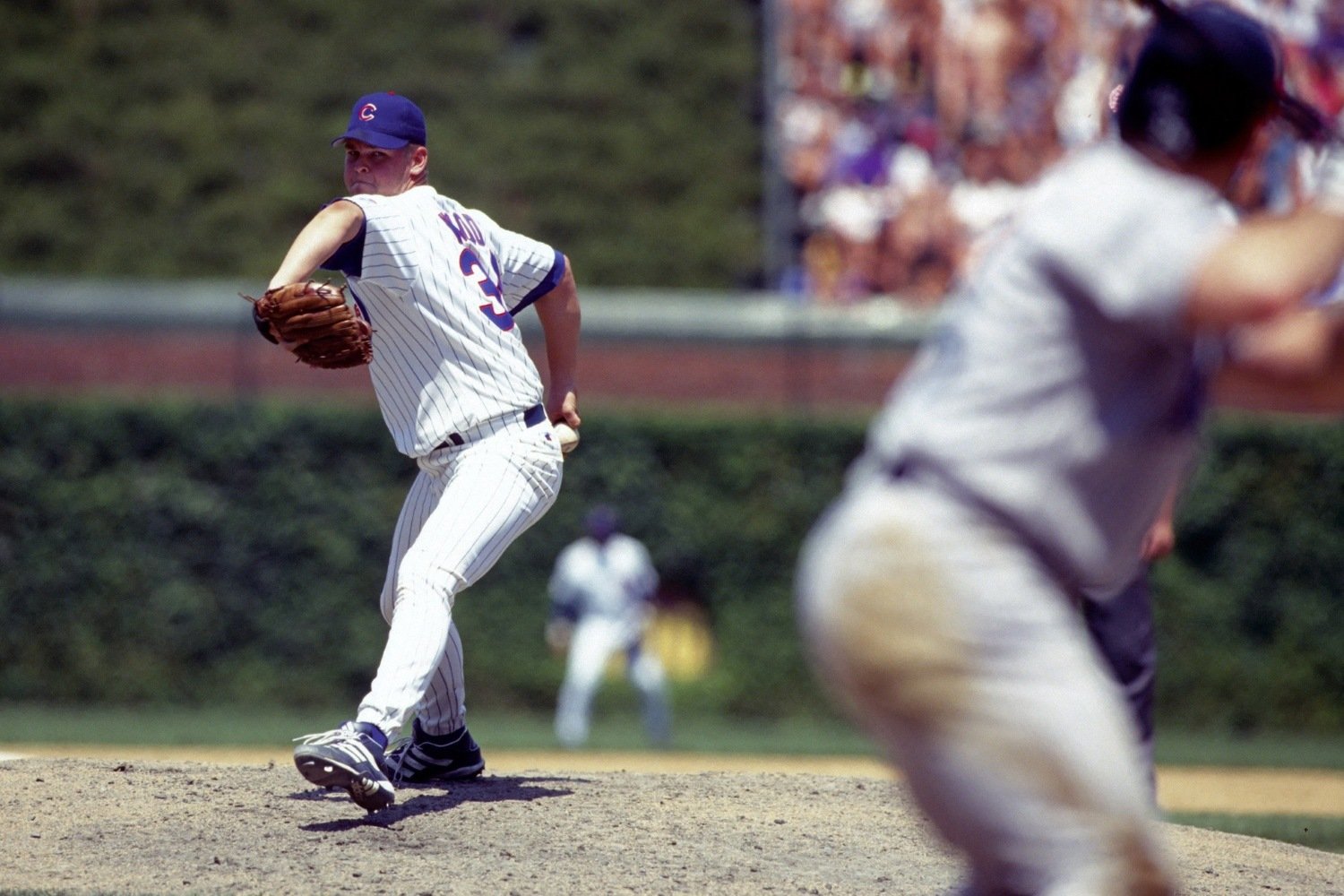
1. Kerry Wood, 1998 (Rookie of the Year)
Wood became a rookie legend in his fifth career outing. On a damp May afternoon at Wrigley Field, the 20-year-old right-hander tied Roger Clemens‘ nine-inning MLB record with 20 strikeouts in a one-hit, no-walk shutout of the Houston Astros. Wood’s feat would be overshadowed that summer by Sammy Sosa‘s pursuit of Roger Maris‘ home run record, but the kid from Texas kept putting up strikeouts in the background (33.3% strikeout rate in 166 2/3 innings). He edged out a future Hall of Famer, Colorado Rockies first baseman Todd Helton, for ROY.