
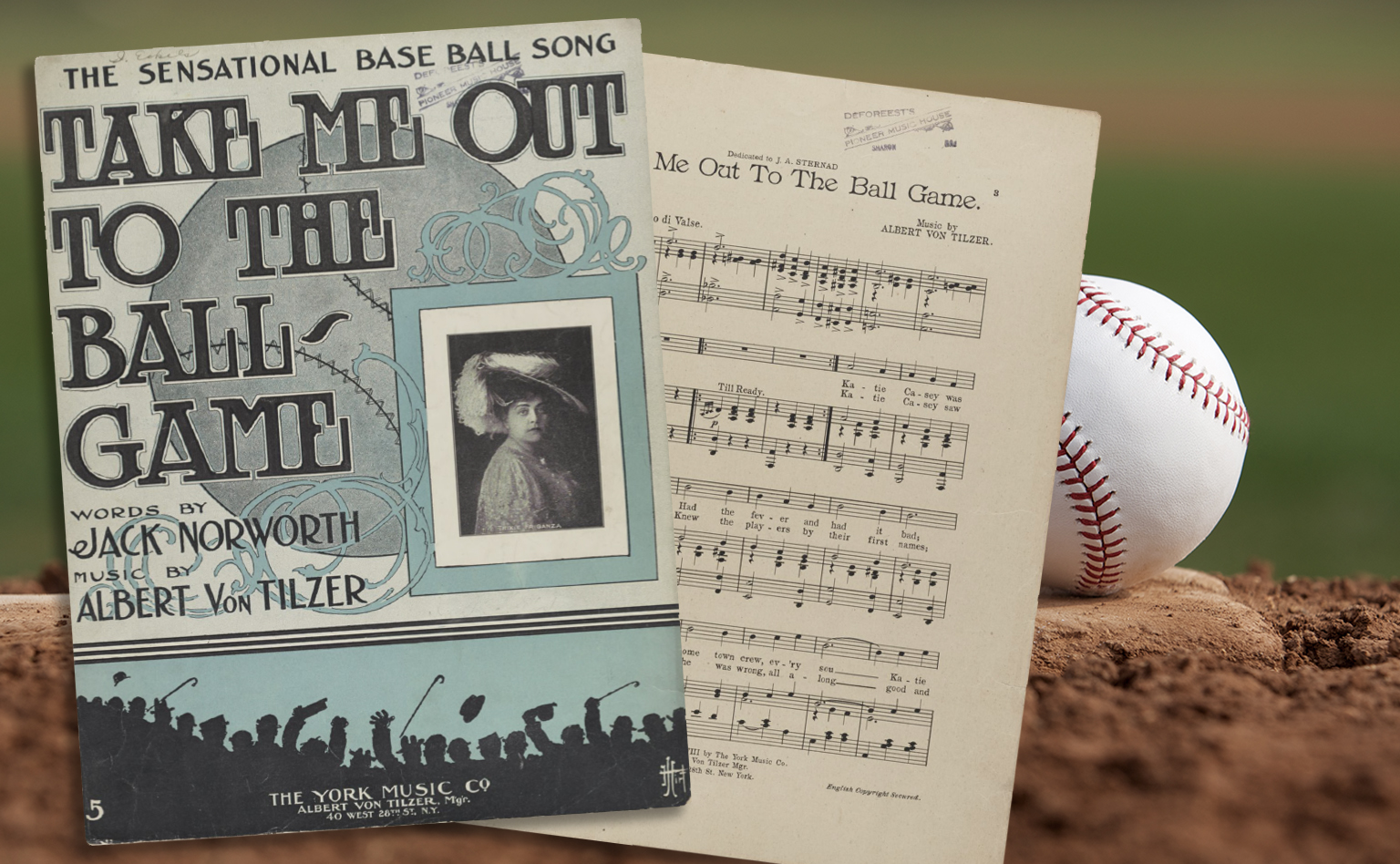
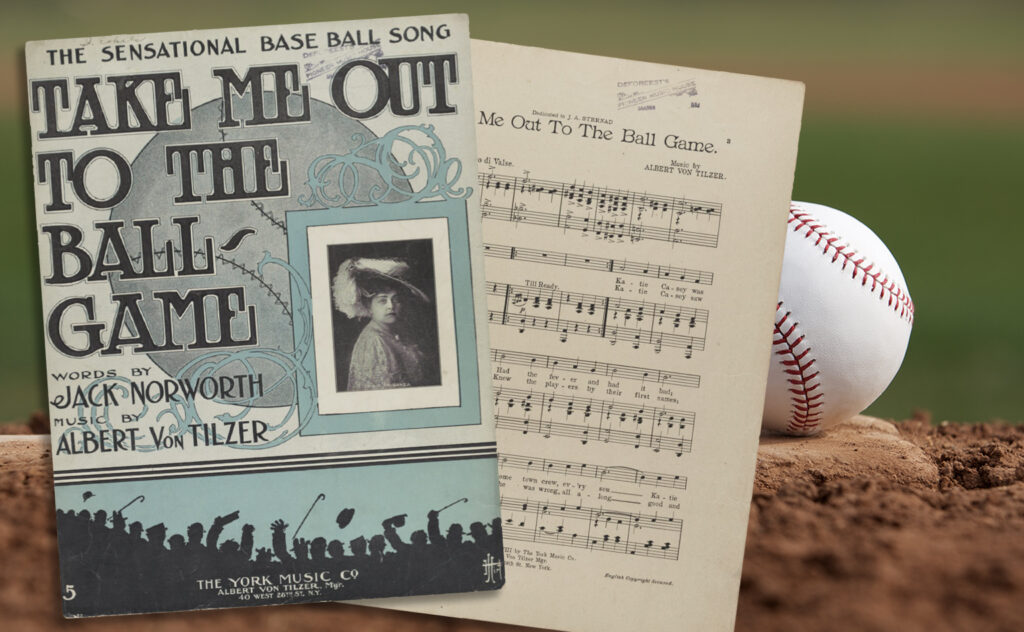
 One of the original covers of the sheet music for “Take Me Out to the Ball Game,” featuring a cameo portrait of Trixie Friganza, vaudeville performer, girlfriend to lyricist Jack Norworth, and the likely inspiration for the song’s leading lady, Katie Casey. Also pictured is a partial image of the song’s sheet music. Credit: Library of Congress Music Division.
In 1908, lyricist Jack Norworth and composer Albert Von Tilzer wrote what would become one of the most recognized and most sung musical works in the United States: “Take Me Out to the Ball Game.” In a relatively short period, it was performed for the first time, registered with the Copyright Office, and published in a series of sheet music depicting vaudeville stars on the covers. The song was an instant hit, though it wouldn’t become the baseball theme we know today until much later. With Opening Day and the start of the 2026 Major League Baseball (MLB) season, we’re looking at the history of the song and copyright’s connection to America’s favorite pastime.
Many people might not realize “Take Me Out to the Ball Game,” as we know it, is the chorus of a longer tune. In the full version, Norworth’s original lyrics tell the story of Katie Casey, a girl who wants her boyfriend to take her to fully experience a baseball game rather than to a show. Ironically, he wrote the song without having ever attended a professional baseball game. On May 2, 1908, Von Tilzer’s publishing company, York Music Co., registered the musical composition with the Copyright Office. Soon, more than thirty vaudeville stars performed the song, promoting it at theaters and nickelodeons, and were each featured on the cover of a different sheet music edition.
Years later, in 1927, Norworth rewrote the lyrics, renaming Katie Casey as Nelly Kelly and updating her image in the wake of women’s suffrage. The chorus, however, remained the same. He registered the updated lyrics and music with the Copyright Office on May 27, 1927.
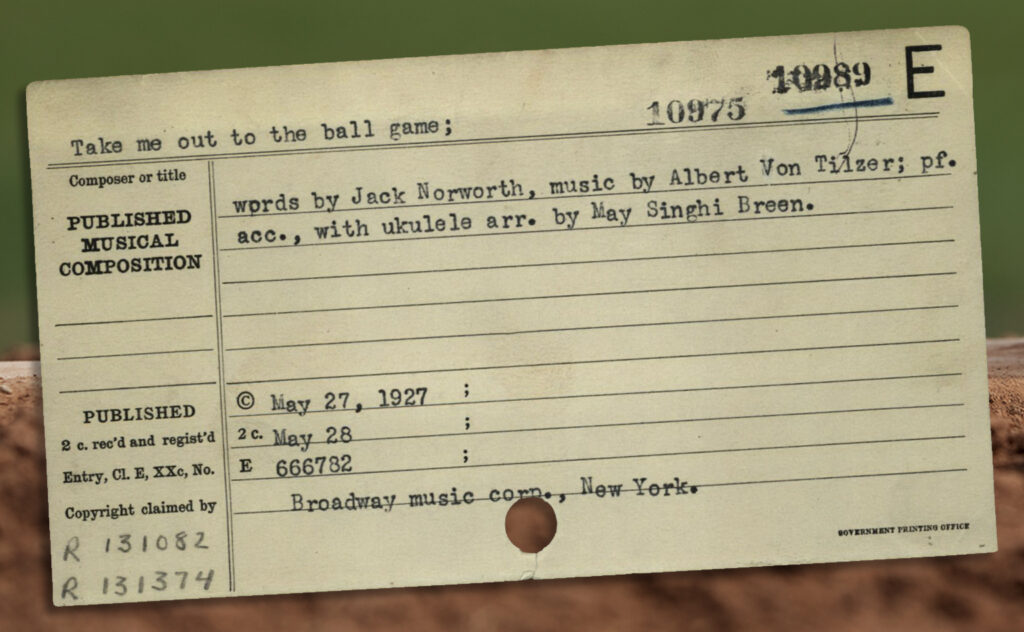 Copyright registration catalog card for the revised 1927 musical composition. Credit: U.S. Copyright Office.
The song eventually faded from the spotlight until it appeared in the 1949 film Take Me Out to the Ball Game, starring Frank Sinatra, Esther Williams, and Gene Kelly. The movie led to renewed popularity, and the song began making its way into ballparks around the country, with organists playing an instrumental version during the games. Then, in 1977, Chicago White Sox (and later Chicago Cubs) announcer Harry Caray sang the chorus of the song for the first time during the seventh-inning stretch, and a tradition was born. Today, the song is sung in major league ballparks around the country.
Ensuring the song’s legacy would extend beyond the ballpark, in 1975, Norworth’s estate instructed the performing rights organization ASCAP (The American Society of Composers, Authors, and Publishers) to use the future royalties from licensing “Take Me Out to the Ball Game” and Norworth’s other works for the creation of a program to support young musicians, leading to the establishment of the ASCAP Foundation.
The song’s original and revised lyrics are now in the public domain, and with the song no longer under copyright protection in the United States, anyone can use the musical work, including by singing it publicly, recording their own version, or creating a new work from it.
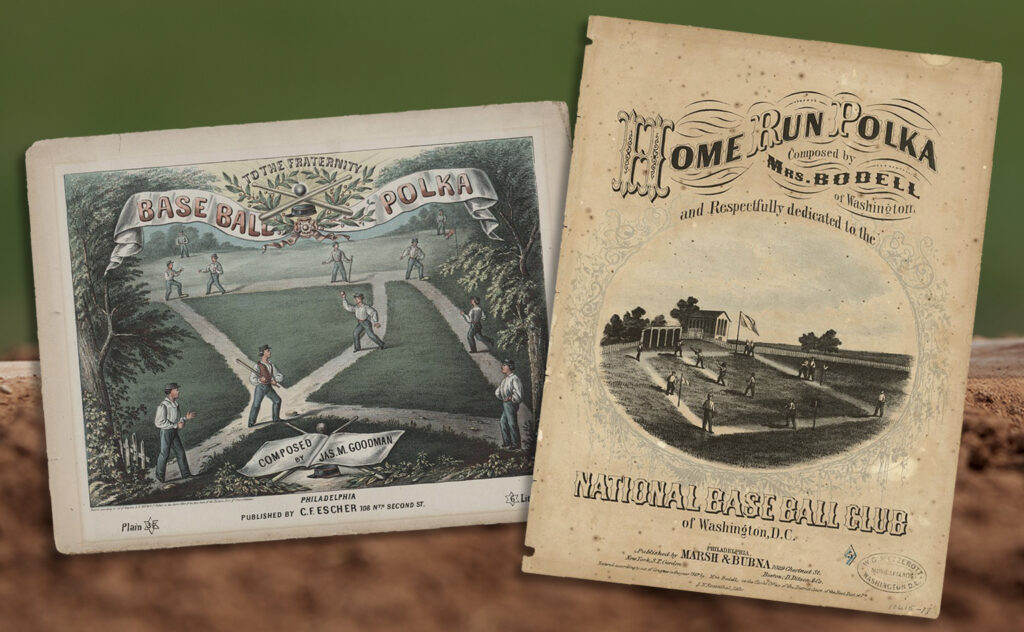 The covers for two of the earliest baseball-themed musical compositions, “Base Ball Polka” and “Home Run Polka.” The covers of early baseball sheet music were known for their colorful and elaborate illustrations. Credits: Library of Congress Prints and Photographs Division and Library of Congress Music Division.
“Take Me Out to the Ball Game” is not the first, or only, musical work associated with America’s favorite pastime. In fact, music and baseball have always gone hand in hand, from as far back as 1858 with the organization of the first baseball league and the first composition of a musical work about baseball.
Baseball-themed music thrived, and sheet music for these songs became increasingly available. Early examples were notable for their colorful and elaborate illustrations on the cover, often depicting the game itself. One particularly rare collector’s piece was the sheet music for the song “Base Ball Polka,” written by composer Jas. M. Goodman, which featured a full-color lithographic cover of a game in progress. Philadelphia publisher C. F. Escher registered the work for copyright protection on January 8, 1867 (see the record on page 22).
Also in 1867, Mrs. Bodell of Washington, DC, registered her musical composition, “Home Run Polka,” in the U.S. District Court for the Eastern District of Pennsylvania, as was required under federal copyright law at the time. It was one of the earliest baseball songs dedicated to a specific team: the National Baseball Club of Washington. The Washington Nationals, whose players at the time included government workers, clerks, lawyers, and war veterans, departed that year for baseball’s first “tour of the west,” traveling to Illinois, Missouri, and Ohio.
Today, most major league baseball teams have team songs. Some teams have used songs written specifically about them, such as the Chicago Cubs’ “Go, Cubs, Go,” the New York Mets’ “Meet the Mets,” and the Detroit Tigers’ “Go Get ‘Em Tigers,” among others. Other teams have adopted popular songs with some connection to their location, like the San Francisco Giants’ “I Left My Heart in San Francisco,” New York Yankees’ “New York, New York,” and the Los Angeles Dodgers’ “I Love L.A.” And some teams even use songs with seemingly no connection to pump up the crowd, as with the Boston Red Sox and the song “Sweet Caroline,” which is played in the middle of the eighth inning during every home game.
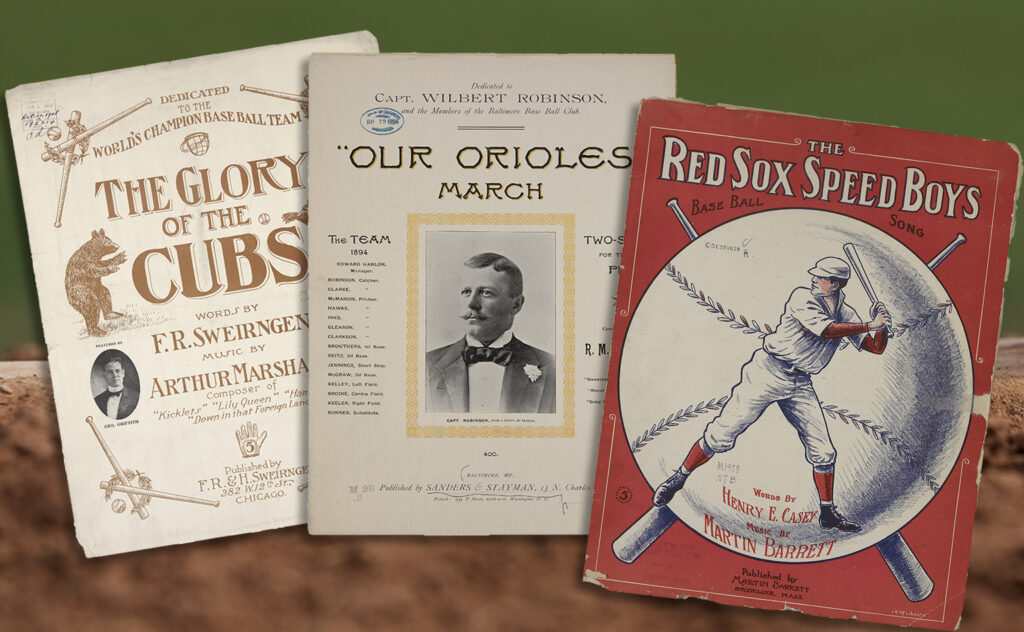 Three sheet music covers highlighting team-specific compositions: “The Glory of the Cubs,” “Our Orioles March,” and “The Red Sox Speed Boys.” Credit: Library of Congress Music Division.
For musical compositions today, copyright protection begins automatically once the author fixes the work in a tangible medium, such as when composers and lyricists write them down as sheet music. Although registration is not required for copyright protection, registering your creative works with the U.S. Copyright Office provides important legal benefits, including the ability to enforce your rights in federal court or before the Copyright Claims Board. Learn more about what musicians should know about copyright.
Copyright protects everyone’s creative works, whether that work is a song written for your home team or the opposition. The Copyright Office is dedicated to making the copyright system as understandable and accessible to as many members of the public as possible.