
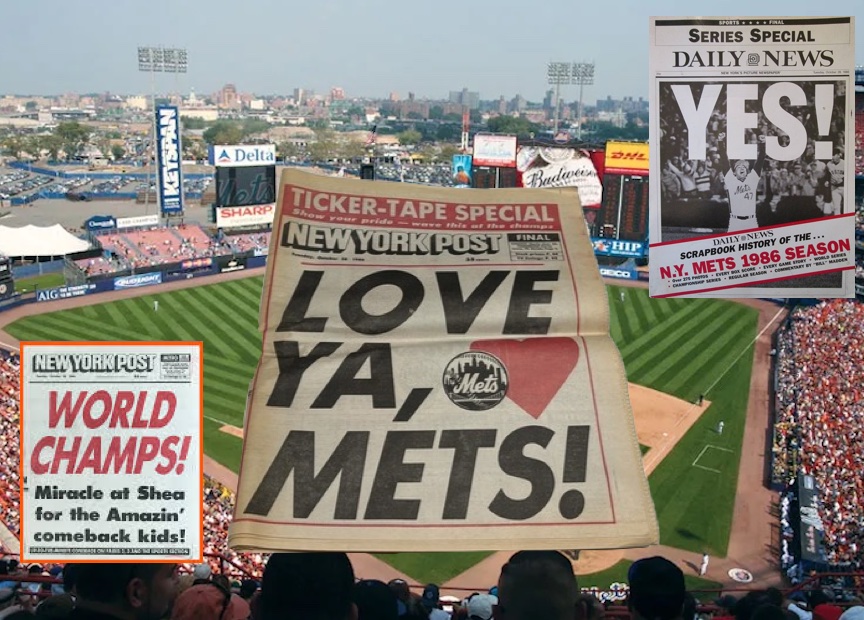
In 1962, the New York Mets brought National League baseball back to the Big Apple. After playing their disastrous first two years at the Polo Grounds, they relocated to Flushing, Queens, where they have remained ever since, first in Shea Stadium and (since 2008) at Citi Field. In New York culture, the Mets have long had a reputation as the perennial underdogs, the dreamers who never-quite-could, the ragtag mean team that contrasted so starkly with their clean-cut crosstown rivals, the New York Yankees. 2026 marks the 40th anniversary of the last time the Mets won the World Series in 1986.
Metropolitans: New York Baseball, Class Struggle, and the People’s Team by A. M. Gittlitz provides a new perspective on the team’s history. Gittlitz, a self-described countercultural writer with a focus on radical politics and social history, is a lifelong fan of the Mets. As the book’s title indicates, he fuses his interest in leftist sociopolitics with his love of baseball, or, rather, his very specific love of the Mets.
“This will not be a typical sports book,” he declares in the book’s introduction. “This is not a book about greatness, nor baseball. It’s about the New York Mets.” At the same time, it is also inevitably a book about the Yankees. In the grand tapestry of Mets history that Gittlitz lays out, the Mets almost always exist in contrast to their American League counterparts.
“The most chauvinistic Yankees supporters were the same bullies that hurled fries and slurs toward my friends’ lunchtime Magic: The Gathering tournaments,” he says. “I became fully convinced the Mets were the team of a downtrodden underworld of artists and radicals, with the Yankees representing the contemptible dominant ideology of New York’s financial elite, its conservative law-and-order mayor and his villainous army of police. I now cared deeply about the World Series—if the Mets could beat the Yankees, I thought, the wretched of the earth had a chance of finally putting all the oppressors in their place.”
This mood persists through the rest of the book. Gittlitz lays out baseball’s history as a people’s sport. He writes at length about its roots during the American Revolution, its evolution from an amateur game into a professional juggernaut and the rise of the original New York Metropolitans in the 19th century. Baseball legend Branch Rickey and franchise lawyer William Shea named the 1960s incarnation of the Mets in honor of that team, and part of Gittlitz’s goal is to stitch together the history of both Mets into one consistent narrative.
Gittlitz makes the argument that those original Mets (then already part of the American Association, which would then be absorbed into the National League) are direct ancestors of the modern Mets. He makes the same case for the Giants and the Dodgers, the two National League teams that left New York after the 1957 season for greener pastures in California, whose colors and logo the current Mets have adopted. His larger argument is that all of the teams that lead to the New York Mets we know today were coded as working class, in direct opposition to the elitism of the Yankees.
This focus on class struggle permeates his writing. Gittlitz makes the argument that various significant social events, including the rise of Marxism in Europe, the conflict against fascism during World War II and the fight for civil rights in the United States, are deeply intertwined with baseball’s history.
Baseball, Gittlitz writes, often serves as a litmus test for how America feels about a given subject. First and foremost is the relationship between worker and employer: The Major League Baseball Players Association, professional baseball’s labor union, rose in opposition to the much-maligned “reserve clause,” which for decades had chained players to particular teams and prevented mobility.
And of course, there is also the matter of race. Jackie Robinson’s story is well known, but Gittlitz reminds us too of the stories of Willie Mays (who eventually played for the Mets in the ’70s after a long career with the Giants) and even Babe Ruth, who scandalized many during the prime of his career by playing exhibition games with Black players and often spoke up in defense of racial equality.
New York City was the center of many of these struggles. After the Dodgers and Giants left for California, the desire for a new National League team was so high that Mayor Fiorello LaGuardia immediately formed a committee to bring one to New York. Robert Moses, subject of Robert Caro’s seminal The Power Broker, would become heavily involved. Moses and Shea would be responsible for bringing the team to its home in Queens.
Unfortunately, Moses in particular would also be responsible for a dearth of accessible public transit to that neighborhood from parts of the city with primarily non-white populations, something that still affects fans from many parts of the region today.
Gittlitz emphasizes how these stories continued as time went on. After New York City faced one of its worst financial crises in the ’70s and the federal government refused to help, it felt like the city’s working class could never recover. But the Mets’s victory in the World Series in 1986 felt like a victory for struggling New Yorkers.
After Shea Stadium found itself transformed into a staging hub for first responders in the days post-September 11, the team itself also provided the city with a shot in the arm: Mike Piazza’s famous home run against the Braves was one of the first moments of good feeling that came back to the city in the days after the towers went down.
Years later, Carlos Delgado, one of the best first basemen in the history of the game, played for the so-called “Los Mets” and was outspoken during a time when baseball was taking advantage of sweatshop labor in Latin America. He also made no secret of his opposition to the wars in Iraq and Afghanistan.
These are just some of the tales that Gittlitz finds time to tell over the course of the book, which goes in direct chronological order from the mid-19th century to the present day of Steve Cohen’s ownership of the team and the 2024 “OMG Mets.” As personal as his love for the Mets is, Gittlitz restrains himself from letting it show too much; he has more than his fair share of critiques of the team over the decades.
Gittlitz’s writing implies more than it says on paper. By placing all these bits of baseball lore in historical context, he gives the reader the feeling that it is all connected: The working-class struggle is the civil rights struggle, is the anti-war struggle, is the labor struggle, is the Mets struggle. When the chips are down and it seems like there is no end to the fight, as Mets closer Tug McGraw first said in 1973, you gotta believe.
Related