
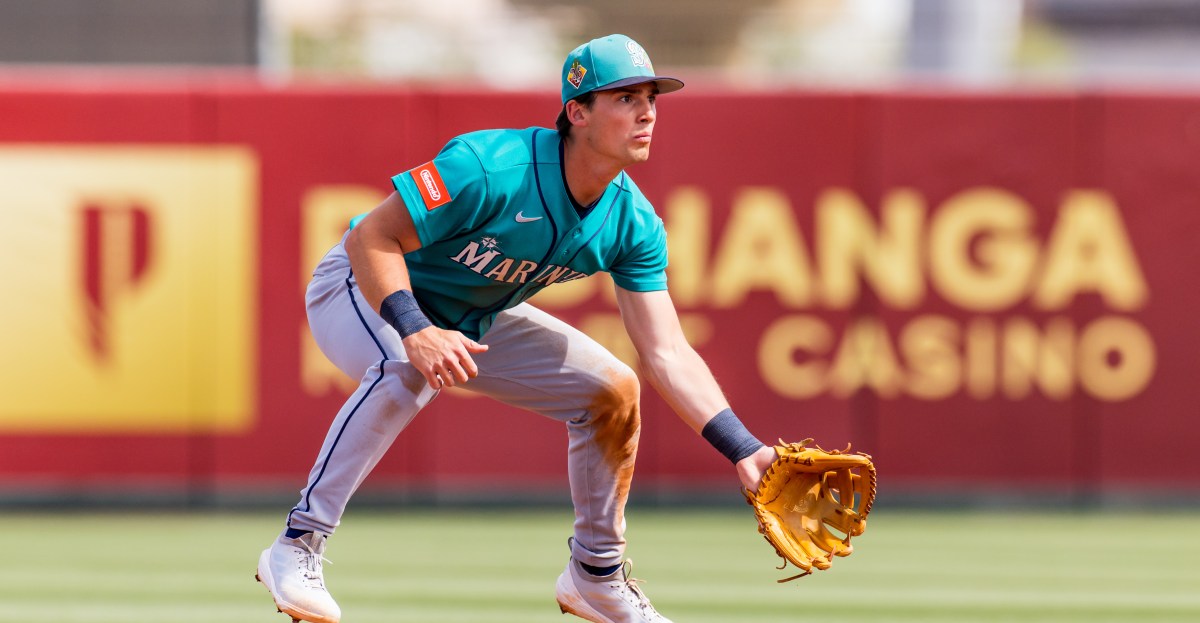
When Cole Young came to big-league camp last year, the expectation was that he’d get reps with the big-league roster before returning to Tacoma to continue his development. Instead, Young was pressed into service after Ryan Bliss went down with a torn bicep muscle in April and the Mariners were unwilling to test Jorge Polanco’s surgically repaired knee in the field every day. Still battling some arm soreness that had bothered him in spring training, and facing new demands of a 162-game season, Young was forced into a position of treading water, occasionally delivering a big hit but ultimately turning in an uneven rookie campaign that saw him tail off sharply at the back end of the season and be left off the playoff roster.
Now, having just wrapped up his second big-league camp and winning the second base job outright, Young has the failures and successes of his rookie season to build on, and he came into camp ready to address those shortcomings immediately. He built an off-season conditioning and nutrition program and implemented it immediately, preparing his body for the rigors of the season from the jump, and used that as a base for his improvements both at the plate and in the field.
“From day one,” said Jerry Dipoto, “Cole showed up ready to work.”
“As soon as the season ended, it was back to work,” said Young. “Started working out right away. I knew I had to put in some work to be in a good spot for this year, so that was kind of my mindset: just put up the work and it will show up when spring comes.”
In addition to the excellent plate discipline that’s always been a hallmark of his game, Young showed last year he was capable of producing some loud contact in the batter’s box, but he wasn’t able to consistently tap into that power. This off-season, working with a Trajekt machine, he worked extensively on his timing, specifically on being on time for the fastball, and it paid dividends this spring: despite a slower start, he ended as the Mariners’ home run leader this spring, with six, and also notched four doubles while producing some of the loudest exit velocities in camp. And he didn’t leave that power in Peoria: in yesterday’s pre-Opening Day workout, he put on an impressive round of BP, lacing balls with ease deep into right field and even banging one off the glass of the Hit It Here Café.
“I think early on it was frustrating for him, just because he wasn’t seeing it pay off right away,” said manager Dan Wilson earlier this spring. “But now you’re really seeing some strong at-bats, stringing them together, and when your body’s able to handle that and you can take your best self up to the plate every time, your confidence is rolling, and that’s what we’re seeing from Cole right now.”
But the most significant change Young has made is in his fielding. Always surehanded in the minors, Young’s defense took a step back at the big-league level. Part of the culprit was the arm injury that nagged him into the regular season, but in dissecting his rookie campaign, Young realized the bigger fault lay with his footwork. Big-league infields play faster, and Young’s footwork wasn’t setting him up for success. He said he especially focused on double play feeds and turns.
“I came from shortstop, so it’s similar footwork when you’re starting the ball to first, but it changes a lot when you’re turning a double play and have to rotate the other way. The arm angle is a little different, too, so learning that, getting good at that, turning my body and making those turns, that’s what I worked on.”
The prevailing logic is that second base is a step down the defensive spectrum from shortstop; the throws are longer from shortstop, where the majority of balls are hit, and shortstops are charged with starting the double play. But shortstops also have the benefit of almost always having the play in front of them, according to Perry Hill, with an easy throwing lane to first or second base; second basemen more often have to twist their bodies to complete a double play, an adjustment that can take time. For Young, the problem was never his speed nor instincts; you can see that in this play from this spring, where he reads a bunt cover situation perfectly, reacts quickly, and puts on some afterburner speed to get to first base in time—making a barehanded snag to top it off. This is Cole Young, the shortstop, but on the right side of the infield:
And the problem wasn’t actually his arm, even though it was likely impacted by the early-season injury in at least some way. Here is a poor throw from Young that’s actually caused by bad footwork and just general lack of muscle memory for the second base position:
Granted, this ball was a rocket off Soderstrom’s bat (107.6 mph EV, with a .530 xBA). But slowing this down, you can see that Young’s footwork as he fields the ball is off: it takes him four shuffle steps to slow his momentum, and one more shuffle step to get his body turned, leading to some bizarre weight transfers and this as a throwing position:

You do not have to be an infield guru on the level of Perry Hill to know that if you are trying to throw the opposite direction of where your feet are pointed, you are not going to get great results. This position also forces Young into a wonky weight distribution where his weight is primarily on his plant leg and his back side, forcing his arm to come over top for the throw as his plant foot pivots towards first to try to deliver the ball on-target. It is not surprising when the ball instead sails towards the first base dugout.
Some of the body positioning issues might be due to Young coming up as a shortstop and having to reorient himself at second base, especially on double play chances, where he’s essentially moving in the opposite direction he would have as a shortstop, having to turn his body rather than move fluidly through the base. “On the second base side, you know, about 20% of what you do is against where you actually want to go,” points out Hill.
In Young’s 40 in 40, Ryan pointed out that Young especially struggled on plays to his right when he had to throw across his body. This tracks with Young struggling to transfer his skills from one side of second base to the other. Again, though, the footwork makes Young’s arm look weaker than it actually is as he fails to start the double play.
Again, Young takes some extra shuffle steps to funnel in the ball and then doesn’t have a strong base to throw from. As he goes to throw, he has to awkwardly transfer his weight from his front leg, which he’s used to pivot from, to his back leg, his plant leg, to try to get off the throw.

The resulting throw is flat-footed, requiring Young to heave the ball with his upper body to try to get anything on it rather than relying on his lower half for power. That’s something he might have been able to get away with in the minors, where fields are of spotty quality and runners are slower; it’s not something that will play in the big leagues.
But again, Young looks to have improved in that area. Here’s a play from this spring where he has to range extensively to his right on a grounder that came off the bat at 100 mph. Young scampers to the ball, makes a tricky snag on the bounding ball, then makes a good-faith effort at following Perry Hill’s “6 Fs”, funneling the ball in and attempting to set his feet before throwing, resulting in a mostly on-target throw to the first baseman.
“He’s under control now,” noted Dan Wilson this spring of the improvements in his second baseman. “‘Bone’ has put in so much work with him, and I think Cole has done the work and understands why, and has really put it to use out there.”
“He did a good job,” said Perry Hill of his pupil. “He came and he was so much more prepared. He worked hard this winter, and you can see the difference.”
“I learned a ton from ‘Bone’ last year,” said Young. “I just took everything I could from him and kept working on it extra. He does a really good job of helping me understand how important the fundamentals are. It’s not about how flashy you are, it’s about fielding the ground ball and making the play every time. I’ve always bought into that since I got drafted here, and I love it. I love the 6Fs, I’m all in on those.”
It’s worth noting, too, that growing confidence in the field can transfer into results in the box and vice-versa. This is a solid, instinctual play from a game on March 4 against the Giants – which is also the game where he said he got his fastball timing back, knocking in a clutch RBI.
A year ago, Young was restricted to a half-DH role due to his injury, unable to develop rhythm in the box or on the field, only to be pressed into a big-league regular role by late April for a team fighting for a playoff spot – something Young admitted got him out of his process at times when he was trying to show he was able to play at the big-league level. This spring, with many of his teammates missing due to injury or the WBC, Young was not only the regular second baseman, but oftentimes the anchor of the infield: a challenge he rose to thanks to the hard work he put in during this off-season.
“I think going into last year, I didn’t really know what to expect,” said Young, reflecting on his two disparate springs. “And once I got caught up, I didn’t know how hard the game actually is. So it’s nice to come into the spring and, after failing a lot last year, work on those failures this off-season and come back this year…It’s nice to be able to take those lessons and keep building on top of that.”
ZiPS projects Young as just over a two-win player, with a perfectly average wRC+ of 100. That feels like a fairly low floor for Young, and if his improvements from the spring hold, it’s not hard to see him blasting past those projections. The uptick in offense this spring was encouraging, but it’s the improved defense that will make Young a valuable everyday player for the Mariners. After nearly a decade of intermittent or subpar output at the position, the Mariners might finally have found their long-term answer at the keystone.