

TUCSON – On March 10, 1951, a record 5,380 fans packed Hi Corbett Field to watch the Cleveland Indians face the reigning World Series champion New York Yankees in a spring training game, with a chance to see legends such as Joe DiMaggio, Mickey Mantle and Bob Feller.
Seventy-five years later, there are no spring training teams left in Tucson and only stories remain about the Hall of Fame players who once walked their hallowed fields.
Many Cactus League stadiums that lost their teams were eventually demolished, due to the ground’s age or to make room for new developments. Others found new tenants, such as Hi Corbett Field, where the Arizona Wildcats have played since 2012.
With the 2026 Cactus League season having concluded on Tuesday, Cronkite takes a look back at the forgotten Cactus League stadiums across Arizona that helped forge the state’s baseball history long before the Diamondbacks arrived in 1998.
Longtime Tucson sportswriter Anthony Gimino spent plenty of days at the venue in Tucson.
“People love Hi Corbett,” said Gimino, now the Pima County communications coordinator. “There’s kind of an emotional connection there, and it’s a great park. It’s great for college, and the University of Arizona loves it, and their crowds have certainly borne that out in the last few years.”
Before the Wildcats moved into the 89-year-old stadium, Bill Veeck and the Cleveland Indians spent 45 years holding their spring training there, a run that ended when the team moved to Florida after the 1992 season. Cleveland and the New York Giants pioneered the Cactus League, becoming the first teams to hold spring training in Arizona in 1947.
Kino Veterans Memorial Stadium served as the Chicago White Sox spring training home from 1998 to 2008 and the Arizona Diamondbacks from 1998-2010. The Rockies and the Diamondbacks both departed Tucson in 2010, ending a run of spring training in the Cactus League that began in 1947.
“It felt like a gut punch, ” said Blake Eager, executive director of the Southern Arizona Sports, Tourism, & Film Authority, “in the sense that it’s been ingrained into our DNA in southern Arizona that that was one of our identities, a large identity when it comes to professional sports and sports. I think it’s a hard pill to swallow, especially in the immediacy of like, ‘what are we going to do now?’”
As Major League teams departed Tucson for the Phoenix area, the southern city’s stadiums were forced to evolve. While Hi Corbett Field found a new tenant with the Wildcats, other facilities, including Kino Sports Complex, adapted in a different way.
“There’s always something going on at Kino,” Gimino said. “Last year, there were events at Kino Sports Complex every day, except for two, which was Thanksgiving and Christmas. Whether it’s soccer, football, rugby, lacrosse, obviously, baseball, softball, pickleball, you name it, there’s always something going on there.”
Even without spring training, Kino Veterans Memorial Stadium has continued to draw major events, including the 2025 World Baseball Classic qualifiers.
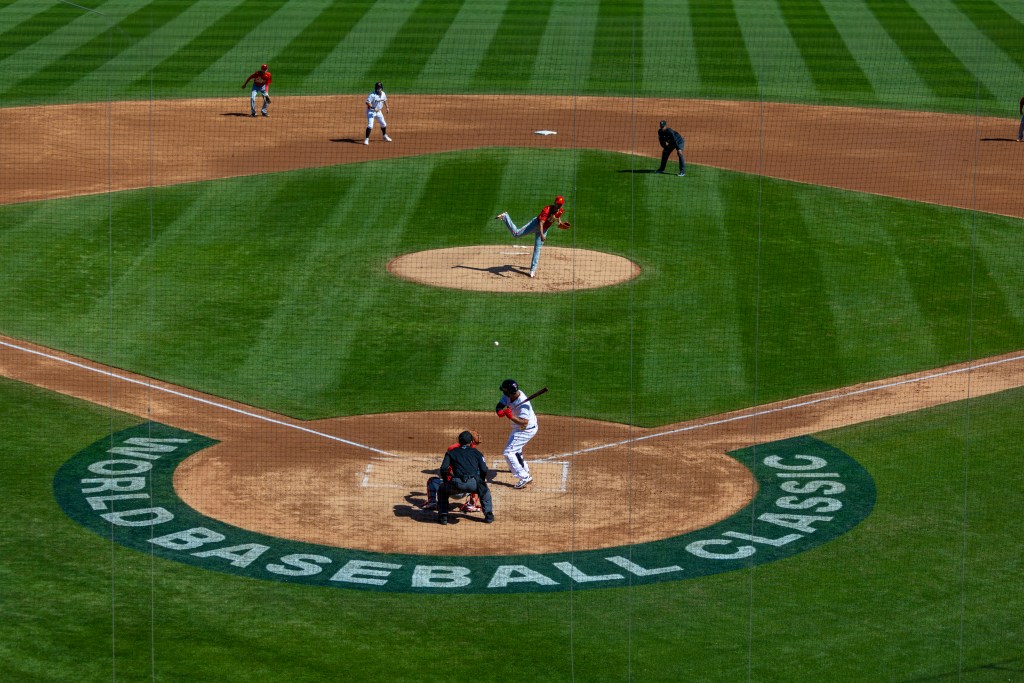 Kino Veterans Memorial Stadium in Tucson hosted the 2025 World Baseball Classic qualifiers. (Photo courtesy of Pima County Communications Office)
“It was a feather in the cap to be able to convince MLB to have this pretty significant event, to think that our facility was worthy of that,” Gimino said. “There were only two facilities in the world that held the qualifiers, so that was pretty cool.”
Kino Veterans Memorial Stadium has helped keep Tucson on the map as a sports tourism destination.
“When you’re talking about Kino, Tucson currently is a tier two city when it comes to tourism and the size and amenities,” Eager said. “But from a facility standpoint, it really borders on that tier one because of Kino.”
Other stadiums faced a different fate, sitting empty for years, before being demolished.
Compadre Stadium, which was situated in south Chandler, served as the home of the Milwaukee Brewers from 1986-97. After the Brewers left, the only signs of life at the Compadre site were the animals that grazed in the outfield, until its eventual demolition for a residential development in 2014.
Rendezvous Park in Mesa opened in 1920 and hosted the Chicago Cubs from 1952 to 1965 and then the Oakland Athletics from 1969 to 1976. The ballpark embodied what old spring training stadiums were like, holding only 3,000 people and featuring wooden grandstands but few amenities. The ballpark was closed and demolished in 1976.
Sun City Stadium served as the Milwaukee Brewers’ spring training home from 1973 to 1985 before it was demolished in 1995 to make room for residential developments.
“You never want to see the beautiful ballpark go,” James Vujs, director of Phoenix Municipal Stadium, said. “But it really becomes a necessity. No one wants to tear down ballparks, but look at Fenway and Wrigley Field. They’ve been around forever, and you’d hate to see it go, but one day they may have to. It just might be time and structure and safety. It’s just unfortunate.”
Even decades later, remnants of Cactus League and Major League Baseball history still linger in stadiums now repurposed for new uses.
“Occasionally you’ll come across something (while) digging through old files, digital and physical, or storage rooms in the stadium itself,” said Aaron Hodge, community engagement manager at the Kino Sports Complex. “I’ve stumbled across blueprints recently.”
Phoenix Municipal Stadium, now home of Arizona State’s baseball team, still holds pieces of that history along its concourse.
“The light poles are from the Polo Grounds in New York,” Vujs said. “When the Giants left for San Francisco, a few years later they tore down the whole grounds, the same year they built this ballpark, so they brought the light poles, and they’re still here.”
The Cactus League’s history isn’t just built into its structures. It’s created by the legends who once played at these ballparks, whether they are still standing or destroyed.
“There was just so much history that I guess maybe you have to be of a certain age,” Gimino said. “But to think that one time Mickey Mantle, Joe DiMaggio, Ted Williams, Satchel Paige, Bob Feller, all the parade of Hall of Famers that came through here in the 50s, 60s, and even through the 90s.”
This <a target=”_blank” href=”https://cronkitenews.azpbs.org/2026/03/27/stadiums-forgotten-cactus-league/”>article</a> first appeared on <a target=”_blank” href=”https://cronkitenews.azpbs.org”>Cronkite News</a> and is republished here under a <a target=”_blank” href=”https://creativecommons.org/licenses/by-nd/4.0/”>Creative Commons Attribution-NoDerivatives 4.0 International License</a>.<img src=”https://i0.wp.com/cronkitenews.azpbs.org/wp-content/uploads/2026/02/favicon1.png?resize=85%2C85&ssl=1″ style=”width:1em;height:1em;margin-left:10px;”>
<img id=”republication-tracker-tool-source” src=”https://cronkitenews.azpbs.org/?republication-pixel=true&post=101433″ style=”width:1px;height:1px;”><script> PARSELY = { autotrack: false, onload: function() { PARSELY.beacon.trackPageView({ url: “https://cronkitenews.azpbs.org/2026/03/27/stadiums-forgotten-cactus-league/”, urlref: window.location.href }); } } </script> <script id=”parsely-cfg” src=”//cdn.parsely.com/keys/cronkitenews.azpbs.org/p.js”></script>
Canonical Tag:
Copy Tag
Article Content:
Forgotten Cactus League stadiums across Arizona still echo baseball history
Austin Gibbs, Cronkite News
March 27, 2026
TUCSON – On March 10, 1951, a record 5,380 fans packed Hi Corbett Field to watch the Cleveland Indians face the reigning World Series champion New York Yankees in a spring training game, with a chance to see legends such as Joe DiMaggio, Mickey Mantle and Bob Feller.
Seventy-five years later, there are no spring training teams left in Tucson and only stories remain about the Hall of Fame players who once walked their hallowed fields.
Many Cactus League stadiums that lost their teams were eventually demolished, due to the ground’s age or to make room for new developments. Others found new tenants, such as Hi Corbett Field, where the Arizona Wildcats have played since 2012.
With the 2026 Cactus League season having concluded on Tuesday, Cronkite takes a look back at the forgotten Cactus League stadiums across Arizona that helped forge the state’s baseball history long before the Diamondbacks arrived in 1998.
Longtime Tucson sportswriter Anthony Gimino spent plenty of days at the venue in Tucson.
“People love Hi Corbett,” said Gimino, now the Pima County communications coordinator. “There’s kind of an emotional connection there, and it’s a great park. It’s great for college, and the University of Arizona loves it, and their crowds have certainly borne that out in the last few years.”
Before the Wildcats moved into the 89-year-old stadium, Bill Veeck and the Cleveland Indians spent 45 years holding their spring training there, a run that ended when the team moved to Florida after the 1992 season. Cleveland and the New York Giants pioneered the Cactus League, becoming the first teams to hold spring training in Arizona in 1947.
Kino Veterans Memorial Stadium served as the Chicago White Sox spring training home from 1998 to 2008 and the Arizona Diamondbacks from 1998-2010. The Rockies and the Diamondbacks both departed Tucson in 2010, ending a run of spring training in the Cactus League that began in 1947.
“It felt like a gut punch, ” said Blake Eager, executive director of the Southern Arizona Sports, Tourism, & Film Authority, “in the sense that it’s been ingrained into our DNA in southern Arizona that that was one of our identities, a large identity when it comes to professional sports and sports. I think it’s a hard pill to swallow, especially in the immediacy of like, ‘what are we going to do now?’”
As Major League teams departed Tucson for the Phoenix area, the southern city’s stadiums were forced to evolve. While Hi Corbett Field found a new tenant with the Wildcats, other facilities, including Kino Sports Complex, adapted in a different way.
“There’s always something going on at Kino,” Gimino said. “Last year, there were events at Kino Sports Complex every day, except for two, which was Thanksgiving and Christmas. Whether it’s soccer, football, rugby, lacrosse, obviously, baseball, softball, pickleball, you name it, there’s always something going on there.”
Even without spring training, Kino Veterans Memorial Stadium has continued to draw major events, including the 2025 World Baseball Classic qualifiers.
“It was a feather in the cap to be able to convince MLB to have this pretty significant event, to think that our facility was worthy of that,” Gimino said. “There were only two facilities in the world that held the qualifiers, so that was pretty cool.”
Kino Veterans Memorial Stadium has helped keep Tucson on the map as a sports tourism destination.
“When you’re talking about Kino, Tucson currently is a tier two city when it comes to tourism and the size and amenities,” Eager said. “But from a facility standpoint, it really borders on that tier one because of Kino.”
Other stadiums faced a different fate, sitting empty for years, before being demolished.
Compadre Stadium, which was situated in south Chandler, served as the home of the Milwaukee Brewers from 1986-97. After the Brewers left, the only signs of life at the Compadre site were the animals that grazed in the outfield, until its eventual demolition for a residential development in 2014.
Rendezvous Park in Mesa opened in 1920 and hosted the Chicago Cubs from 1952 to 1965 and then the Oakland Athletics from 1969 to 1976. The ballpark embodied what old spring training stadiums were like, holding only 3,000 people and featuring wooden grandstands but few amenities. The ballpark was closed and demolished in 1976.
Sun City Stadium served as the Milwaukee Brewers’ spring training home from 1973 to 1985 before it was demolished in 1995 to make room for residential developments.
“You never want to see the beautiful ballpark go,” James Vujs, director of Phoenix Municipal Stadium, said. “But it really becomes a necessity. No one wants to tear down ballparks, but look at Fenway and Wrigley Field. They’ve been around forever, and you’d hate to see it go, but one day they may have to. It just might be time and structure and safety. It’s just unfortunate.”
Even decades later, remnants of Cactus League and Major League Baseball history still linger in stadiums now repurposed for new uses.
“Occasionally you’ll come across something (while) digging through old files, digital and physical, or storage rooms in the stadium itself,” said Aaron Hodge, community engagement manager at the Kino Sports Complex. “I’ve stumbled across blueprints recently.”
Phoenix Municipal Stadium, now home of Arizona State’s baseball team, still holds pieces of that history along its concourse.
“The light poles are from the Polo Grounds in New York,” Vujs said. “When the Giants left for San Francisco, a few years later they tore down the whole grounds, the same year they built this ballpark, so they brought the light poles, and they’re still here.”
The Cactus League’s history isn’t just built into its structures. It’s created by the legends who once played at these ballparks, whether they are still standing or destroyed.
“There was just so much history that I guess maybe you have to be of a certain age,” Gimino said. “But to think that one time Mickey Mantle, Joe DiMaggio, Ted Williams, Satchel Paige, Bob Feller, all the parade of Hall of Famers that came through here in the 50s, 60s, and even through the 90s.”
This article first appeared on Cronkite News and is republished here under a Creative Commons Attribution-NoDerivatives 4.0 International License.
Copy Content
Tracking snippet:
Copy Snippet