
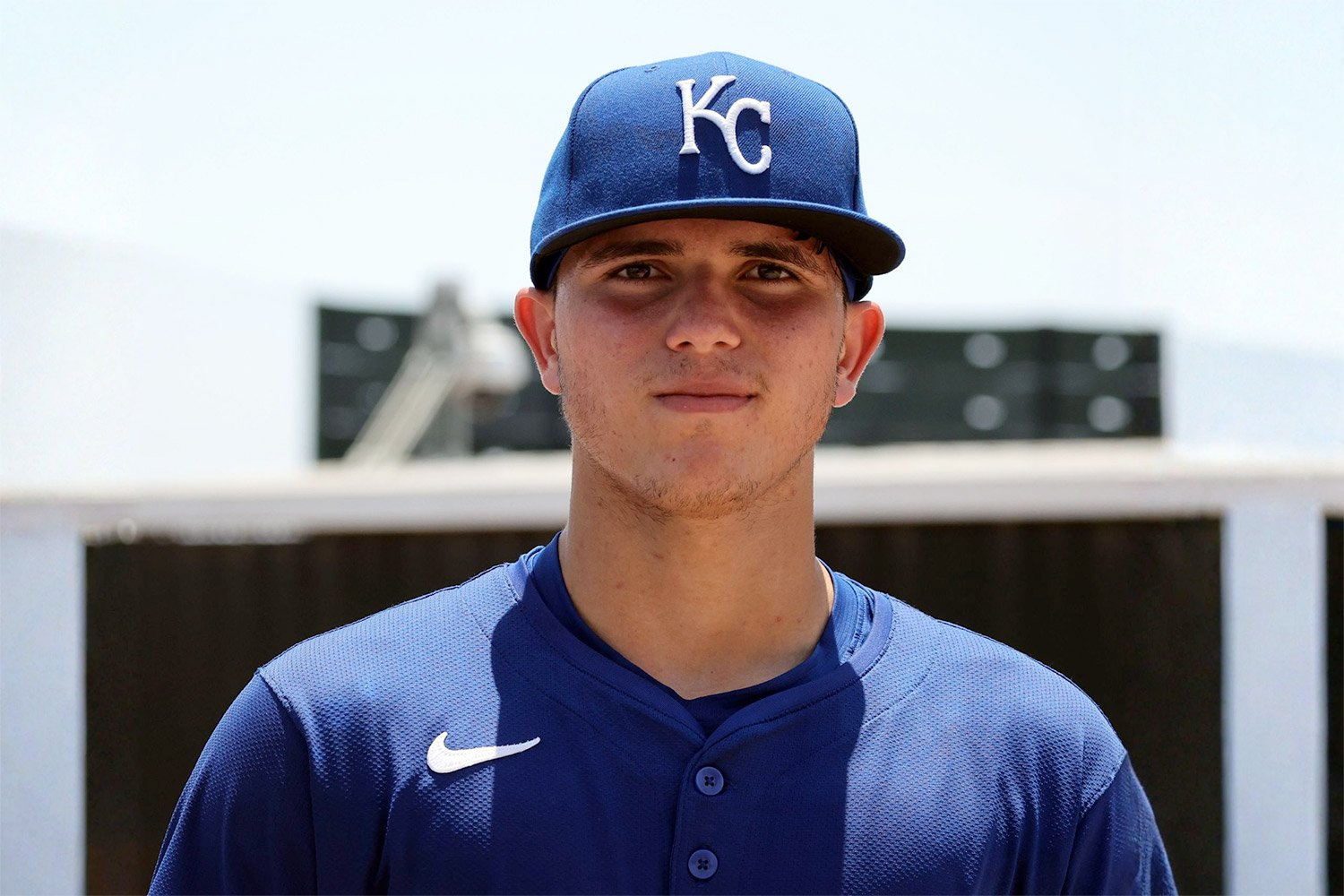
In January 2025, the Royals signed 17-year-old Kendry Chourio to a $247,500 deal. On its face, it was a relatively small contract for a teenage Venezuelan. One year later, we have him ranked fourth in the Royals’ farm system, and his future is bright.
Chourio is a rare combination of elite stuff and elite control at a very young age. In 51 1/3 innings across the DSL, Arizona Complex League, and Low-A, he posted a 3.51 ERA, a 0.95 WHIP, and 63 strikeouts while walking five batters, numbers that translate to an 11.05 K/9, a 0.88 BB/9, and a 12.6 K/BB ratio.
According to Baseball America, his four-seam fastball averages 95 mph, with a peak of 98 mph. It is cast off a 6-foot, 160-pound body that is yet to develop. He also possesses a good down-arm curveball and, as claimed by CBS Sports, one of the best changeups available to minor-league right-handers. To a teenager who signed a contract of roughly a quarter-million dollars a few months earlier, this is outstanding.
The Royals’ Rotation & Payroll Timeline
The reason Chourio’s timeline carries unusual financial weight is what’s sitting on the Royals’ books right now and what’s scheduled to fall off. Kansas City has committed a substantial amount of money to its rotation through 2027.
Michael Wacha is on a three-year, $51 million deal paying him $18 million in both 2025 and 2026 and $14 million in 2027, with a $14 million club option for 2028. Seth Lugo, who agreed to a two-year extension last July, will earn $20 million annually in 2026 and 2027, with a vesting option that could add a third year at $20 million if he throws 335 innings over the two seasons. Cole Ragans signed a three-year, $13.25 million extension covering 2025 through 2027, with salaries of $1 million this year, $4.5 million in 2026, and $7.5 million in 2027, which is a relative bargain for a pitcher who finished fourth in AL Cy Young voting in 2024.
The Royals are assured of around $42-43 million in guaranteed salaries for starting pitchers in 2026 and 2027. Ragans will be paid the least. Lugo will be 37 in 2027. Wacha will be 35. Neither of those contracts commits money after 2027. Ragans still has one year of arbitration in 2028 before he is a free agent; however, his salary may reach up to $20 million based on performance.
The Bobby Witt Jr. contract complicates this further. His salary escalates steeply: $13 million in 2026, $19 million in 2027, and then $30 million in 2028, the year Wacha’s and Lugo’s guaranteed money is gone. By 2028, Witt alone accounts for $30 million of payroll. Adding Ragans’ final arbitration year, a starting salary for Kris Bubic (assuming any extension materializes), and minimum-level roster filler, the Royals are going to need to make hard choices about where rotation spending goes post-2027.
According to MLB Trade Rumors, in 2026, the Royals are going to spend approximately $79 million before arbitration players sign on. That is Kris Bubic and Vinnie Pasquantino, among others, and that puts the payroll above that figure. In September 2025, Royals Review reported that the 2026 payroll would total slightly less than $82 million without arbitration cases.
The Rotation Cliff That Arrives After 2027
The post-2027 rotation situation is the crux of why Chourio’s development timeline matters so much. When Wacha’s guaranteed money expires and Lugo’s vesting option resolves, Kansas City faces a version of a question: how do you replace above-average starting pitching without the budget to simply go out and buy it?
There is a high price in trading for starting pitchers. In 2022, good starting pitchers in the free-agent market are priced at 20-30 million a year. The extension of Lugo, worth $20 million annually, is similar to that of an aging second starter. The Royals cannot make three or four of those deals simultaneously without compromising depth at other jobs or facing the luxury tax, which is beyond their comfort zone.
David Shields is an 18-year-old lefty with a 2.01 ERA and an 81:15 K:BB ratio in 71 2/3 innings that he threw in Low-A in 2025. Many projections have him in High-A or Double-A in 2026. It refers to the fact that he would have to wait until 2027 to have the opportunity to become one of the majors, and only if the plan works quickly. Chourio’s path looks the same.
The math around this is actually pretty clean. If Chourio develops on a typical aggressive curve for a high-ceiling arm — Low-A in 2026, High-A in 2027, Double-A in 2027 or early 2028, and then a possible big-league debut sometime in 2028 at age 20, and he arrives right when the Royals need rotation help most.
Cost-Controlled Starters Are The Royals’ Future
A pitcher in his first three years of service time earns roughly the major league minimum — currently $740,000 on the low end. Against a market where a legitimate No. 3 or No. 4 starter costs $15 million annually in free agency, a pre-arb arm performing at that level generates over $10 million in surplus value per year.
The Royals already have a decent rotation, with total annual expenditures of over $42 million on Wacha, Lugo, and Ragans through 2027. However, two of those deals expire in 2027, when Bobby Witt Jr. will earn $30 million. That will strain the Royals’ meager payroll, which is usually in the bottom third of Major League Baseball.
Interested in learning more about the Kansas City Royals’ top prospects? Check out our comprehensive top prospects list that includes up-to-date stats, articles and videos about every prospect, scouting reports, and more!