
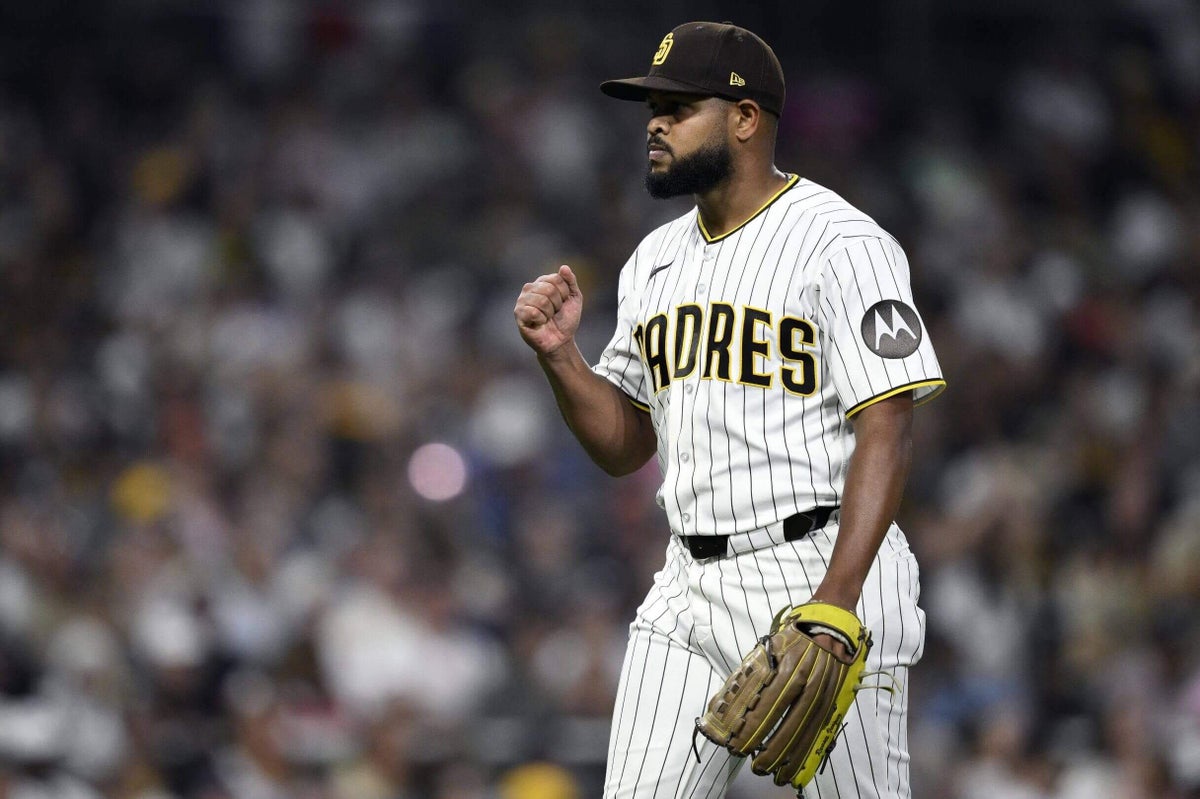
SAN DIEGO — Last July in Miami, Randy Vásquez retired 13 Marlins batters without striking out any of them. He issued a walk and allowed seven hits, including a home run. After the San Diego Padres won a low-scoring game, he conceded something else.
“If God doesn’t want me to strike out these guys,” Vásquez said through interpreter Jorge Merlos, “then I’m just going to find out another way to do it.”
Among big-league starters, Vásquez carried the second-lowest strikeout rate. Yet he owned a respectable 3.73 ERA, surviving on late movement, apparent resilience and plain luck.
Then, in August, his average four-seam fastball velocity climbed from 93.5 mph to 94.1 mph. The following month, it jumped to 95 mph.
That is where it sat Saturday in his 2026 debut. And Vásquez asserted something else.
His eight strikeouts were one shy of his career high, set in September against an awful Colorado Rockies lineup. The Detroit Tigers supplied a stiffer challenge, and for a night, at least, Vásquez was the stopper. Behind the right-hander’s six scoreless innings, the Padres avoided a season-opening sweep and shut out the Tigers 3-0, giving Craig Stammen the first win of his managerial career.
“We needed a big start from him after the first two games,” Stammen said. “He delivered.”
Vásquez’s performance eased the pressure felt by a rookie skipper. It also demonstrated how he can raise the floor of a suspect starting rotation. Vásquez remains in search of his ceiling, a pitcher Stammen recalled as a raw talent in late 2023 when the Padres acquired him from the New York Yankees as part of the return for star outfielder Juan Soto. But in some ways, he is already a developmental success.
Randy Vásquez’s 2Ks in the 5th.
8Ks thru 5 pic.twitter.com/wz2PM2fDzA
— Rob Friedman (@PitchingNinja) March 29, 2026
A little more than a year ago, Vásquez arrived in spring training in suboptimal shape. He struggled to maintain a firm fastball and nibbled around the strike zone. The Padres put him on a strength and conditioning program and prescribed mechanical tweaks.
Eventually, after the All-Star break, the work began to pay off. Vásquez touched 97 mph in his final start as he fired seven scoreless innings against the Milwaukee Brewers. Five days later, with the Padres headed to the postseason, Vásquez came out of the bullpen and topped 98 mph, impressing an unlikely mentor.
“I think anybody who has a relationship with a pitcher that has done it successfully for a lot of years with the demeanor and the personality of Yu Darvish, you take advantage of those words and that coaching,” Padres associate manager and pitching coach Ruben Niebla said of Vásquez earlier this month. “It was building confidence, and most importantly, Darvish was the one who held him a little bit more accountable to everything he was doing throughout the course of the day.”
Vásquez, 27, was born in the Dominican Republic. He speaks enough English to get by. Darvish, 39, is one of the most accomplished Japanese pitchers in major-league history and is fluent in two languages, neither of which is Spanish.
The two Padres formed a friendship, anyway. Vásquez began soliciting advice from Darvish in 2024 and particularly in 2025. Darvish taught Vásquez how to prepare, from refining his scouting reports to observing a stricter routine between starts. By last winter, the mentee appeared to have fully bought in.
“This offseason, he’s waking up at 6 in the morning and working out,” Stammen said, “and ‘by the time I’m done, Darvish is calling me because he hasn’t woken up yet.’”
This weekend, after pitching the 2026 Padres to their first win, Vásquez broke into a toothy smile at the mention of his absent teammate. The two men locker near each other at Petco Park, but Darvish is away from the team; the five-time All-Star went on the restricted list on Opening Day to save the Padres substantial money and rehab from elbow surgery at his own pace as he contemplates a future that may or may not include another major-league pitch.
“He’s an incredible person,” Vásquez said through interpreter Pedro Gutiérrez. “He’s helped me out a lot ever since I came here to San Diego. He’s very special to me. We text, we FaceTime, we call each other.”
Before Saturday’s game, that meant a quick text from Darvish, wishing the younger pitcher a good start. Then, Vásquez took the mound and largely confounded the Tigers, issuing three walks but yielding only two hits. The second-best strikeout performance of his career was a byproduct of both increased velocity and greater conviction.
“I think it’s just trust,” Stammen said. “Trust in his pitches, and trust in the zone. I think we (used to see) from Randy a little bit of … pitching around the zone. And I think what we’re seeing now is him attacking hitters and not being afraid, and knowing that he’s got good stuff.
“He’s been poured into from a lot of people in the organization, and he’s listened to it. He’s been open to coaching and learning.”
A Randy Vasquez 80-Grade 4-Seam fastball v. Matt Vierling:
95.4 mph
19.1” iVB
7.8” horizontal break
2561 rpms
6.2 vRel pic.twitter.com/M4THyitU9M
— Clark Fahrenthold (@CFahrenthold11) March 29, 2026
The Padres are counting on continued, on-the-job development.
Their top starters, Nick Pivetta and Michael King, face concerns related to health and regression. Another veteran, Joe Musgrove, could return from Tommy John surgery in May, or he might have to continue waiting, given the whims of a reconstructed elbow. The club’s back-of-the-rotation depth consists of reclamation projects and pitchers with less upside than Vásquez, suddenly a potential linchpin for an entire unit.
“I think last year there was some searching for what type of pitcher he was going to be,” Niebla said earlier this month. “I think it brought more clarity when the velocity started climbing. … Being a pitcher is not just about what he does on the mound. A lot of it is, like, the discipline of what he does off the mound, right? It’s the four days in between. It’s a routine. That routine builds confidence.”
On Saturday, a winter and spring of adhering to a strict routine produced six of Vásquez’s best innings with the Padres. The offense capitalized on a few opportunities, which proved more than enough as Vásquez and left-hander Kyle Hart — who made his own season debut with two scoreless innings — created a clean chance for star closer Mason Miller.
Soon, it was over. Stammen was, for the first time, a victorious manager. And the Padres had struck out 13 batters. Eight of those belonged to Vásquez.
Did he ever think he might one day become a strikeout pitcher?
“Not very much,” Vásquez said, “but at the same time, it’s something that I’ve been focusing on.”