
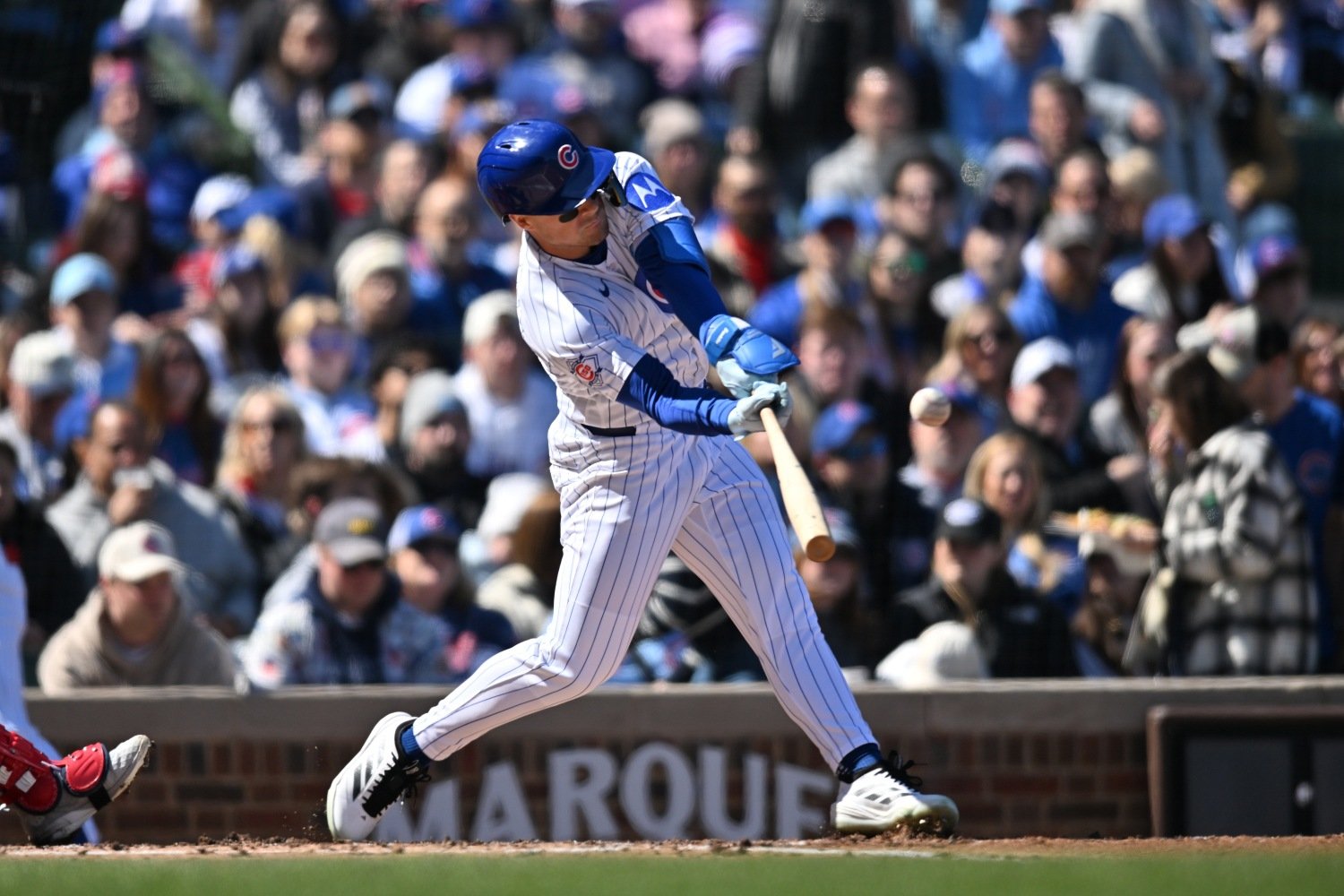
Matt Shaw will never be the Chicago Cubs’ starting second baseman, shortstop or third baseman. When the team signed Alex Bregman to a five-year deal this winter, Shaw was asked to start learning the outfield, and when they struck a deal with Nico Hoerner that will keep him in the fold at second base through 2032, that became the only imaginable way in which Shaw will find consistent playing time for the team, barring injuries. Of course, Pete Crow-Armstrong is also locked in as the team’s center fielder for the foreseeable future, so Shaw essentially has to become a competent corner outfielder to be more than a utility man for the Cubs.
That could, of course, mean that the Cubs will soon look to trade Shaw, who remains under team control through 2031. For the moment, though, let’s focus on the implications of the team’s recent moves should he stay in town, and let’s further assume that Bregman, Hoerner and Dansby Swanson are healthy enough to force him to be an outfielder. That leaves two questions to answer:
Can Shaw become sufficiently adept in the outfield itself to avoid causing major damage to the defense?
Can he hit enough to justify giving him regular playing time in positions where the team will need significant offensive production?
The first answer is likely to be ‘yes’. Shaw is a good athlete, and though he’s small and has a weak arm, he’s shown decent aptitude in limited opportunities there this spring. With speed and skills, he should be able to offset his deficiencies and play average or better defense in (especially) left field. He played a couple of balls quite well in right field on Opening Day, despite gusting wind.
Offensively, though, the standard in either corner is quite high, and Shaw hasn’t yet shown the ability to meet it. He batted .226/.295/.394 last year. There was a prolonged period in the second half in which he tapped into much more power and it was possible to envision him being a valuable bat in a corner spot, but even then, his plate discipline was shaky and he was too whiff-prone. The big leg kick he brought with him to the majors had to be adapted, but even after he did so, he seemed to be overstriding. He wasn’t well-balanced, and he wasn’t keeping his head still enough to see the ball well.
To be a useful right or left fielder, Shaw has to be better and more consistent at the plate this year. The league figured him out after his July/August power binge, and countered his adjustments; he’ll have to adjust again. This spring, he hit .320/.417/.500 in the Cactus League, but all that matters is what happens once the games count—and that, in turn, will be determined by whether Shaw can make adjustments that yield better pitch selection, more contact, and/or more power.
In that regard, there’s good news and bad news, so far. Shaw has made a major adjustment this spring to shorten his stride and (thereby) improve his stability in the box. That should mean better pitch recognition and a better contact rate, over time. Here’s a comparison of his stance and stride for 2025 with the one he’s shown (in an extremely limited sample, of course, but the difference is real and intentional) in 2026.
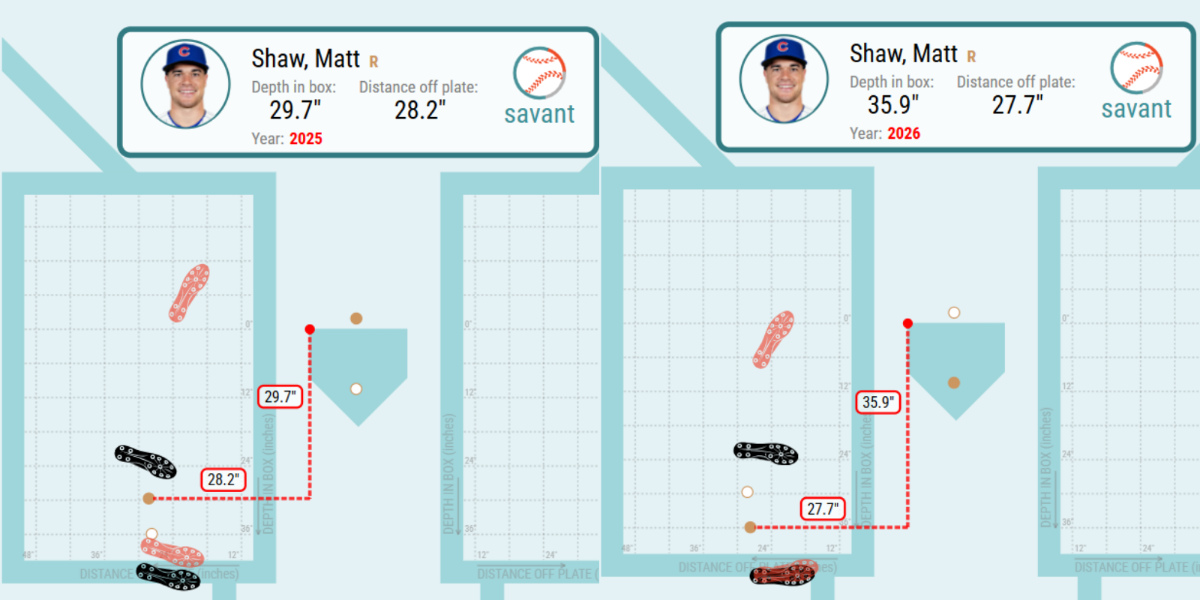
As you can see, he’s dramatically reduced the length of his stride, and he’s also a bit closer to the plate and a bit deeper in the batter’s box. All of these things are good, in the long run, for his odds of making good swing decisions and making contact on swings. The sample is too small for the results to say anything meaningful about the efficacy of the changes yet, but for this, we don’t really need stats. We just need proof that he’s changing the math—the physics, the geometry, and the algebra—of his duel with opposing pitchers. We have it. For what it’s worth, Shaw is also swinging a bit more steeply this season. That’s a noisier thing, over a sample of a game or two, and it might not remain true, but it’s noteworthy because his swing appeared to have that extra tilt even in the spring. A steeper swing would yield a greater amount of damage at the same bat speed.
That, alas, brings us to the bad news: Shaw’s bat speed so far is dreadful. On 14 competitive swings, Shaw’s average bat speed is 65.8 miles per hour. Last year, his monthly bat speeds ranged from 68.4 MPH to 70.5. Again, it’s too early to treat this as something lasting and real, but directionally, it makes a sad sort of sense. Shaw’s highest bat speeds last year were when he was striding most aggressively; he got a lot of bat speed from the sheer momentum of his attack. Shortening the stride increases control but lowers momentum. Increasing tilt improves the chances of squaring the ball up but decreases sheer torque.
Shaw will, surely, swing faster than this as he settles in and gets going this year. Still, if he doesn’t get back up to at least that 69 MPH range, he has little hope of having average power. That applies extra pressure to control the strike zone well, minimizing strikeouts and increasing walks. He might well prove able to do that; those are the things his tweaks this spring should augment. It’s just a troublesome signal, for a player whose value will have to come in large part from his bat for the foreseeable future.