
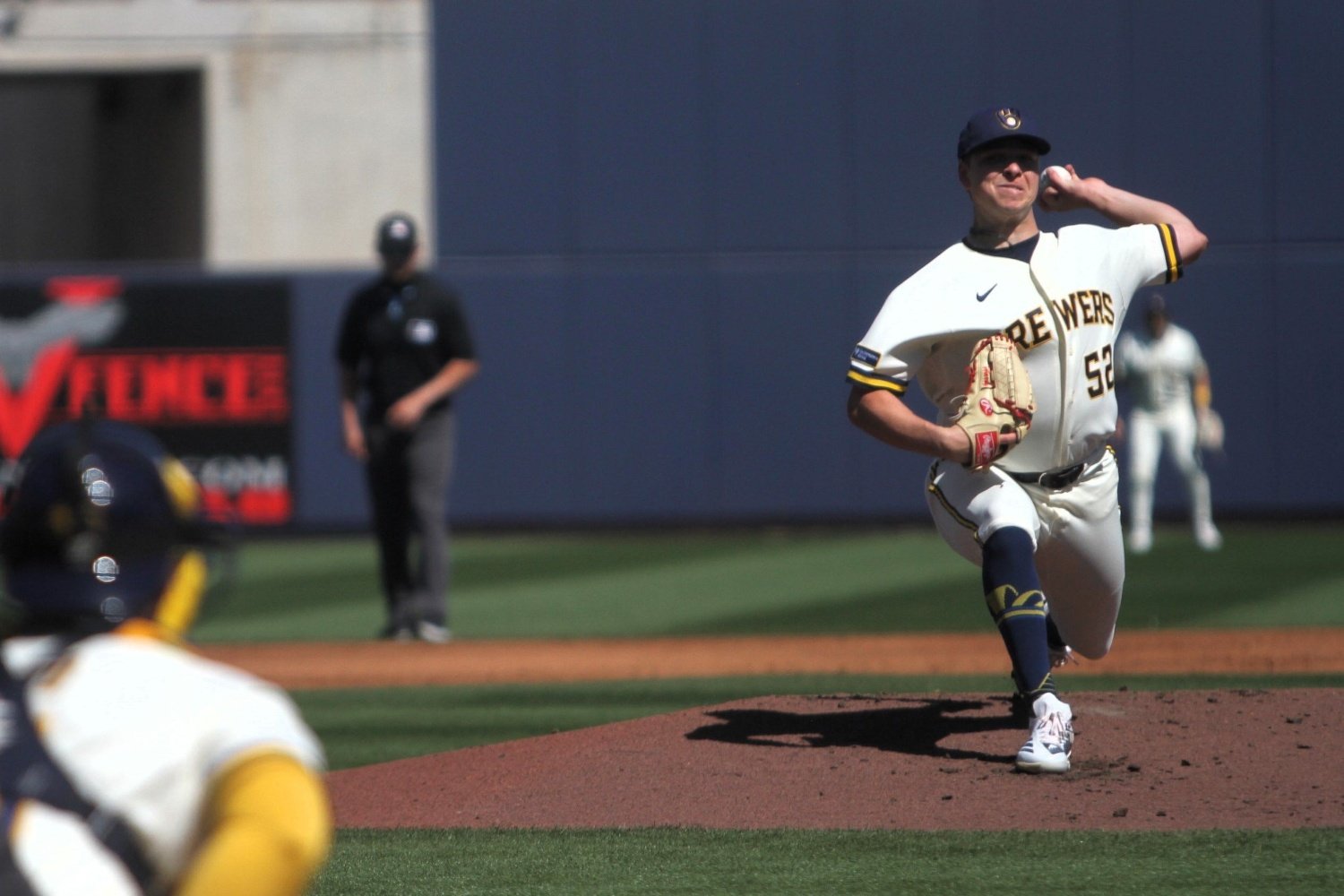
Kyle Harrison learned in unexciting fashion that he would start the Brewers’ fourth game of the regular season.
“Nothing, really,” the left-hander said with a laugh last week, when asked if he received a personal heads-up before the club announced its rotation. “Just saw that I’m pitching Monday.”
The question was not whether Harrison had earned a spot in the Opening Day rotation, but whether he’d be ready to pitch after developing a blister on his left index finger, which stemmed from the new kick-changeup grip he brought into spring training. When his fingernail started cutting his thumb as he made a circle along the inside of the baseball, Harrison trimmed the nail, but it caused the finger to blister.
“That started to build a little blister on the finger just because I cut the nail too short,” he said. “So now I know I need to have a longer nail, drink my collagen, get the nail stronger, and let it grow. Just kind of an annoying thing to deal with, but I’m glad that I got to stop it early.”
Harrison is a full go for his official Brewers debut on Monday night, after extensive work with pitching coaches Chris Hook, Jim Henderson, and Juan Sandoval in spring training. Much of that work was geared toward maximizing his strengths, which is the club’s framework for developing all of its pitchers.
“That’s what I really love about it here,” Harrison said. “It’s been like you’re running the show, basically. What you want to do, you go out and do it. They’re going to be supportive, and they’re going to give their input, and we’re going to settle on something that’s just going to be best for me.”
For Harrison, that means working off his signature four-seam fastball. While his new changeup’s outlier depth captured headlines during camp, his heater remains his best pitch. He’s thrown it roughly 60% of the time in each of his three big-league seasons so far.
“I love my fastball,” he said. “I’ve always loved my fastball. That’s something I want to throw, but throw it in the right counts and throw it in the right locations.”
The Brewers like Harrison’s fastball, too, and for good reason. With a -0.6 StuffPro (meaning that it decreases expected run production by 0.6 runs for every 100 he throws), it graded out as one of the better four-seamers among starting pitchers based on its velocity, movement, and where he releases it from his low arm slot. It induced whiffs on 26.2% of swings last season, while holding opponents to a .281 xwOBA.
“There’s an instance I remember from San Francisco when he was pitching against us, I thought to myself, ‘Oh, fastball must play up a little bit,’ because he got swing and miss with the fastball,” manager Pat Murphy said.
Harrison’s hand stays behind the baseball exceptionally well at release, which gives it true backspin from his 27-degree arm angle. According to Statcast, 98% of the spin on his four-seamer contributed to its movement last year. With an average of 12.4 inches of induced vertical break and 14.3 inches of arm-side break, it has a ride-run shape that is less common than the typical movement of the modern four-seamer.
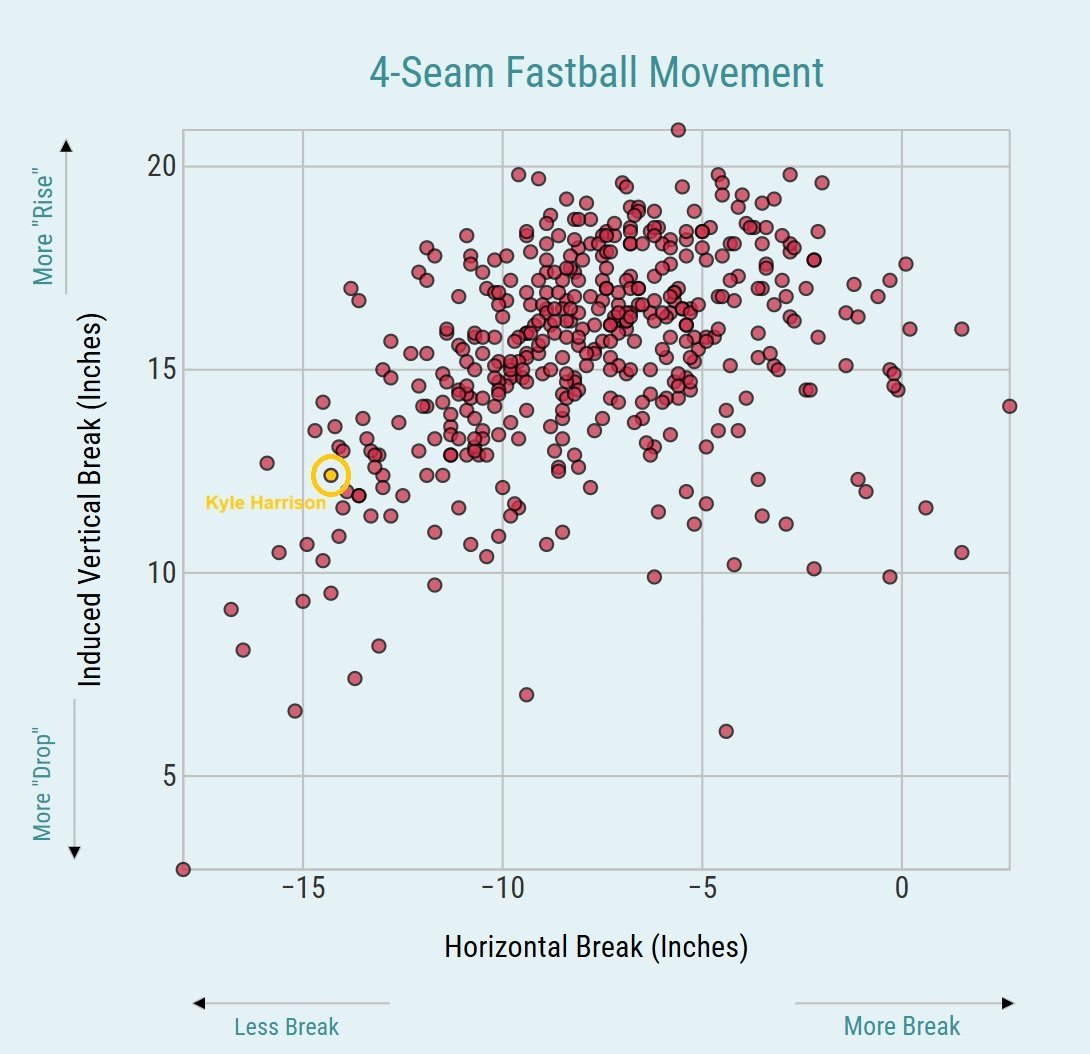
“It’s unique,” Hook said, before comparing Harrison’s heater to one of the most effective fastballs in franchise history. “Josh [Hader’s] obviously had a little bit more vert, but similar slot things. Obviously, it’s just a touch different, but I think he can get the same kind of angle at times.”
Plenty of pitchers throw with true spin on their fastballs, but most who do so have much higher arm slots, which carries other implications for their secondary pitches. Compare Harrison’s active spin profile (the percentage of the spin on each of his pitch types that contributes to movement) to those of Hader and Jacob Misiorowski, and the differences jump out.
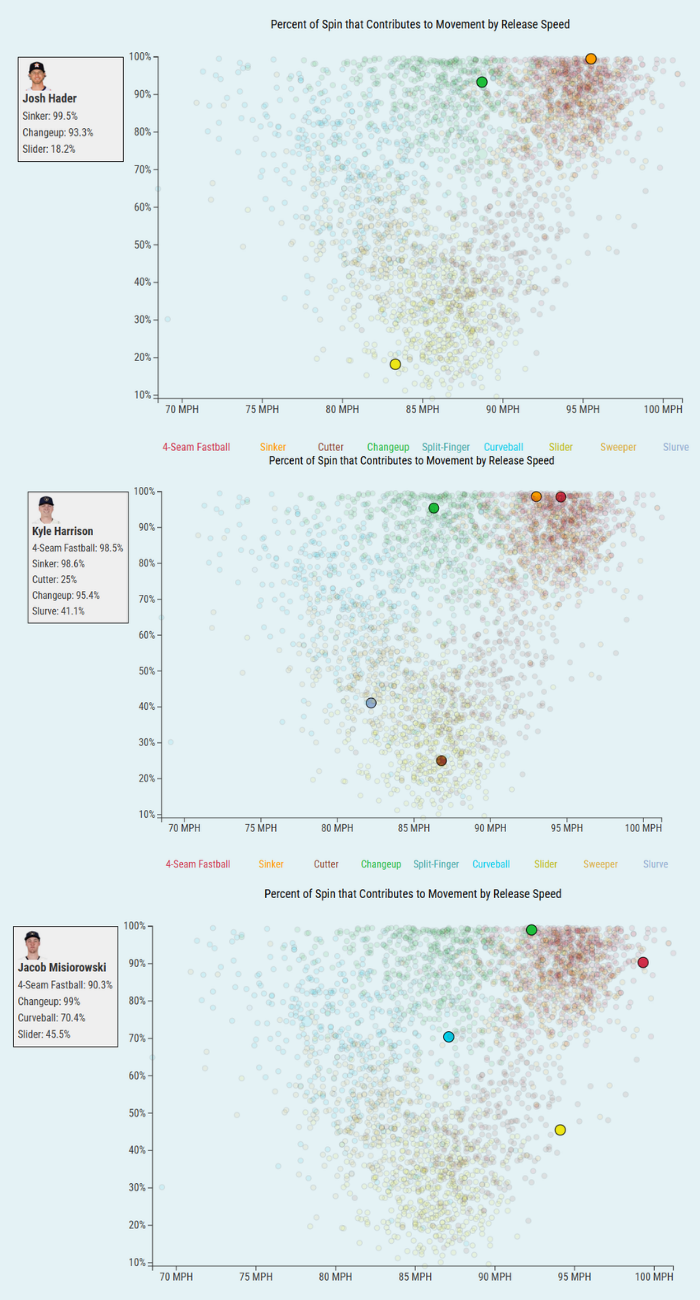
Misiorowski, who throws from a similar angle to both Harrison and Hader, is more typical of pitchers in that slot, with lower-than-average spin efficiency on his fastball but higher-than-average efficiency on his breaking balls. Harrison and Hader are the opposite, which makes their fastballs more natural cousins to high-slot guys like Jeff Hoffman, Casey Mize, or Jack Dreyer.
The expectation is that Harrison will get plenty of mileage out of that fastball, but part of his remaining development will be finding the best way to supplement it. After a midseason trade to the Boston Red Sox last year, their pitching coaches encouraged him to add a two-seamer and cutter and replace his existing changeup with the kick-change.
The Brewers felt that trying to refine all of those pitches at once was hurting his development. Moreover, with limited time in spring training to improve Harrison’s breaking ball, clean up his delivery, and tweak his routine between starts, they wouldn’t be able to perfect every pitch by Opening Day.
“I think it’s very difficult when you’re working on four ******* pitches and trying to be on time and trying to stay through it, and you’re like, ‘Okay, this is new, and this is new,'” Hook said. “When I get into crunch time, all of this is new to me. It’s too much.”
To simplify things, they scrapped the cutter, which graded out as his worst pitch in 2025. Harrison’s low slot and natural tendency to stay behind the ball—the same traits that make his fastball so effective—make it challenging to throw a true cutter. He was either releasing it too early (causing it to back up), or releasing it too late, causing it to spin like a slider instead of a cut fastball. In both cases, it led to poor location of what was supposed to be an in-zone pitch that bridged his fastball and slider.
“The struggle that I had with it was maintaining the vertical break,” Harrison said. “I’d throw one good one at eight [inches of] vert, kind of trying to get similar [carry] to your heater, and I had some where I’d stay on it a little too long. I’m a low-slot guy, so I stay on the heater, and then it just ends up getting like 2 vert. So that’s something I wouldn’t really want to throw at the top of the zone.”
The Brewers frequently target pitchers who throw cutters and often encourage those who don’t to add one to their arsenal. They rank third in cutter usage since 2024. Harrison, though, is different than many of their recent starters, who throw from a more traditional slot and slightly cut their normal fastballs. The plan is to reintroduce a cutter in the future, but only after he makes the improvements necessary for throwing an effective one from his unique release point and angle.
“If you’re not effectively rotating, if you’re not getting through the baseball the correct way, the cutter could be a detriment,” Hook said. “It’s going to be big. It’s going to be early. So I want to make sure he’s getting through the ball properly first, before it’s potentially added here in a little bit.”
For now, Harrison and the Brewers are riding with his four best pitches: fastball, slider, changeup, and the occasional two-seamer to use inside to left-handed batters. In their eyes, he’s far from a finished product, but they’re optimistic about his ceiling. He already has uncommon stuff from the left side, and their internal testing shows that he’s gotten stronger since joining the club, which they believe will lead to a velocity bump.
“There’s a lot of upside there,” Hook said. “Left-handers with that unique slot and that velo and that makeup don’t come around that often. To me, the combination of all those things makes a pitching coach super excited.”
“I’ve liked him a lot,” Murphy said. “He seems like really the right guy. He’ll figure it out at some point.”