
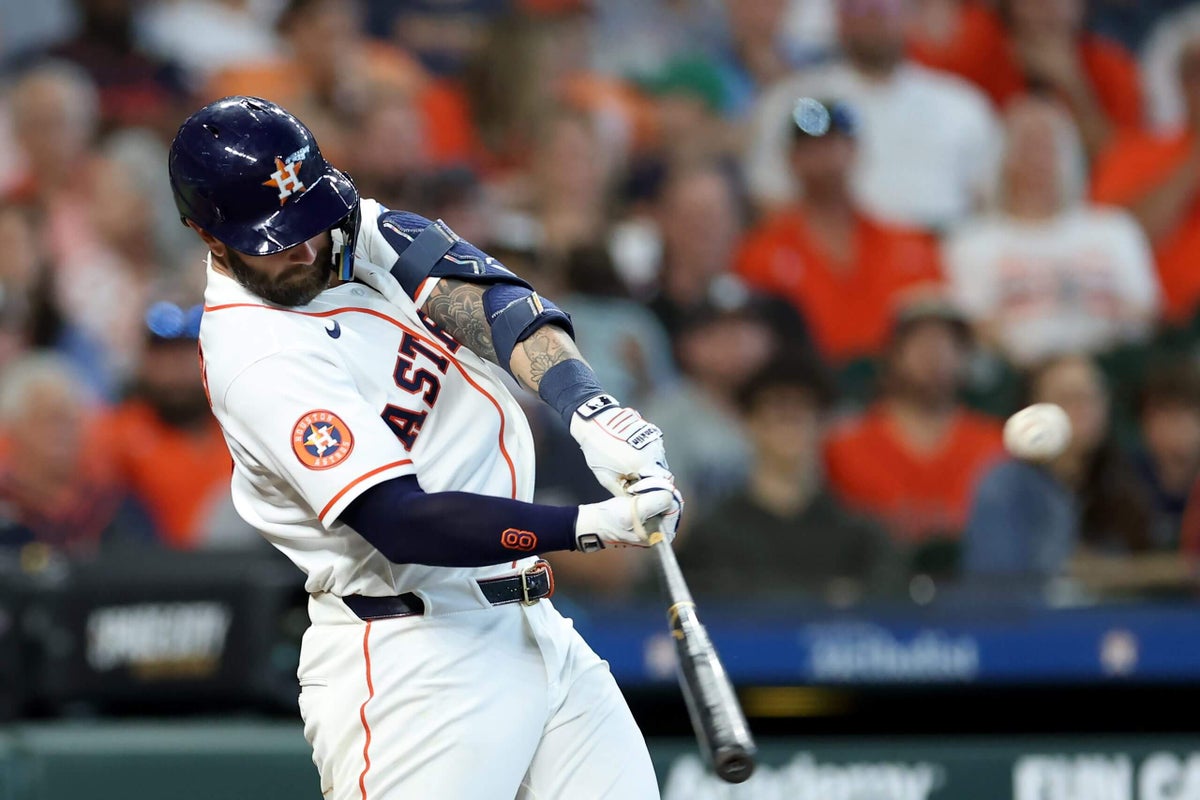
HOUSTON — No Astros hitter saw more pitches thrown 98 mph or harder last season than Christian Walker, whose struggles against high velocity became a hallmark of his underwhelming first year in Houston.
Against the 102 high-velocity fastballs Walker saw, he only mustered six hits. Jeremy Peña, for reference, had seven against 59 pitches thrown to him at least 98 mph. Jake Meyers struck six hits against the 56 he saw.
Peña is 28 and Meyers is 29. Walker turned 35 on Saturday, an age that perhaps factored into seeing all those fastballs and, in Houston, is sometimes magnified by the man he replaced.
For however long he remains an Astro, Walker will be inextricably linked with José Abreu, whom Houston gave an almost identical free-agent contract to play first base before his age-36 season. Abreu did not finish the three-year, $58.5 million deal amid a marked decline.
Walker disappointed during the first season of his three-year, $60 million contract, but never approached Abreu’s anemic production. Abreu finished his only full season as an Astro with dreadful defensive metrics and a .680 OPS — 37 points lower than what Walker posted in 2025. Walker’s 27 home runs last season led the team, too. Abreu hit 20 home runs in 714 Astros plate appearances.
Comparisons persisted from a perturbed fan base. To stop them, Walker must author a turnaround in 2026. A four-game sample size is not enough to determine whether one is coming, but some of Walker’s early success against high velocity is a positive indicator.
Walker already has two hits against 15 fastballs thrown 98 mph or harder, including the go-ahead single he stung off a 99.3 mph sinker during Saturday’s 11-9 win against the Angels. He has already put six balls in play harder than 100 mph.
The sample size is minuscule, but it demonstrates the benefits of Walker’s offseason weight loss (10 to 12 pounds) and a bat path change that he said: “I’ve been trying to chip away at for a few years.”
Walker has natural loft when he swings the bat, which can cause him to swing under high-velocity fastballs. His hands can get “pushy” and create a downward motion with the barrel of his bat. When it comes back up to meet the baseball, it is almost akin to a check mark.
“I put a lot of work this spring training on my bat path staying higher and more direct … trying to stay higher with my hands and trying to stay more direct,” Walker said. “I know my barrel is going to drop, it’s going to come down. Having that better loft and move to be on the other side of the spectrum, it feels like I’m being very direct. And, if you watch the video, it’s actually on-plane.”
Walker acknowledged the adjustment “was harder to hold onto” last season. An oblique strain during spring training didn’t help matters. Walker played in 154 games and never went on the injured list, but lost at least some of his freedom to unleash his best swings.
“When I feel confident in my body, I’m not feeling for things. I trust that my body can handle them,” Walker said.
After four games, and two telling hits, that confidence has returned.
“It breeds a lot of confidence because I feel like I’m not doing extra to get to those pitches,” Walker said.
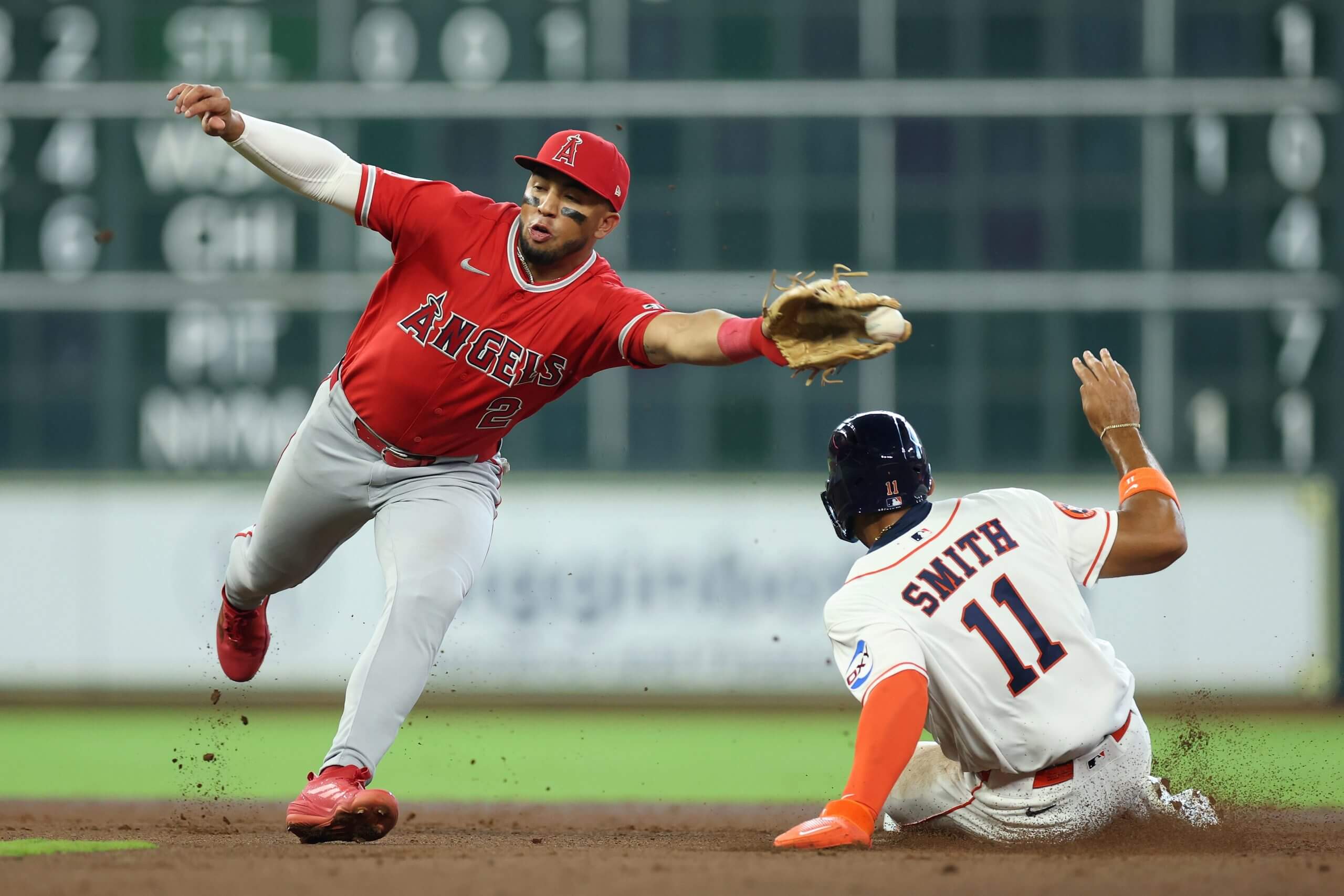
Cam Smith stole second base in Thursday’s loss. He had eight stolen bases last season. (Tim Warner / Getty Images)
Before every game, Dave Clark does some homework. Houston’s veteran first-base coach studies the opposing starter, tracks his delivery times and tries to diagnose any tells or moves that may give his base runners an advantage.
After Clark finishes, he will hand an iPad to Cam Smith and say nothing. Smith is the second-fastest player on Houston’s team, but a novice at the nuances of base running and base stealing.
Manager Joe Espada believes Smith is capable of stealing “15 to 20 bases,” even though he attempted just nine steals as a rookie. A .312 on-base percentage didn’t help matters — and must increase this season if Smith hopes to harness one of his most tantalizing tools.
“Mentally, I wasn’t fully committed to it,” Smith said Sunday morning. “Now I’m like, ‘OK, I want to help these guys win. I want to do anything I can. I’ve got the tool to run, and I’m going to use it.’”
To harness this motivation, Smith must become a better student of the game. Clark is overseeing the process. He will sit in silence after Smith gets the iPad.
“I want him to see if he can pick up something different than what I have,” Clark said Sunday morning. “And he did that yesterday.”
Clark politely declined to reveal what Smith uncovered, but that he did so illustrated Smith’s continued evolution as a major-leaguer. So much of Smith’s rookie season became about “just getting my feet under myself,” he said, leaving intricacies like stolen bases somewhat on the back burner.
Smith stole just seven bases in his final two seasons at Florida State — “We swung it so well I didn’t even have to run,” he quipped — and played in only 32 minor-league games before making his major-league debut last season. The quick ascent, coupled with Espada’s emphasis on aggressive base running, has forced Smith to be a fast learner.
“I think more so than anything, it’s a mentality — trying to go back and not have any doubt, believe in yourself and just really get the fear out of the way,” Clark said. “(We want) him not to have any doubt or any fear in his game. We know he has speed. It’s just teaching him how to do it and making sure he gets good jumps and making sure that first step is quick. He’s been able to adapt to that very well.”
Four innings into the season, Smith showed it. He stole second base off Angels Opening Day starter José Soriano, who had just six stolen base attempts against him in 169 innings last season.
Smith stole the base while Soriano incorporated a slide step. The move is designed to deliver the baseball quicker and limit opportunities like this — ones Smith wouldn’t have seized advantage of last season.
“I understand it, and I should add that to my game,” Smith said. “Let’s take some bags.”
Bryan Abreu’s cameo as the Astros’ closer is off to an inauspicious start — and generating concern from his manager.
Handed a three-run lead in the ninth inning of Sunday’s game, Abreu walked two of the three batters he faced. His four-seam fastball, which averaged 97.3 mph last season, sat at 93.2 mph.
Abreu threw 26 pitches Saturday, but Espada scoffed at the notion of back-to-back outings being the cause of such a precipitous drop. Espada promised to “talk to him a little bit to make sure all is there.”
As reporters entered the clubhouse following Espada’s postgame news conference, the skipper pulled Abreu into his office for that conversation.
“I want to see him attack. He’s one of the best relievers in the game. Those guys on the other side, they don’t want to see you on the mound,” Espada said. “I want to see that bulldog mentality. It’s in there, and today (wasn’t) one of those days. We’ll turn the page and get him going.”
Abreu allowed four runs across 1 1/3 innings of work against the Angels. Three of them came Saturday, a game in which he inherited a five-run lead. That he appeared in a non-save situation seemed surprising, but bear in mind, Abreu had not pitched since Monday’s exhibition game against Triple-A Sugar Land.
Using Abreu on Saturday felt necessary to avoid a longer layoff. Abreu struck out each of the first two batters he faced. Consecutive two-out walks — again, with a five-run lead — preceded a three-run home run from Nolan Schanuel, turning a farce into a tight game.
Abreu will only remain Houston’s closer until Josh Hader recovers from his biceps issue. General manager Dana Brown said the club hopes Hader is facing hitters “in mid-April,” meaning that he may not return to the major-league bullpen until May. Between now and then, Abreu must find that “bulldog mentality.”