
Baseball is a numbers game. Fantasy Baseball even more so.
What better way to sum up opening weekend, then, than by looking at some of the numbers that defined it? In particular, these 10 caught my attention.
Notable number: Five
That’s how many miles per hour were missing from Carlos Estevez’s fastball Friday, as compared to last year. It was an improvement over the seven miles per hour that were missing in spring training but still proved to be untenable in his first official outing of 2026, during which he surrendered six earned runs while recording just one out, with the big blow being a walkoff grand slam by Dominic Smith. The Royals turned to Lucas Erceg for their save chance Sunday, ostensibly because Estevez was hobbled by an ankle injury, but manager Matt Quatraro also revealed that he’s “not averse to putting [Estevez] in a lower-leverage situation.” I should think not, and unless Estevez has a eureka moment mechanically that brings all the missing velocity back, I’d say we’ve just witnessed our first closer change for the new season.
Notable number: Four
That’s the number of games started by Astros utility player Isaac Paredes over weekend. Yes, while the majority of teams with only three games still saw fit to give some of their lineup fixtures a day off, Paredes, who was presumed not to have a job of his own, ended up being the ultimate workhorse. He had two starts at third base, one at second and one at DH, while also making an appearance at first base. It’s the clearest evidence yet that the Astros view Paredes as an everyday player, just not with an everyday position. And they should because he’s arguably their best hitter aside from Yordan Alvarez, given how well his extreme pull tendencies play at their home park. You can start Paredes with confidence at the one position where he’s currently eligible, third base.
Notable number: Three
That’s the number of consecutive games in which both Munetaka Murakami and Chase DeLauter homered to begin their career. Murakami’s streak is still active, in fact, which gives him a chance to equal Trevor Story’s high of four. He indeed has transcendent power, the kind that made him a two-time MVP in Japan, but he’s also supposed to have swing-and-miss issues so enormous that they threaten to take him down, much like Joey Gallo. It may be a couple weeks before the book gets out on Murakami and the league figures out how best to exploit that weakness, and you can enjoy his power in the meantime.
I have longer-term hopes for DeLauter, who’s the much better contact hitter even though he currently has the more strikeouts of the two (six to four). All-too-frequent injuries in the minors prevented us from seeing the full extent of his potential there, but it turns out his comically stiff swing can really turn on pitches. It’s surprisingly versatile, too, as evidenced by the fourth of his home runs going to the opposite field on an almost defensive swing against a 97 mph pitch up and away Saturday. Maybe DeLauter gets hurt in the long run, as his history would suggest, but for now, he’s looking like a must in three- and five-outfielder leagues alike.
Notable number: 32
That’s how many strikeouts the Blue Jays trio of Dylan Cease, Kevin Gausman and Eric Lauer accumulated in a three-game set against the Athletics. Lauer’s nine to end the weekend put a damper on Cease’s 12 by underscoring that the Athletics lineup was likely more responsible for the outlandish totals than the pitchers themselves. It’s information to file away for future pitchers matching up with the Athletics and also reason to monitor Cease’s next start extra closely. While I don’t see much reason to think Gasuman and Lauer have made a leap developmentally, Cease flashed a much wider variety of pitches in his first start after signing a mega contract with the Blue Jays, mixing in six different ones at least 8 percent of the time after going mostly fastball/slider in previous years. It may well have been a breakthrough that was obscured by the weakness of his opponent.
Notable number: 49
That’s the percentage of pitches that Tatsuya Imai threw for strikes in his major league debut Sunday, which, if you’re unaware, is ghastly. A 59 percent strike rate, as in 10 points higher, would itself be terrible. Not surprisingly, Imai walked four in his 2 2/3 innings of work and obviously has some adjustments to make before his next turn. Walks were an issue for most of his career in Japan, leading to per-nine rates in the fours and fives from 2021 through 2023, but he seemed to whip the issue with 2.5 BB/9 (to go along with a 1.92 ERA, 0.89 WHIP and 9.8 K/9) last season. He has to get used to a ball with a different size and feel than in Japan, but it wasn’t an issue in spring training, when he walked one in six innings. Imai gets a pass for now — his official MLB debut was obviously a high-pressure situation for him — and I’d even suggest keeping him active for his next start, seeing as it’s against the same Athletics lineup that Dylan Cease, Kevin Gausman and Eric Lauer just thoroughly dominated — but if we see more of the same from Imai in that start, our level of trust will rightfully plummet.
Notable number: 110.5
That’s how hard (in miles per hour) Matt McLain hit a ball in a 3 for 4 performance Saturday, which represents a new high. In all, he went 4 for 10 (.400) over opening weekend, which comes on the heels of a massive spring performance in which he hit .509 (27 for 53) with seven home runs and just an 11.9 percent strikeout rate compared to 28.8 for the rest of his major league career. It all points to him righting the ship after a dreadful season in which he was plagued by sliders down and away. The book on him no longer applies, and we’re seeing outcomes more like his 2023 rookie season, when he looked like a rising star in Fantasy.
Notable number: One
That’s how many games it took manager Aaron Boone to renege on his commitment to playing Ben Rice against lefties. It seemed dubious once the Yankees signed Paul Goldshmidt in February, but Boone addressed the issue within a couple days, saying that while Goldschmidt would play plenty against lefties, Rice could move to catcher on those days as a way to keep his bat in the lineup. That’s not what happened when the Yankees faced Robbie Ray on Friday. Rice was simply left out of the lineup. Granted, sitting him against one lefty doesn’t mean Boone will sit him against every lefty, but it does raise immediate doubts as to how regular of a regular Rice will be.
Along those same lines, I should also point out that Jac Caglianone and Carter Jensen both sat against the first lefty the Royals faced Friday. It could just be that the left-hander in question was one of the absolute best in Chris Sale, but Caglianone and Jensen were nonetheless glaring omissions from the opening day lineup for all the hype they received this spring.
Notable number: 1990
That’s the last time a player got four hits in an opening day debut prior to Kevin McGonigle doing it Thursday. In all, the Tigers new third baseman went 5 for 12 (.417) with two doubles over the weekend and seems well on his way to becoming an impact player in Fantasy. He was second on most preseason prospect rank lists, surpassed only by Konnor Griffin, and while he stands out most for his hit tool, he has strong enough pull tendencies to deliver on power as well. He should be rostered in every league and will stand out all the more once he adds third base to his existing shortstop eligibility.
Notable number: 111
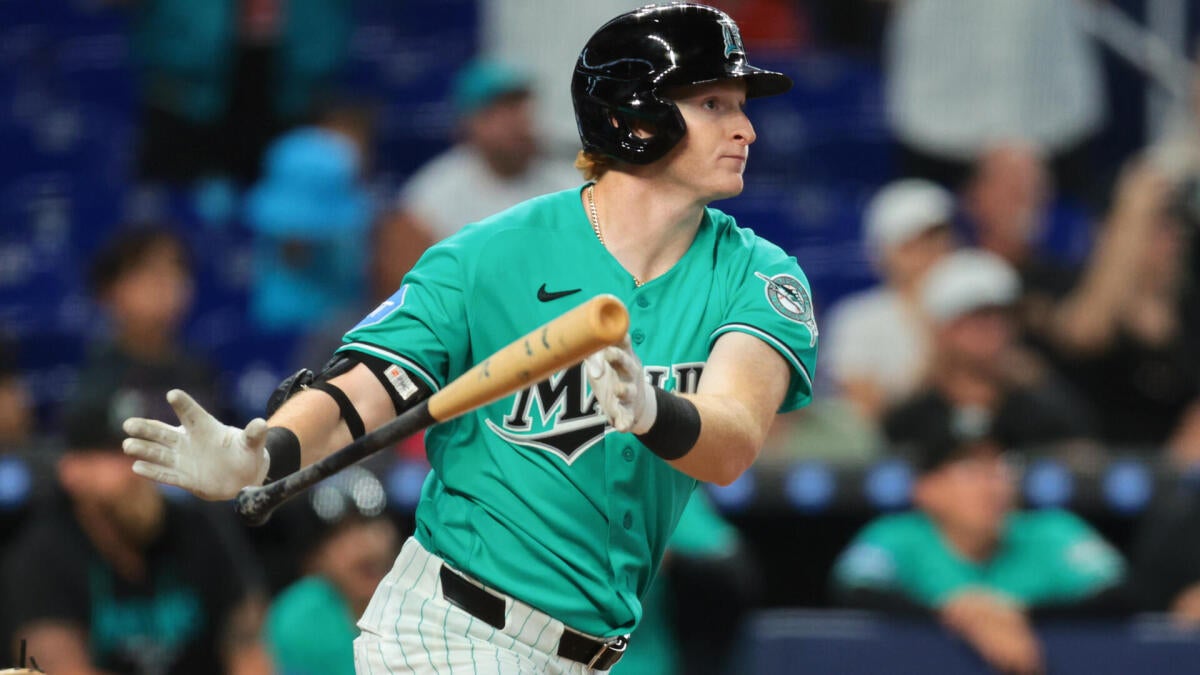
That’s how hard Caissie hit two balls — a single and a double — in a 3 for 4 performance Saturday, which wasn’t even the highlight of his weekend. The 23-year-old delivered a walkoff two-run home run Sunday in a game he didn’t even start. In a draft pool oversaturated with rookies, Caissie was largely forgotten, being away with Team Canada for much of spring training and only going 2 for 15 (.133) in his time with the Marlins. But he’s already proven to be up to the task with the kind of hard-hit balls that show off his 60-grade power. Good batting eye, too. The fact he was out of the lineup for Sunday’s game may impact his usefulness in three-outfielder leagues, but he’s good enough to force his way into a true everyday role.
Notable number: 91.2
That’s the number (in miles per hour) that Emmet Sheehan hit on his fastball during his fourth and final inning against the Diamondbacks on Friday, down from 95.7 in the first inning and an average of 95.6 for all of 2025. There were reports of him struggling to sustain his velocity this spring as well. Sheehan was a trendy breakout pick for his ability to rack up whiffs, but this is a concerning development for a pitcher who’s attempting to make the transition to full-time starting status this season. Above all, you hope he’s healthy, but even if he is, the Dodgers have enough rotation alternatives that they could end up deciding Sheehan is a better fit for the bullpen. There’s no reason to jump to that conclusion yet, but it has to be in the back of your mind.