
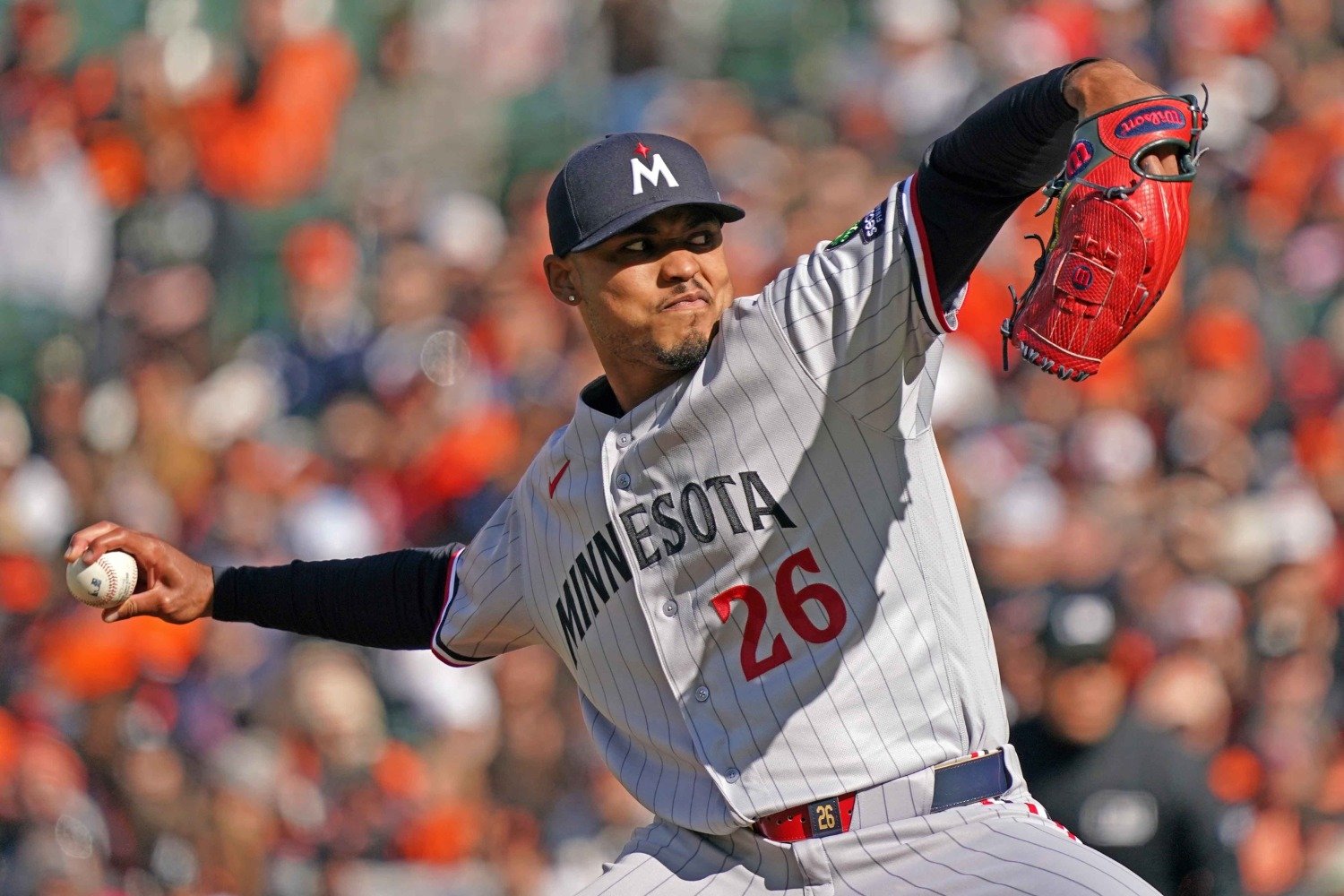
When the Minnesota Twins acquired Taj Bradley from the Tampa Bay Rays at last year’s trade deadline, they weren’t just buying a struggling arm. They were betting on a version of Bradley that once looked like one of the most electric young starters in baseball. That version showed up (at least in flashes) on Saturday.
In a win over the Baltimore Orioles, Bradley allowed one earned run on three hits and three walks while striking out nine across 4 1/3 innings. It wasn’t a perfectly clean outing, as he needed 92 pitches to get just 13 outs, but the raw ingredients were impossible to miss. The swing-and-miss that once made him a top prospect was back. The confidence looked different. And perhaps most importantly, the process is evolving.
After posting a 6.61 ERA in six starts following the trade last season, Bradley entered 2026 needing to show tangible growth. Through his first outing (and dating back to a strong finish against Texas in 2025 and a sharp spring training), there are signs that something has clicked.
For Bradley, the biggest difference might not be mechanical or statistical. It might be mental.
“It’s just me being hardheaded in the past,” Bradley said. “I stuck to what I was good at and stuck to what I knew, you know. If it’s different, it gets scary, so you don’t even want to walk down that path.
“What I’ve done in the past is what I felt I solidified on. Going into the offseason, I figured I’d take different routines, different practices, and bring it into this year.”
That openness is already showing up in how he attacks hitters.
Velocity Increase
The most encouraging development came from Bradley’s fastball, which showed a noticeable jump in velocity compared to previous seasons. Throughout his big-league career, his four-seam fastball has typically sat a little above 96 mph. In his first start of 2026, that number climbed to 97.4 mph, and he even reached back for 99.6 mph at one point. Bradley used the pitch effectively, generating three strikeouts and holding the Orioles to a .167 batting average against it.
If that velocity holds, it could have a ripple effect across his entire arsenal. A firmer fastball makes his splitter more deceptive, especially when it falls off the same plane. It can also help his cutter play up, giving hitters less time to differentiate between pitches that already feature similar initial trajectories.
Of course, we’ll also have to wait and see whether that velocity jump holds. Early-season adrenaline can sometimes lead to elevated velocity readings, but maintaining an average near 97 mph deep into the year would represent a meaningful step forward for Bradley. It’s encouraging, at least, that we saw him throw harder late last year, too. If he can pair that added power with his evolving pitch mix, it raises the ceiling on what he can become in this rotation.
Breaking Pitch Changes
One of the more notable changes came from his cutter. In 2025, the pitch had an average of 5.6 inches of induced vertical break. In his first start this season, that number dropped to 1.1 inches. That’s a notable difference in the depth of its movement, which is consistent with what we saw in spring training.
Interestingly, it is also coming in slower, with velocity down by roughly 2.5 miles per hour. That tradeoff appears intentional, sacrificing velocity for more movement. It’s become a true slider. If Bradley can consistently locate it, the pitch could become more of a bat-misser, rather than just a weak contact generator.
The biggest shift in Bradley’s arsenal was his willingness to trust the splitter. Last season, he used it just over 15% of the time. Against Baltimore, that number jumped to nearly 30%. He threw it 27 times, primarily to left-handed hitters, and the results were dominant: no hits allowed, two strikeouts, and a 63.6% whiff rate.
That kind of effectiveness is hard to ignore. Whether it was matchup-driven or a sign of things to come, the splitter gives Bradley a legitimate weapon to neutralize hitters on both sides of the plate.
A Lingering Concern With Contact Quality
For all the positives, there is still a red flag that followed Bradley from his time in Tampa Bay. When hitters do make contact, they can elevate and pull the ball with authority. In his 2026 debut, O’s batters posted a 28.6% pull air rate against him. That’s a significant jump from his previous seasons, where he hovered below 19% as a rookie and under 17% more recently. That number must come down.
Early-season conditions can mask mistakes. Cold weather tends to suppress carry, turning potential home runs into warning track outs. As temperatures rise, those same swings can do much more damage. If Bradley continues to allow pulled fly balls at that rate, it could quickly become a problem. Of course, with nine strikeouts and in such a short outing, the sample is far too small to say whether that vulnerability to pulled air balls will be a real issue.
Encouraging Signs With Work Still Ahead
It’s easy to see why the Twins believed in Bradley when they made the deal for him. The strikeout ability is real. The raw stuff has ticked up. Now, there are early indications that the approach is starting to evolve, as well.
It’s also fair to acknowledge what still needs refinement. Efficiency remains an issue. Contact quality is something to monitor. And one strong start doesn’t erase the inconsistency that defined his 2025 season. Still, this looked like a different pitcher.
The Twins are going to need that version of Bradley. With questions throughout the rotation, they can’t afford to wait long for answers. Starters need to take the ball and begin carrying more of the load.
It’s early, and the weather will change. The league will adjust. Bradley will have to adjust back. For now, though, there is something worth watching here.
What stands out from Bradley’s first start? Leave a comment and start the discussion.