
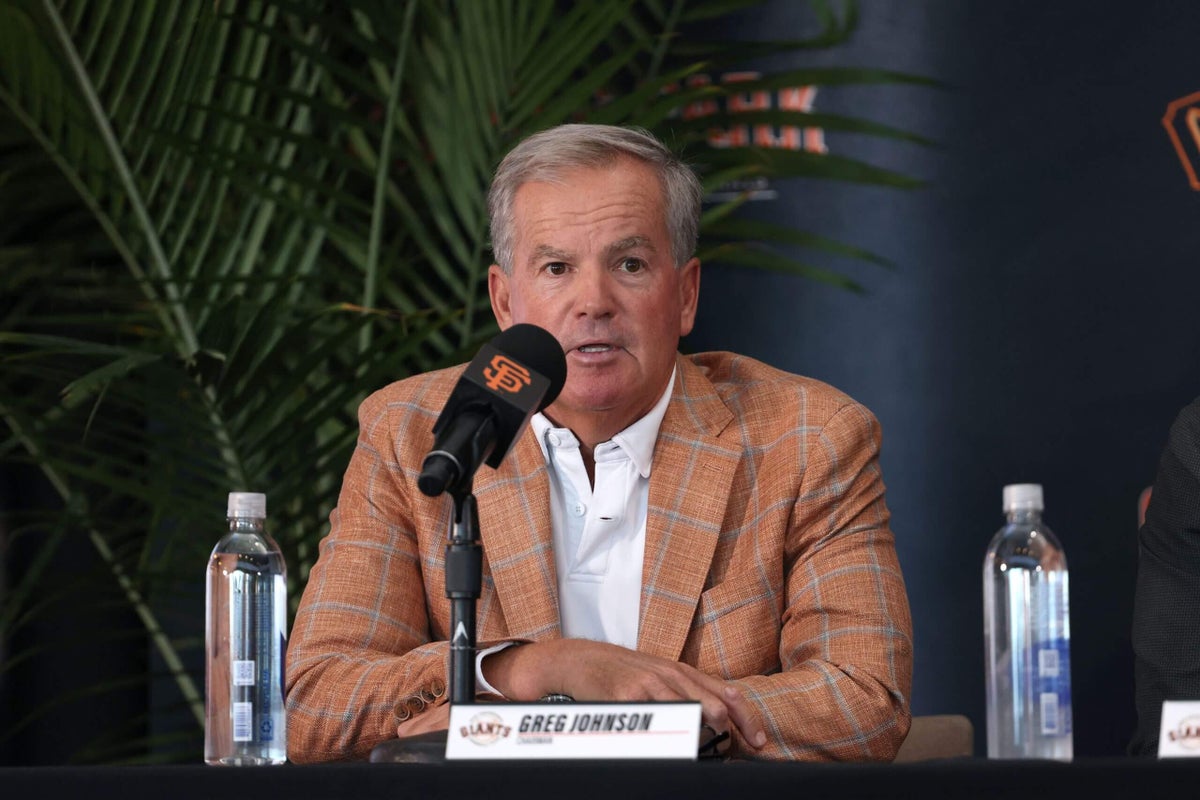
Part one of The Athletic’s conversation with Giants chairman Greg Johnson covered a lot of ground: the unprecedented hiring of a pro baseball neophyte to manage a major-league team, a payroll that ranks on the outskirts of the top 10, the meme-worthy complaints from some fans over the club’s $13.66 million acquisition of the historic Curran Theater, and major capital improvements coming to Oracle Park that could involve a very big dig.
(Might want to invest in a sump pump. Just a thought.)
Does that leave anything else to discuss? Why yes! Only the fragmentation of media rights, the looming expiration of the collective bargaining agreement, a potential lockout, and the topic I was most interested in raising: What it really means now that 1) the A’s are headed to Las Vegas, 2) the Bay Area is a one-team market, and 3) the Giants own all of it.
While we’re on the topic, here’s a bit of a seat squirmer: How much responsibility should the Giants bear for the A’s departure?
Beyond the on-field results, this is an interesting time for the Giants organization. Yet, Johnson kept returning to the same point: the on-field results are what matter most to the ownership group.
Here’s the remainder of our interview, which has been lightly edited for clarity and brevity.
Let’s continue with another revenue question and it’s a big one: media rights. The Giants are in better shape than many teams that are trying to figure it out as they go. You have a deal with NBC Sports Bay Area that goes through 2032. You also take part of your rightsholder fee as a 30 percent ownership stake in the network, correct? As I understand it, that fee is essentially a cut of revenues. Given cord-cutting and the disappearance of passive cable income from people who don’t even watch sports, that can’t be nearly as robust a source of money as it used to be, right?
Yes. The whole model is in jeopardy and you’re seeing that with bankruptcies and long-term deals (breaking down). Nobody anticipated cable penetration would drop over 50 percent, so our main concern is, in the Bay Area, the younger generation is not going to hook up on a cable service, so we can’t reach them. Maybe YouTube TV gets some of that. But the streaming model is the future for baseball, like all sports, and we have to figure out how we get there with the least amount of disruption to people.
We know right now it’s disruptive. Even having Netflix (broadcast) your opening game creates a lot of noise. But it was good for baseball and we were pleased that we got chosen to be the marquee Opening Day game for all of baseball. You’ve seen the World Baseball Classic and 10 million viewers for the final game, which shows the growing global interest in the game. Netflix, those kind of mediums can have a much broader potential reach. And then how we leverage the entire media landscape … it’s not an efficient way to maximize the value of marquee matchups.
The frustration with blackouts and all of that, we need to fix. And we need to fix it in a way where we simplify the offering and everybody has access in one place. And to get there is a difficult task, but one that a lot of work’s being done on.
How will the Giants weigh in on what that offering will look like? If it’s a centralized model and an equal split of revenues, obviously a team like the New York Yankees is not going to be happy, and a team like the Tampa Bay Rays is going to benefit. How much of an even spread do you think it will be?
Well, there’s all tradeoffs, because, remember, with the amount of taxes you pay on sponsor revenues, and there’s already a big tax for the big-market teams to support the smaller-market teams. So a lot of that could get alleviated by doing something central (with media revenue). So we’re not there yet. They’re looking at all those variables and it gets even more complicated when you look at networks that have outside investors and it’s, “How do we transition into this?” So, very smart people that have much more experience in media than me are working on that full-time.
We can probably say officially that the Bay Area is a one-team baseball market now. There’s a widely held assumption that the Giants are in for a windfall now that they’re the only game in town and the A’s are transitioning from Oakland to Sacramento to Las Vegas. But from a practical standpoint, how does the A’s leaving the Bay Area impact your business from a dollars-and-cents perspective?
Good question, and I don’t have a good answer other than, obviously, you know, I think it’s a benefit to us. I couldn’t give you a monetary number that says, “We had X lift from that.” I think we’re trying to be respectful of the A’s and their fans by not being aggressive in trying to market them to the Giants and take it as more of a longer-term proposition. But clearly, having the entire territory is a benefit and will strengthen the organization.
It’s not as if the A’s were drawing 40,000 fans every night and huge multimillion-dollar sponsorship deals and all of a sudden those people are looking to spend their money elsewhere.
But they had a period where they were drawing those kinds of numbers. And so I think it’s there. And I think there was some frustration with the performance and lack of competitiveness there. So, hopefully, we can create a strong base in the East Bay over time.
You did have a very well-attended FanFest event in San Ramon. That probably wouldn’t have happened with the A’s still in Oakland. What other opportunities are open to you now that hadn’t been open to you before? How are you letting A’s fans know that the welcome mat is out?
It’s a delicate balance with them still in Sacramento and (not wanting to be) too aggressive on that side. We’re just going to take our time on that.
This might be a tough question, but to the extent that the Giants held firm in their territorial rights when the A’s wanted to explore moving to the South Bay, are the Giants, on some level, among the responsible parties for the A’s moving out of the Bay Area?
You know, at the end of the day, we have to protect this franchise. That’s our responsibility. Look, I’m a guy from the Mid-Peninsula, a diehard Giants fan my whole life, and San Jose is just as close for me to drive to. We have a huge fan base there. The overlap would be large, and it would have been detrimental to the strength of this organization. And if you go back — remember when (Oracle Park) was built — the ownership group personally guaranteed debt on it to get it built. And a part of that was, “You’re not going to put a team next to us after we’re taking all the risk.”
So I think you’ve got to go back and look at where things were historically. Is this a (two-team market)? It’s very hard to have it in any major city and not have one strong team and one weak team. You show me where you have enough support for two teams. But one team tends to be the much stronger team. So I think there’s a lot better, viable options. And I think Vegas, for the A’s, will be a good place with a tremendous stadium and that’s a better move for MLB. At the end of the day, that’s how people felt. And there’s other cities that are looking for expansion teams now as well.
What if a group makes a strong effort to attract an expansion team to Oakland? Would the Giants be supportive or actively discourage it?
I balance what’s good for baseball and good for the Giants, and I have no direct answer on that one.
I think we’re done with the toughest questions, except wait, we haven’t talked about the upcoming expiration of the collective bargaining agreement! In terms of your budgeting and mid-term planning, are you working under the assumption that there’s going to be a lockout? If so, how is that impacting decisions you are making now?
I think that we shouldn’t have a lockout. That’s the goal. People talk about, “Well, MLB wants a lockout.” The last thing MLB wants is a lockout right now. We recognize that there’s a lot of momentum in baseball and a lockout is detrimental to the fan base.
Whatever form this collective bargaining takes, my encouragement to all sides is to start talking earlier. And I think if we do that, we can end up in a much better place than waiting to talk till the end of the season. I think the possibility (of a lockout) is always there. We have to think about that as far as how we plan, but we’re a long way from even knowing what form and shape this whole thing is going to take.
I’ve said this to the players as well: “Whatever form this takes. Have an open mind and an open discussion, instead of just saying you’re against whatever it is we start with.” Because that’s never a good position. Listen, learn and ask questions and get to a reasonable place that we both can benefit from. That’s hopefully where we end up, and the sooner we can talk versus later is just a much, much better way to go.
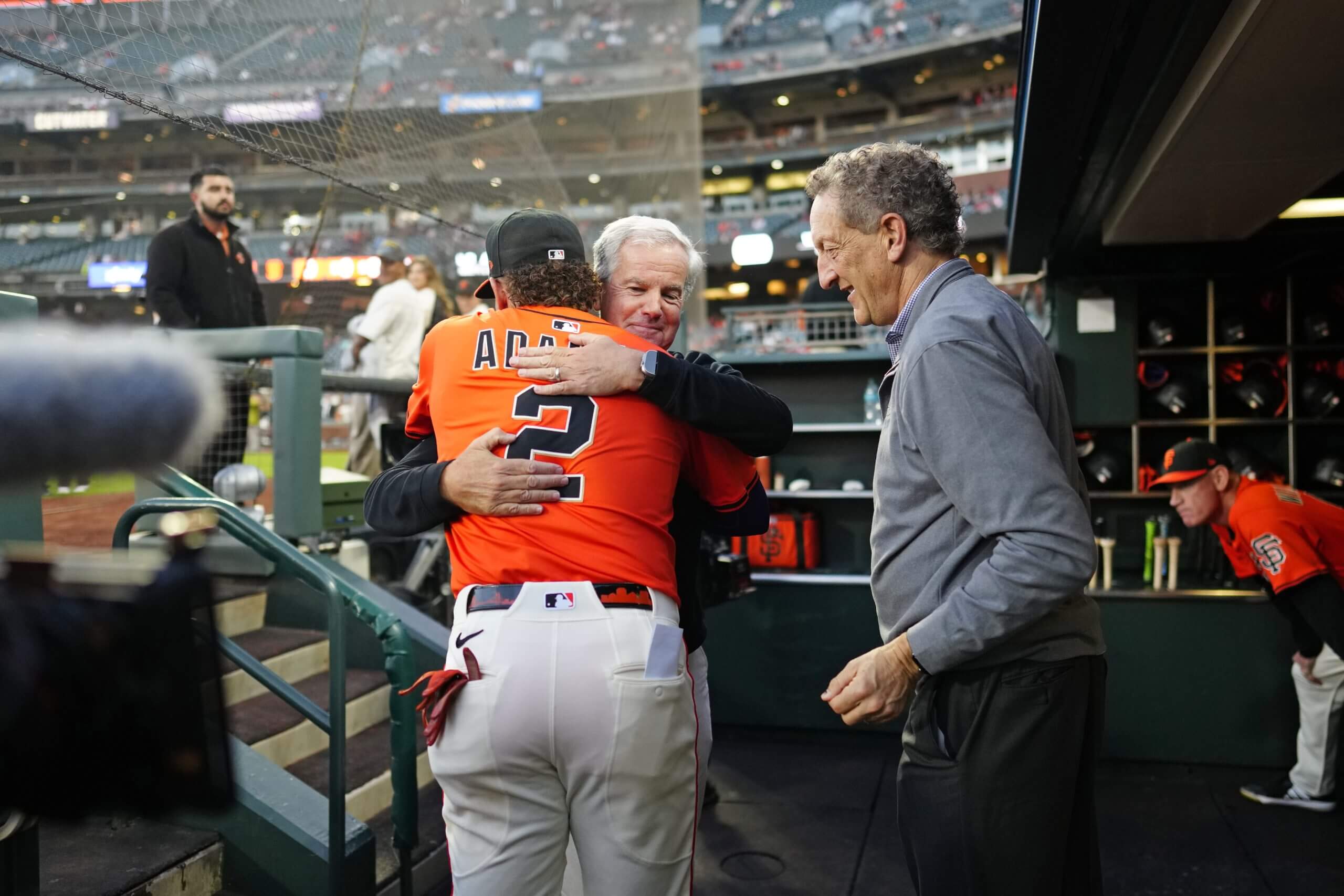
Willy Adames hugs Greg Johnson in the dugout as Larry Baer walks past before the 2025 Willie Mac Award presentation. (Suzanna Mitchell / San Francisco Giants / Getty Images)
It’s fair to say there’s a widespread expectation that a salary cap will be a line-in-the-sand item for the commissioner’s office. Is it a line-in-the-sand item for you?
Good question for the commissioner.
Doesn’t the commissioner act on the advice and input of the 30 clubs?
He does, but as far as speculating on line-in-the-sand at this stage doesn’t serve any purpose for anyone. Questions related to any cap talk should be coming from New York, not from me.
What positions are most important for you to express to MLB’s negotiating team to ensure that the Giants’ franchise-specific interests are best served in these negotiations?
Well, I would start with (saying) I’m a firm believer that a healthy sports league has to have balance and parity. It doesn’t mean the big-market teams aren’t going to always have an advantage, but the gap has gotten far too wide. If anybody would argue that we have parity in baseball, they’re not being honest. You can have exceptions every now and then that make the playoffs, but we’re not in a healthy place as far as I view a healthy sports league.
Now, baseball is in a healthy place. And you could also argue it’s a good thing to have the Dodgers and Yankees and the big-market teams in there. There’s probably some truth to that, but I think long-term, the support of teams that are not competitive or can’t be competitive on payroll is just not a healthy thing for a league.
And I would also say that anything we can do that partners us with the players is a heck of a lot better than, say, any time we have any kind of change. It’s, “What are we going to get for that change?” Even though it’s a change that everyone agrees is good for baseball. I’ve seen it where players even agree with good ideas, and then all of a sudden they go out publicly and say, “That’s a bad idea,” because they’re told to say that. So I think the whole industry, the whole league and the players and the ownership will be much better served if we can figure out a way where we all grow together and share together. That’s my ultimate goal in all of this. It just doesn’t serve anyone with how we’re structured today.
The starkest example of this disparity you’re talking about is a team in your division. So are the Dodgers bad for baseball?
Yeah, look, no. The Dodgers are an extremely well-run organization playing by the rules and have done an excellent job in attracting the Japanese players that they’ve gotten. That’s added huge value to the franchise. The media rights and the huge market is a huge advantage over other teams. But I tip my cap. They’ve done a great job. But it also points to the level that we’ve gotten to where even the Yankees get criticized for not spending now, which is hard to believe, right? They spend a lot.
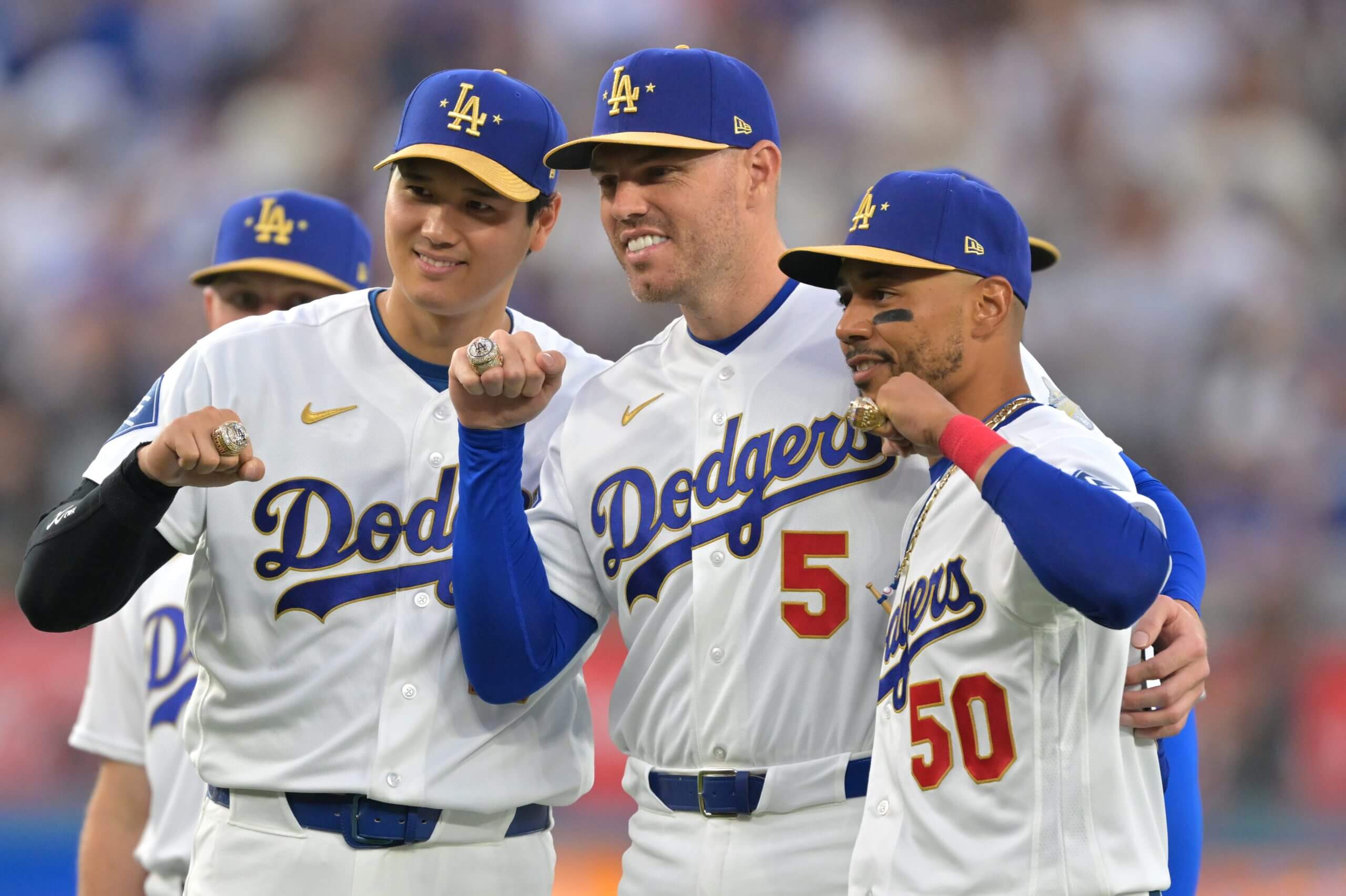
Shohei Ohtani, Freddie Freeman and Mookie Betts pose with their World Series championship rings on March 27. (Jayne Kamin-Oncea / Imagn Images)
You mentioned examples of players voting against their interests. You definitely saw that when you served on the competition committee and players spoke highly of proposed rule changes before ultimately voting against them. Are you still on that committee?
Yeah, I’m actually chairing it now. To me, it’s a great starting point to have engagement with the players that we haven’t had in the past. Those discussions are open and productive. That’s why I say I’ve been shocked with how they vote after having discussions. We’ve had players from the Giants (Austin Slater) on that committee before, and I could have sidebars with them on things. But it just speaks to how we’re structured today.
What other committees are you serving on now?
The executive committee for the ownership group, which is just a smaller representation, so I think you can be a little more open in discussions than you would if you had 30. It’s a representative group of smaller-market teams, middle-market and the larger markets to kind of scratch things out.
There’s been a lot of talk about MLB players participating in the 2028 Olympics in Los Angeles and the league wanting to keep the All-Star Game on the West Coast. San Francisco has gone the longest among West Coast cities without hosting the game. Is it all but official at this stage that the Giants will host the Midsummer Classic for the first time since 2007?
I hope so. Yeah. It’d be good. It’s a possibility, but we’re waiting to hear on that. It’s something we’ll strongly advocate for.
And then you mentioned growing the brand internationally. Your organizational leaders participated in a high-profile trip to South Korea. You know what the international market has meant to the Dodgers. Where would you assess the Giants’ efforts in that area?
We’ve gone after those players, (Shohei) Ohtani and others. L.A. is close to Japan. They’ve built a strong link there. And hopefully with Korea, we could possibly do that. We’re still there in Japan, working as hard as we can on any prospects that we can attract to San Francisco. We haven’t been that successful with Japanese players to date, and we’ll continue to work on that. But Korea, with (right fielder) Jung Hoo Lee, and that connection, we’re going to make sure we build relationships there with fans that we have for the first time.
With the Olympics, your first reaction is, “Well, gee, we’re going to stop in the middle of the season to do this?” That’s a challenge for how we operate and it’s a potential revenue loss. But the tradeoff is the players want to do it, it’s good for baseball and it’s probably the right thing to do. So we’re for that. The injury part is tricky, just like it is for the World Baseball Classic, but nobody anticipated the growth of the WBC. So it tells you there’s a worldwide demand for the game, and like the NBA and the NFL, we need to keep thinking about how we can effectively grow in those markets. If anything, it tells you the Olympics would be another great thing for the game of baseball.
The Giants played a series in Mexico City two years ago, but what about an international Opening Day?
Why not?
Finally, the floor is open. Is there anything you want to express to Giants fans, anything we haven’t covered here or anything we have that you’d like to clarify? What’s your general message as this season gets underway?
I would just say, representing the ownership group and management, that, sometimes it takes a little bit of time to get where we want to go. And I think we’re on a tremendous path right now to do that with regard to how this team is being built, the type of players we’re bringing to this team, and also, I would say the same with the manager. Sometimes I’m a little sympathetic with how we look at our manager right now. I heard sports talk (radio) the other day and they were saying, “Well, should we put this (Opening Day) loss on Tony?” I was like, “Wait a minute.”
So it’s just having patience. There’s a reason why we have 162 games. You’re going to have ups and downs in the season, and we’re going to do everything we can to smooth out those ups and downs, because there were a few too many (last year). And I think that’s partly what we’ve built here with this coaching staff, with Tony’s energy, and what Buster brings to the table: that drive to not just accept these lulls and to do what we can to fill those gaps.
So I would just say there’s a little bit of patience on the direction. But with that said, our expectations are to win, to be in the playoffs and do it like we’ve done it the other (three championship seasons from 2010-14). I look at Venezuela (beating Team USA for the WBC title), and it shows you that it’s not all about having the … you just get to the playoffs. And I think we’ve got a team that can go deep.